• Link to Facebook
  • Link to X
  • Link to LinkedIn
  • Link to Youtube
  • Inicio
  • NOSOTROS
  • SECTORES
    • ENERGÍA
      • Eléctrico
      • Petróleo y Gas
      • Renovables
    • Marítimo
    • INFRAESTRUCTURA
      • Puertos
      • Ductos
      • Carreteras
      • Edificios
      • Vías Férreas
      • Terminales de almacenamiento
  • SEGUROS
    • EMPRESAS
      • RESPONSABILIDAD CIVIL
        • Responsabilidad Ambiental
        • Responsabilidad Civil
        • Responsabilidad Civil Profesional
      • MARÍTIMO
        • Puertos y Terminales
        • Responsabilidad Civil Portuaria
        • Casco y P&I
        • Carga
        • Responsabilidad Civil del Fletador
      • DAÑOS
        • Daño Material
        • Múltiple Empresarial
        • Pérdida de Beneficios
      • CONSTRUCCIÓN
        • Construcción y Montaje
        • Obra Civil Terminada
      • MAQUINARIA Y EQUIPO
        • Equipo de Contratistas
      • EXPLORACIÓN Y EXTRACCIÓN
        • Control de Pozos
      • Aviación y Drones
      • Transporte
    • PERSONAS / BENEFICIOS
      • Vida Colectivo
      • Gastos Médicos Mayores Colectivo
      • Accidentes Personales
    • Hogar
    • AUTOS
      • Flotillas Autos y Camiones
      • Autos, Pickups y Camiones individuales
    • LINEAS FINANCIERAS
      • Cyber
      • Errores y Omisiones (E&O)
      • Directores D&O
      • Crime
  • FIANZAS
    • Licitación
    • Anticipo
    • Cumplimiento
    • Buena Calidad
    • Contingencias Laborales
    • Arrendamiento
    • Fiscales
    • Daños y Perjuicios
    • Fidelidad
    • Suministro Combustibles
    • Aduanales
  • BLOG
  • Noticias
  • CONTACTO
  • Click to open the search input field Click to open the search input field Buscar
  • Menú Menú

Listado de la etiqueta: Economy

Los beneficios sociales de la Reforma Energética

en Reforma energética de México

Cuando se promulgó la Reforma Energética a finales del año 2014, fueron diversos los beneficios sociales anunciados por el Gobierno Federal, entre los que se encontraban: 1) la creación de empleos; 2); el aumento de recursos públicos que serían utilizados para la construcción de escuelas, hospitales y el mejoramiento de servicios públicos en general, y 3) el aprovechamiento sustentable de los recursos naturales.

A poco más de tres años de la puesta en marcha de la Reforma Energética, es importante preguntarse si estos beneficios se han cumplido o tienen posibilidades de hacerse realidad, lo anterior, teniendo como base la idea de que estamos hablando de un proyecto de largo plazo, cuyas bondades requieren de tiempo para madurar. No obstante, podemos mencionar algunos datos que ya es posible vislumbrar.

Actualmente, más de 70 empresas nacionales e internacionales se encuentran realizando actividades para la exploración y extracción (E&E) de hidrocarburos en México, a través de los más de 100 contratos que ya se han adjudicado en los procesos de licitación organizados por la Comisión Nacional de Hidrocarburos (CNH), y que se traducen en inversiones comprometidas de más de 200 mil millones de dólares.

Todas estas empresas requieren de una variedad de servicios y personal capacitado para llevar a cabo sus operaciones en nuestro país, lo que trae consigo la creación y/o reactivación económica de empresas mexicanas, así como empleo para diversos profesionistas en lo individual; esto además, facilita a los contratistas cumplir con sus obligaciones de contenido nacional. De acuerdo a estimaciones de la Secretaría de Energía, se espera la creación de 230 mil a 900 mil empleos durante los próximos 15 años[1].

En cuanto a mayores recursos públicos para el Estado, los contratos de E&E, prevén diversas contraprestaciones a su favor, entre las que se encuentran regalías, bonos y pago de impuestos; además, México obtiene, en promedio, el 70% de utilidad de los mencionados contratos[2]. Hoy en día ya es posible hablar de importantes éxitos como el pozo Zama, perforado por la empresa Sierra Oil & Gas, de capital mexicano, el cual es definido como uno de los más grandes descubrimientos de los últimos 20 años; o el campo de la empresa italiana Eni, que ha resultado ser más productivo de lo que inicialmente se pronosticó. Dichos éxitos se verán reflejados también en las finanzas públicas.

Por último, en cuanto al objetivo de aprovechar sustentablemente los recursos naturales, la Agencia de Seguridad, Energía y Ambiente (ASEA) ha puesto especial atención en regular los aspectos relacionados con la seguridad industrial y protección ambiental, a fin de procurar que las actividades de la industria de los hidrocarburos no causen daños a terceros, en sus bienes y personas, instalaciones y medio ambiente.

Una de las medidas tomadas al respecto consiste en la obligación que tienen los operadores del sector hidrocarburos de contratar seguros de responsabilidad civil- ambiental y control de pozos, una efectiva garantía financiera, cuyo propósito es asegurar que contarán con los recursos necesarios para reparar los daños que causen en el desarrollo de sus actividades.

En NRGI Broker hemos participado activamente en la Reforma Energética y conocemos su regulación. Para contratar seguros, acércate a nosotros, somos los expertos y con gusto te atenderemos.

[1] https://www.animalpolitico.com/2018/02/900-mil-empleos-pemex/

[2] https://www.eleconomista.com.mx/empresas/Enfatizan-beneficios-de-reforma-energetica-20171206-0020.html

https://nrgibroker.com/wp-content/uploads/2017/11/home.jpg 800 1204 Soporte https://nrgibroker.com/wp-content/uploads/2025/12/logo-nrgi.svg Soporte2026-05-11 19:26:552026-05-11 19:26:55Los beneficios sociales de la Reforma Energética

Seguros para las actividades de transporte, almacenamiento, distribución y expendio de hidrocarburos y petrolíferos; compresión, descompresión, licuefacción y regasificación de gas natural  

en Pipelines, Reforma energética de México

Las empresas que realicen actividades de Transporte, Almacenamiento, Distribución y Expendio de Hidrocarburos y Petrolíferos, así como Compresión, Descompresión, Licuefacción y Regasificación de Gas Natural deben contar con seguros, de acuerdo a las Disposiciones Administrativas de Carácter General en materia de Seguros para dichas actividades, publicadas en el Diario Oficial de la Federación el 23 de julio de 2018 (DAGCS-TADE).

Con ello, la Agencia de Seguridad Industrial y Protección del Medio Ambiente del Sector Hidrocarburos (ASEA) cumple con la atribución que le fue otorgada en el artículo 6, fracción I, inciso c), de su Ley, en donde se establece “el requerimiento de garantías o cualquier otro instrumento financiero para que los Regulados cuenten con coberturas financieras contingentes frente a los daños o perjuicios que pudieran generar” en toda la cadena de valor de los hidrocarburos.

Requerir garantías financieras obedece al hecho de que el sector de los hidrocarburos es particularmente susceptible a experimentar accidentes, ya que el petróleo y el gas natural son considerados sustancias peligrosas, por su potencial para generar incendios, explosiones o contaminación por derrames.

Si bien es cierto que las empresas son cada vez más conscientes de la importancia de implementar programas de administración de riesgos, que les permitan identificar, analizar, controlar, transferir y monitorear los riesgos a los que están expuestas, hay eventos difíciles de predecir o que no pueden ser controlados, como son los desastres naturales o la negligencia y/o impericia de empleados o de terceros.

Es precisamente para esos riesgos que superan las medidas preventivas que el seguro se vuelve el instrumento financiero por excelencia para evitar pérdidas mayores que aquellas derivadas del siniestro, como pueden ser: afectación patrimonial; incumplimiento ante clientes y proveedores; paralización de las actividades y la quiebra.

Actualmente los seguros son reconocidos como una de las mejores prácticas internacionales en materia de seguridad industrial y protección ambiental en el sector hidrocarburos, para reparar los daños y absorber las pérdidas económicas que se puedan derivar de un siniestro.

La publicación de la regulación en materia de seguros de responsabilidad civil y responsabilidad ambiental para las actividades de Transporte, Almacenamiento, Distribución y Expendio de hidrocarburos y petrolíferos, así como Compresión, Descompresión, Licuefacción y Regasificación de Gas Natural establece montos mínimos de seguros para ciertas actividades como el transporte por auto-tanque, buque-tanque y carro-tanque. Para otras actividades cuyas características hacen difícil establecer un estándar, se solicita elaborar un estudio de pérdida máxima probable para determinar la suma asegurada.

Los seguros deberán registrarse ante la ASEA como requisito previo para obtener el permiso correspondiente de la Comisión Reguladora de Energía (CRE).

En NRGI Broker somos expertos en administración de riesgos y seguros y fuimos el consultor de la ASEA para la regulación en materia de seguros de responsabilidad civil y responsabilidad ambiental para Transporte, Almacenamiento, Distribución y Expendio de hidrocarburos y petrolíferos; Compresión, Descompresión, Licuefacción y Regasificación de Gas Natural, por lo que somos la mejor opción para asesorarte.

Acércate a nosotros, con gusto te atenderemos.

[1] Conocido como PML (Probable Maximum Loss), por sus siglas en inglés.


https://nrgibroker.com/wp-content/uploads/2018/07/Seguros-para-la-activiades-de-transporte-almacenamiento-distribución-y-expendio-de-hidrocarburos-y-petroliferos.png 400 600 Soporte https://nrgibroker.com/wp-content/uploads/2025/12/logo-nrgi.svg Soporte2026-05-11 19:25:092026-05-11 19:25:09Seguros para las actividades de transporte, almacenamiento, distribución y expendio de hidrocarburos y petrolíferos; compresión, descompresión, licuefacción y regasificación de gas natural  

Mexico’s incoming government names ally from left to central bank

en Mercados internacionales

Reuters / Frank Jack Daniel / November 26


MEXICO CITY (Reuters) – Mexico’s incoming finance minister on Monday nominated left-leaning economist Gerardo Esquivel as central bank deputy governor, the second appointment to the board by the new government following an independent named in September.

In a 2016 newspaper opinion piece, Harvard-educated Esquivel raised the question of whether the autonomous Banco de Mexico should adopt a dual-mandate to promote growth as well as low inflation, and argued for more diverse views on the board.

Esquivel was a spokesman on economic matters for the campaign of President-elect Andres Manuel Lopez Obrador. He is married to Lopez Obrador’s choice for economy minister, Graciela Marquez, and was previously due to serve as a deputy finance minister in the cabinet.

Lopez Obrador, who secured a landslide election victory in July, takes office on Saturday.

In his profile on Twitter, Esquivel says “his heart beats to the left.” In 2015 he co-authored an Oxfam study titled “Extreme Inequality in Mexico” that explored the rapidly increasing wealth of Mexico’s small group of billionaires.

He did not immediately respond to an interview request for this story.

In a December 2016 column in Mexican daily El Universal, Esquivel strongly defended the bank’s independence, but suggested a debate about whether to change its objective.

“Maybe what we should start to ask ourselves is whether it is time to move to a dual objective (growth and inflation) in the central bank, instead of a single objective (inflation), in the same way as happens in other countries, like the United States,” he wrote.

He also cited an article in which he said economist Jonathan Heath argued for “a plurality of visions and perspectives about the economy” on the central bank’s five-strong board.

Incoming finance minister Carlos Urzua nominated Heath to the board in September, to replace a departing deputy governor. Esquivel is replacing another deputy, who is standing down on health grounds.

Incoming finance minister Carlos Urzua told Reuters earlier this year that the central bank should preserve its single objective.

Heath is an outspoken and well-known private economist who was previously chief economist for HSBC bank in Mexico. He told Reuters in September he had a “balanced” view on monetary policy. He has been critical of the outgoing government as well as some of Lopez Obrador’s policies.

Both nominations must be approved by the Senate, which is controlled by Lopez Obrador’s MORENA party and its allies.

Urzua announced the appointment in a news conference aimed at calming investors, after Mexico’s S&P/BVM IPC stock index .MXXcrashed to its lowest in more than four years on Monday and the peso weakened.

Urzua later told Reuters he would name Victoria Rodriguez Ceja, another close ally who previously worked with him in Mexico City’s local government, to replace Esquivel.

The losses to the index and the peso MXN=, which slipped to its weakest against the dollar in more than five months on Monday, come after Lopez Obrador announced he would stop the construction of a $13 billion airport and after a series of bills from his party aimed at regulating business more closely.


Reuters / Frank Jack Daniel / November 26


https://nrgibroker.com/wp-content/uploads/2018/11/WhatsApp-Image-2018-11-27-at-17.26.44.jpeg 400 600 Soporte https://nrgibroker.com/wp-content/uploads/2025/12/logo-nrgi.svg Soporte2018-11-27 17:40:582026-05-11 19:51:14Mexico’s incoming government names ally from left to central bank

AGRICULTURE, ECONOMY, GDP, INTERNATIONAL TRADE, TRADE WARS Last week in economy: Indian rupee slides while US dollar stabilizes after Trump secures Mexico trade deal

en Mercados internacionales

Qrius / Pavas Gupta / September 3


Last week heralded further woes for the Indian economy as the rupee touched its lowest-ever-level of 71 against the dollar. At the same time, GDP forecasts stood at an all-time-high of 8.2% in 2018-19’s Q1. On the other side of the world, the US and China agreed to overhaul the NAFTA deal, bringing relief to the dollar. Read on to know more about what’s been up in the economy, outside and at home:

Indian Rupee slides to record-low at 71 against the greenback

On Friday, the rupee hit an all-time-low at 71 against the US dollar. The primary reason identified behind the drastic drop is persistent demand for the dollar amid rising crude oil prices. This is further reinforced by weak exchange rates of almost all Asian peers of the rupee. Per Forex dealers, the dollar’s strength against its rival currencies on expectations of rising interest rates amid lingering Sino-US trade tensions also weighed on the Indian fiat. To add to all these factors is the growing fear about rising inflation and consistent outflow of foreign funds from the domestic equity market.

“[The] Indian rupee has depreciated around 11 per cent year to date. Higher crude oil prices, demand from defence and oil marketing firms have contributed to the latest bout of weakness. Rupee was overvalued on trade weighted real effective exchange rate. Robust FDI flows in e-commerce companies, healthy forex reserves may limit the downside of the rupee”, said VK Sharma, Head Private Client Group & Capital Market Strategy, HDFC Securities.

US dollar steady post US-Mexico agreement to overhaul trade deal

After the United States and Mexico agreed to overhaul the North American Free Trade Agreement (NAFTA), volatility in the dollar cooled down; the currency is now steady against the euro and a basket of other major currencies. The overhauling of the deal brought optimism amidst global trade tensions.

The agreement to overhaul NAFTA exerted pressure on Canada to consent to new terms with the aim of preserving a three-nation pact.

“[The deal] would be positive for the Canadian dollar, Mexican peso, these currencies that have been sold on the back of higher trade tensions,”, said Shusuke Yamada, currency and equity strategist at Bank of America Merrill Lynch in Tokyo. “Overall, that would be negative for the Japanese yen and the US dollar. That’s positive for the risk assets in general,” he added.

On Tuesday, following two sessions of losses, the dollar index, which gauges the fiat’s performance against six other currencies, fell nearly flat. Later, it edged 0.05% higher to 94.834, making up for the earlier losses.

Ever since it hit a high on August 15, the dollar has fallen more than 2%. This comes amidst US President Trump’s criticism of the Federal Reserve for raising interest rates while the US government attempted to boost the economy.

India poised to become world’s fifth-largest economy in 2019

Finance Minister Arun Jaitley, on Thursday, said that India is expected to outstrip Britain to don the title of the world’s fifth-largest economy in 2019.

“This year, in terms of size, we have overtaken France. Next year we are likely to overtake Britain. Therefore, we will be the fifth largest [economy],” he asserted. Further, he said that the other economies of the world were growing at a much slower rate, adding that India had the potential to rank among the top three economies of the world within a span of 10-20 years.

India’s GDP growth at 8.2% in Q1 of 2018-19

In the first quarter of the 2018-19 fiscal year, ending June 30, India’s economy performed at an impressive rate of 8.2%. This marks India’s highest growth rate since the first quarter of 2016. Gross Domestic Product (GDP) growth was backed by a strong core performance and a healthy base.

These growth figures will be factored in by the monetary policy committee at its next review, which is scheduled for October 3-5.

The sectors of the economy that registered a growth of over 7% include ‘manufacturing, electricity, gas, water supply and other utility services’, ‘construction’, and ‘public administration, defence and other services’.

Foodgrain output to reach new heights in 2017-18

Foodgrain production in India is expected to grown to an all-time-high of 284.83 million tonnes in the 2017-18 crop year, which ended in June. According to the Agriculture Ministry, this burst in output is fuelled by record production of wheat, rice, coarse cereals and pulses after a normal monsoon cycle.

The previous record was pegged at 275.11 million tonnes, in the 2016-17 crop year.

In the Ministry’s fourth advance estimate released on Tuesday, it revised, in the upward direction, the total foodgrain production by 5.3 million tonnes from the earlier projection of 279.51 million tonnes for the current crop year.

“As a result of near normal rainfall during monsoon 2017 and various policy initiatives taken by the government, the country has witnessed record foodgrain production in 2017-18,” the ministry said in a statement.


Qrius / Pavas Gupta / September 3


https://nrgibroker.com/wp-content/uploads/2018/09/AGRICULTURE-ECONOMY-GDP-INTERNATIONAL-TRADE-TRADE-WARS-Last-week-in-economy-Indian-rupee-slides-while-US-dollar-stabilizes-after-Trump-secures-Mexico-trade-deal.png 400 600 Soporte https://nrgibroker.com/wp-content/uploads/2025/12/logo-nrgi.svg Soporte2018-09-04 16:05:072026-05-11 19:51:17AGRICULTURE, ECONOMY, GDP, INTERNATIONAL TRADE, TRADE WARS Last week in economy: Indian rupee slides while US dollar stabilizes after Trump secures Mexico trade deal

Trump deal with Mexico eases fears of trade wars, offers template to end other conflicts

en Mercados internacionales

Market Watch / Jeffry Barthash / August 27


That sound of ice thawing? It’s the Trump administration’s tentative deal with Mexico to rewrite the controversial Nafta free-trade pact, the first clear evidence the White House is willing to compromise on its hardline demands and avert ruinous trade wars.

News of the deal sent U.S. markets surging Monday. The Nasdaq Composite IndexCOMP, +0.17%  topped 8,000 points and the S&P 500 SPX, +0.06%  index almost hit 2,900, both touching record highs. The Dow Jones Industrial AverageDJIA, +0.15%   jumped nearly 260 points to surpass 26,000.

Details of the pending agreement are sketchy for now. Senior White House officials suggested the new pact would result in more new cars and trucks being made in the U.S. using steel and other materials produced in North America. That was one of President Donald Trump’s chief goals.

Other key provisions could lead to higher wages for Mexican auto workers and even give them greater rights to unionize, moves meant to reduce the incentive for U.S. automakers to shift operations south of the border due to lower labor costs.

The new agreement also puts greater emphasis on crafting rules to govern the “digital economy” and protect copyrights and intellectual-property rights, areas in which the U.S. is a global leader.

“I think this is an extremely historic time,” said Robert Lighthizer, the chief U.S. trade negotiator, in a call with reporters. “We had a Nafta agreement that got seriously out of whack … and needed modern updating.”

A deal is far from done, of course. Canada is the third country that was party to the original North American Free Trade Agreement signed in 1994, but negotiations have been at a standstill. The White House hopes Canada will now rejoin the talks and quickly join with the U.S. and Mexico to ratify a successor agreement to Nafta.

“We hope that Canada can join in now,” Lighthizer told reporters Monday. Talks are expected to resume soon, and at this point, it’s unlikely that any Nafta successor would be voted upon until the next Congress convenes in early 2019.

The Canadians and no doubt the Europeans and Chinese are likely to comb over the details of the agreement. The U.S. is sure to use the deal with Mexico as a template for negotiations in talks with other countries to update trade rules that Trump has long complained are unfair.

What the Mexico deal also shows, though, is the Trump administration is ready to compromise on some of its toughest demands. The U.S., for instance, dropped its insistence on a hard “sunset” clause that would cause the trade deal to expire after a certain number of years.

“Despite the Trump administration’s intransigence over trade disputes in recent months, it is willing to negotiate in good faith and accept a compromise, which will be welcomed in both China and Europe,” contended Paul Ashworth, chief U.S. economist at Capital Economics.

The new pact calls for the U.S. and Mexico to review an updated North American free-trade deal six years into a 16-year window. The countries could extend the pact another 16 years at any point after that six-year period.

The U.S. also appears to have softened its demand for an end to an arbitration process for determining if a country was violating the trade agreement. Industries in the U.S. mostly support the current process for resolving problems and lobbied the White House to back off.

Yet even if the agreement is not entirely what the White House wanted, the deal with Mexico allows Trump to claim partial victory for his “America First” policy.

What’s more, the deal will go a long way in easing tensions on Wall Street and in Washington that Trump’s tough talk on trade would ignite a conflagration damaging to economies all around the world.

Major industry lobbying group and trade experts were cautiously optimistic after the White House deal.

It’s “a victory for rationality over rhetoric,” said Steve Nelson, a partner at the law firm Dorsey & Whitney and a former state department lawyer.


Market Watch / Jeffry Barthash / August 27


https://nrgibroker.com/wp-content/uploads/2018/08/Captura-de-pantalla-2018-08-28-a-las-13.06.33.png 399 599 Soporte https://nrgibroker.com/wp-content/uploads/2025/12/logo-nrgi.svg Soporte2018-08-28 13:07:122026-05-11 19:51:17Trump deal with Mexico eases fears of trade wars, offers template to end other conflicts

NAFTA negotiations: Mixed feelings for US companies on Mexican border

en Mercados internacionales

America CGTN / Steve Mort / June 18


The U.S., Canada, and Mexico say talks on the North American Free Trade Agreement (NAFTA) will press ahead despite Washington’s steel and aluminum tariffs. But recent tensions between the U.S. and Canada are casting doubt on whether a deal is possible.

At Allen Russell’s warehouse in the border city of El Paso, materials are processed for shipment to factories in Mexico. His company depends on those shipments being tariff-free under NAFTA, so he rejects President Trump’s claim that the trade deal is the worst ever made.

“It is not the worst trade deal. It has done more for North America than could even have anticipated.”

Russell’s business provides U.S. corporations with manufacturing facilities employing around 8,000 people in Mexico, where labor costs are lower. He fears that without NAFTA, his cost of doing business will rise.

“The American consumer is going to pay the bill,” according to Russell. “The product is just going to be more expensive. It doesn’t mean anybody is going to move from Mexico to the US to produce the product.”

The US-Mexico border region is one of the largest in the world. Its population exceeds 2.5 million, with an economy to match. Mexico is Texas’ largest export market, with cross-border trade worth hundreds of billions annually.

More than 1/5 of that trade crosses the border in El Paso.

Thomas Fullerton, a professor at the University of Texas at El Paso, studies the region’s economy and the potential impact should NAFTA talks fail.

“It will throw a monkey wrench into how things operate rather seamlessly at this point,” he explained. “Existing operations will probably remain in place, but the level of investment and business formation will plummet.”

But not everyone is so sure. Nicole Grado’s company sells packaging. Up to 90 percent of her customers ship internationally. She’s looking for ways to diversify her business and says she’s confident other US companies could thrive without NAFTA.

“There would be changes, but I think it’s like everything: you adjust to those changes and you adapt,” the CEO said. “You figure out ways to continue moving forward.”

While the outcome of the NAFTA talks remains far from certain, business on the border continues. El Paso’s economy is projected to grow two percent in 2018.

But most here hope a long-term deal can be reached soon, to avoid the lingering uncertainty hanging over this region’s economy.


America CGTN / Steve Mort / June 18


https://nrgibroker.com/wp-content/uploads/2018/06/shutterstock_394500997-e1529435504896.jpg 400 600 Soporte https://nrgibroker.com/wp-content/uploads/2025/12/logo-nrgi.svg Soporte2018-06-19 14:12:002026-05-11 19:51:20NAFTA negotiations: Mixed feelings for US companies on Mexican border

Canada’s Freeland to visit Washington this week for NAFTA talks

en Mercados internacionales

Reuters / Reuters Staff / May 28


OTTAWA (Reuters) – Canada’s Foreign Minister Chrystia Freeland will go to Washington on Tuesday to meet with the U.S. trade chief, officials said on Monday, as officials press for a deal on reworking the North American Free Trade Agreement (NAFTA).

Freeland will be in Washington on Tuesday and Wednesday, said her spokesman Adam Austen. The United States, Mexico and Canada have spent months struggling to settle deep differences over what a new NAFTA should look like.

“We’ve said all along we are ready to go (to Washington) at any time,” Austen said by phone, but declined to comment when asked about the chances of the three nations sealing a deal.

A spokesman for U.S. Trade Representative Robert Lighthizer said Freeland would meet the U.S. trade chief on Tuesday, but did not give details of the meeting. A Canadian official said that NAFTA would be on the agenda during the talks.

Mexican Economy Minister Ildefonso Guajardo said last week there was about a 40-percent chance of concluding the NAFTA talks before Mexico’s July 1 presidential election.

Guajardo will not be at the Tuesday meeting in Washington.

The Mexican minister’s office said that he and his deputy Juan Carlos Baker would be in Paris through Thursday for high level meetings of the Organization for Economic Co-operation and Development (OECD) and the World Trade Organization.

Earlier, the European Commission said Lighthizer and U.S. Commerce Secretary Wilbur Ross are scheduled to be in Paris on Wednesday for meetings with Europe’s top trade official on the sidelines of the OECD event.

Meanwhile, the Mexican economy ministry said Guajardo and Baker would be holding bilateral talks with ministers from Mexico’s top trade partners while in Paris. The United States is easily Mexico’s most important trading partner.

Guajardo and Freeland have held several rounds of talks with Lighthizer, who says he wants a quick deal to avoid the talks overlapping with election campaigning in Mexico.

The negotiations are moving slowly as Mexico and Canada try to grapple with U.S. demands to impose tougher minimum content requirements for autos built in the region, along with several other contentious proposals.


Reuters / Reuters Staff / May 28


https://nrgibroker.com/wp-content/uploads/2018/05/UsCanada.jpeg 395 599 Soporte https://nrgibroker.com/wp-content/uploads/2025/12/logo-nrgi.svg Soporte2018-05-29 16:50:482026-05-11 19:51:21Canada’s Freeland to visit Washington this week for NAFTA talks

NAFTA negotiations enter critical week with the U.S. still pushing a hard line

en

From: Financial Post / Thomson Reuters / Veronica Gomez and Anthony Esposito / May 7


Sources close to the talks have suggested there is a creeping feeling of uncertainty and pessimism because of gridlock on the most critical issues

WASHINGTON — Talks to update the NAFTA trade deal enter a make-or-break week on Monday, as ministers from Canada, the United States and Mexico seek to resolve an impasse in key areas before elections in Mexico and the United States complicate the process.

Discussions in Washington will center on rules of origin that govern what percentage of a car needs to be built in the North American Free Trade Agreement region to avoid tariffs, the dispute-resolution mechanism and U.S. demands for a sunset clause that could automatically kill the trade deal after five years.

U.S. Trade Representative Robert Lighthizer warned last week that if the talks took too long, approval by the Republican-controlled Congress may be on “thin ice.” The aim is to complete a vote during the “lame-duck” period before a new Congress is seated after November’s congressional elections.

Mexico holds its presidential election on July 1 and the front-runner, leftist Andres Manuel Lopez Obrador, says he wants a hand in redrafting NAFTA if he wins.

“We have a window of opportunity in the next two or three weeks … considering two things: where the talks are now and the political calendars” in Mexico and the United States, said Moises Kalach, head of the international negotiating arm of Mexico’s CCE business lobby, which is leading the private sector’s involvement in the talks.

Sources close to the talks have suggested there is a creeping feeling of uncertainty and pessimism going into the new round because of gridlock on the most critical issues.

At the heart of the NAFTA revamp is U.S. President Donald Trump’s desire to retool rules for the automotive sector in order to try to bring jobs and investment back north from lower-cost Mexico. Despite months of talks on the issue, the sides remain far apart.

A round of talks among Canadian Foreign Minister Chrystia Freeland, Mexican Economy Minister Ildefonso Guajardo and Lighthizer scheduled for last week was cancelled to allow consultations with the Mexican car industry and for the American to go on a trade mission to China.

Mexico’s main auto sector lobby has described the latest U.S. demands, which include raising the North American content to 75 per cent from the current 62.5 per cent over a period of four years for light vehicles, as “not acceptable.”

“The positive momentum on the rules of origin appears to be counterbalanced by the opposite movement on labour wage treatment proposals,” said Flavio Volpe, president of Canada’s Automotive Parts Manufacturers Association.

The U.S. proposal also would require that 40 per cent of the value of light-duty passenger vehicles and 45 per cent for pickup trucks be built in areas with wages of US$16 per hour or higher.

That is seen as a hard pill to swallow for Mexico, where the Ann Arbor, Michigan-based Center for Automotive Research has estimated auto assembly workers average under US$6 an hour, and auto parts plants workers average less than US$3 an hour.

Critics also say it would create a bureaucratic nightmare of paperwork.


From: Financial Post / Thomson Reuters / Veronica Gomez and Anthony Esposito / May 7


https://nrgibroker.com/wp-content/uploads/2018/01/naftamc.jpg 400 600 Soporte https://nrgibroker.com/wp-content/uploads/2025/12/logo-nrgi.svg Soporte2018-05-08 17:53:482026-05-11 19:51:22NAFTA negotiations enter critical week with the U.S. still pushing a hard line

Trudeau meets with Mexican president at critical time in NAFTA talks

en

From: Lee Berthiaume / The Canadian Press / Times Colonist / 13 April


LIMA, Peru — Two of the three political leaders with the most at stake at the NAFTA table huddled Friday behind closed doors, their most senior trade lieutenants alongside, in hopes of unlocking a mutually beneficial solution to the cross-border conundrum posed by U.S. President Donald Trump.

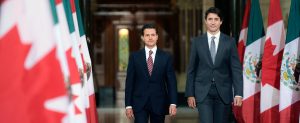
Prime Minister Justin Trudeau and Mexican President Enrique Pena Nieto gathered on the sidelines of a major international summit in Peru’s capital, along with Foreign Affairs Minister Chrystia Freeland and Mexico’s economy secretary Ildefonso Guajardo.

 U.S. Trade Representative Robert Lighthizer pulled out of the summit at the last minute, sending his deputy, C. J. Mahoney, in his place.

The sit-down, the first face-to-face between the two leaders since November, comes at a critical time, with Canada, Mexico and the U.S. all looking for a breakthrough in the ongoing effort to update the North American Free Trade Agreement — and Trump’s wild-card trade strategies doing little to clear the air.

It was also a chance for Trudeau to take stock of Mexico’s position — and perhaps share strategies — before the prime minister heads into a meeting Saturday with U.S. Vice-President Mike Pence.

Pence is in Peru instead of Trump, who was originally scheduled to attend but decided against it at the last minute, ostensibly to deal with the American response to a chemical attack in Syria. Earlier this week, Trump said he was prepared to «renegotiate forever» to get a good NAFTA deal.

Trudeau and Pena Nieto made small talk as members of the media captured the start of their meeting.

But the presence of several senior Mexican trade officials, as well as Freeland — Trudeau’s most trusted point person on NAFTA — left little doubt about the subject that would dominate the agenda once the doors were closed.

Trudeau’s meetings with Pena Nieto and Pence come as the three are attending the Summit of the Americas, which is held every four years and brings together leaders from across the Western Hemisphere.

The prime minister started his day Thursday by meeting Peruvian President Martin Vizcarra, who served as Peru’s ambassador to Canada before the previous president was forced to resign over a scandal last month.

Trudeau delivered a 10-minute address to business leaders from across the Americas encouraging them to invest in Canada, noting that the country has free trade agreements with dozens of countries around the world.

Even as his government struggles to deal with a pipeline crisis at home, one that has forced him to return to Canada on Sunday before resuming his travels to Europe, Trudeau pitched his country as a great place to invest, telling hundreds of business leaders «that big things can get done in Canada.»

More than half the countries with which Canada has free trade agreements are in the Americas, Trudeau said, and the hope is to add a deal with Latin America’s largest trading bloc, Mercosur, to that tally.

«Even in this age where the value of trade is being questioned by some, we have successfully negotiated landmark agreements with Europe and with Asia,» Trudeau added — a not-so subtle dig at protectionists like Trump.

The prime minister went on to emphasize Canada’s skilled labour force, low unemployment and debt-to-GDP ratio, recent federal investments in infrastructure and a new investment agency as proof that Canada is open for business.

The message appeared well received, and Kenneth Frankel, president of the Canadian Council for the Americas, said the region offers a natural opportunity for Canada — particularly as it looks for a northern partner who isn’t Trump.

Yet Siegfried Kiefer, president of Calgary-based engineering firm Atco Ltd., said Latin American leaders have told him they need massive new investments in infrastructure to grow their economies first.

On that front, Canada’s own record on infrastructure and «national-interest projects» has room for improvement, Kiefer said, including Kinder Morgan’s Trans Mountain pipeline, which is at the centre of a fierce battle between the Alberta and B.C. governments.

«The business community is generally looking for proof in the pudding,» he said.

«The public unrest relative to some of these projects is really what you’re trying to deal with. And that in my mind deals with how do you gain the trust of the people of the country that you have looked at the merits of the project objectively.»

Trudeau’s day also included hosting a lunch with representatives from the 15-country Caribbean Community, where he announced $25 million in new funding to help the region deal with natural disasters such as hurricanes.

The prime minister is also scheduled to meet with Chilean President Sebastien Pinera, who took office in March and whose country is an important political and trade partner with Canada.

From: Lee Berthiaume / The Canadian Press / Times Colonist / 13 April

https://nrgibroker.com/wp-content/uploads/2018/04/Captura-de-pantalla-2018-04-17-a-las-16.12.10.png 1023 1142 Soporte https://nrgibroker.com/wp-content/uploads/2025/12/logo-nrgi.svg Soporte2018-04-17 16:13:272026-05-11 19:51:23Trudeau meets with Mexican president at critical time in NAFTA talks

Mexico’s economy minister says odds of a Nafta deal ‘in principle’ at 80%

en

From: Market Watch / 9 April

Mexico’s economy minister, Ildefonso Guajardo, said in a TV interview on Monday that the likelihood of signing a renegotiated pact ‘in principle’ on the North American Free Trade Agreement is about 80%. Guajardo, however, said he didn’t expect a Nafta deal would be struck this week, but would likely be signed around the first week of May. He speculated that the U.S. and would be inclined to complete a deal ahead of coming midterm elections. Nafta negotiators are currently meeting in Washington, D.C., for their eighth round of talks. Last week, President Donald Trump said he was looking for a deal in principle at the Summit of the Americas in Lima, Peru, next week. The Mexican peso USDMXN, -0.3324% which started Monday’s session weaker, climbed 0.2% higher versus the dollar, with one buck fetching 18.2450 pesos. The iShares MSCI Mexico ETF EWW, +1.29% was up 0.5% in response.

From: Market Watch / 9 April


https://nrgibroker.com/wp-content/uploads/2018/04/EST13133484c784908_0.jpg 617 980 Soporte https://nrgibroker.com/wp-content/uploads/2025/12/logo-nrgi.svg Soporte2018-04-10 16:16:052026-05-11 19:51:23Mexico’s economy minister says odds of a Nafta deal ‘in principle’ at 80%
Página 2 de 3123

Buscador

Search Search

Categorías

  • Mexicanas Mujeres (14)
  • Mujeres (14)
  • Mujeres Exitosas (15)

Entradas Recientes

  • Rompiendo Barreras. Construyendo el Futuro
  • El Poder Femenino de la Perspicacia en el Mundo Empresarial Mexicano
  • La Secretaría de Marina reconoce a Graciela Alvarez Hoth en el día Internacional de la Mujer en el Sector Marítimo
  • Graciela Álvarez reconocida como una de las pioneras en la industria energética por la revista Oil and Gas Magazine
  • NRGI Broker Presente en el Congreso Mexicano de Petróleo 2022

NRGI Broker

Somos el enlace entre los riesgos que enfrentan las industrias del sector energético con las soluciones para administrarlos y respaldarlos mediante esquemas confiables de garantías financieras.

Contáctanos

Prolongación Paseo de la Reforma 1015 Torre A Piso 21. Col. Desarrollo Santa Fe, Contadero, C.P. 05348 CDMX, México

Tel: +52 (55) 9177 2100

Horario de Atención

Lunes – Viernes: 7:30-18:00
Contáctanos: [email protected]

© Copyright - NRGI Broker | Aviso de Privacidad | Términos y condiciones
  • Link to Facebook
  • Link to X
  • Link to LinkedIn
  • Link to Youtube
Desplazarse hacia arriba Desplazarse hacia arriba Desplazarse hacia arriba