• Link to Facebook
  • Link to X
  • Link to LinkedIn
  • Link to Youtube
  • Inicio
  • NOSOTROS
  • SECTORES
    • ENERGÍA
      • Eléctrico
      • Petróleo y Gas
      • Renovables
    • Marítimo
    • INFRAESTRUCTURA
      • Puertos
      • Ductos
      • Carreteras
      • Edificios
      • Vías Férreas
      • Terminales de almacenamiento
  • SEGUROS
    • EMPRESAS
      • RESPONSABILIDAD CIVIL
        • Responsabilidad Ambiental
        • Responsabilidad Civil
        • Responsabilidad Civil Profesional
      • MARÍTIMO
        • Puertos y Terminales
        • Responsabilidad Civil Portuaria
        • Casco y P&I
        • Carga
        • Responsabilidad Civil del Fletador
      • DAÑOS
        • Daño Material
        • Múltiple Empresarial
        • Pérdida de Beneficios
      • CONSTRUCCIÓN
        • Construcción y Montaje
        • Obra Civil Terminada
      • MAQUINARIA Y EQUIPO
        • Equipo de Contratistas
      • EXPLORACIÓN Y EXTRACCIÓN
        • Control de Pozos
      • Aviación y Drones
      • Transporte
    • PERSONAS / BENEFICIOS
      • Vida Colectivo
      • Gastos Médicos Mayores Colectivo
      • Accidentes Personales
    • Hogar
    • AUTOS
      • Flotillas Autos y Camiones
      • Autos, Pickups y Camiones individuales
    • LINEAS FINANCIERAS
      • Cyber
      • Errores y Omisiones (E&O)
      • Directores D&O
      • Crime
  • FIANZAS
    • Licitación
    • Anticipo
    • Cumplimiento
    • Buena Calidad
    • Contingencias Laborales
    • Arrendamiento
    • Fiscales
    • Daños y Perjuicios
    • Fidelidad
    • Suministro Combustibles
    • Aduanales
  • BLOG
  • Noticias
  • CONTACTO
  • Inglés
  • Click to open the search input field Click to open the search input field Buscar
  • Menú Menú

Listado de la etiqueta: Mexico}s energy reform

México 2018: un nuevo capítulo de la Reforma Energética

en Reforma energética de México

A cuatro años de su implementación, los avances de la Reforma Energética en México son indudables: 1) se han creado 66 empresas de exploración y producción (E&P); 2) se han firmado 70 nuevos contratos de E&P a través de las 7 licitaciones realizadas, lo que representa inversiones comprometidas por 77,000 mdd; 3) 11 empresas de gasoductos se encuentran operando para aumentar la eficiencia del transporte, así como 45 empresas de almacenamiento actividad que se ha vuelto estratégica ante hechos como la libre importación de combustibles; 4) 18 nuevas marcas de gasolineras y, por último, 5) Pemex ha encontrado socios para la explotación de los campos Trión, Cárdenas Mora y Ogarrio, a través de los farmouts, además de que cierra el año con la buena noticia sobre el descubrimiento del campo Ixachi, que se encuentra muy cerca de la prolífica zona de la “Faja de Oro”.

En 2018, empezará a escribirse un nuevo capítulo de la Reforma Energética, en el que habrá que darle continuidad a los objetivos plasmados en el Plan Quinquenal de Licitaciones 2015-2019 y en donde el principal desafío será la sucesión presidencial, sobre todo para evitar que la efervescencia habitual de los procesos electoral y pos-electoral impida el incumplimiento de las acciones programadas en tiempo y forma.

En primer lugar, se deberán concretar las licitaciones que ya se encuentran en progreso, tales como la Ronda 2.4 (aguas profundas) y los farmouts Ayin-Batsil y  Maximino-Nobilis, cuyos términos de licitación serán replanteados por la CNH en el transcurso del año.

Asimismo, se llevarán a cabo las licitaciones correspondientes a la Ronda 3, cuya primera emisión ya está publicada (Ronda 3.1. Aguas someras) y la Ronda 2.5, para campos terrestres no convencionales (shale) que, aunque no estaba prevista, se llevará a cabo antes de que finalice la presente administración.

Todo lo anterior, nos deja ver que 2018 será un año muy dinámico para la industria de los hidrocarburos y petrolíferos: las empresas participantes deberán poner en marcha o continuar con sus operaciones y cumplir con la diversidad de obligaciones establecidas en su contrato y en la regulación aplicable, tales como la contratación de seguros; la elaboración de la Línea Base Ambiental y la conformación e implementación del Sistema de Administración de Seguridad Industrial, Seguridad Operativa y Protección Ambiental (SASISOPA). Para ello, se requiere la asesoría de expertos en dichos temas que garanticen resultados exitosos.

NRGI Broker es experto en seguros para la industria de los hidrocarburos y además cuenta con alianzas estratégicas con empresas líderes en servicios legales, consultoría ambiental y control de pozos. Acércate a nosotros, con gusto te atenderemos.


https://nrgibroker.com/wp-content/uploads/2018/01/amarilla-mailchimp1.jpg 400 600 admin https://nrgibroker.com/wp-content/uploads/2025/12/logo-nrgi.svg admin2026-05-11 19:27:022026-05-11 19:27:02México 2018: un nuevo capítulo de la Reforma Energética

¿Participarás en consorcio con otras empresas en las Rondas de Licitación de CNH? Conoce de qué se trata la Responsabilidad Solidaria.

en Reforma energética de México, Rondas de licitación de México

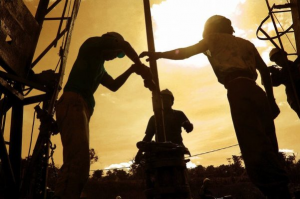
En 2014, México promulgó  la Reforma Energética y con ello abrió paso a un hecho histórico, por vez primera en 75 años se permitió a la inversión privada participar en las actividades de Exploración y Extracción de hidrocarburos.

Las empresas y consorcios  interesados en participar en los concursos de licitación organizados por la Comisión Nacional de Hidrocarburos (CNH) lo pueden hacer como licitante individual o licitante agrupado (consorcio). Aquellos que deciden participar como consorcio no están obligados constituir una nueva persona moral, sino simplemente a manifestar su voluntad de presentar una propuesta conjunta para la licitación y firmar el contrato correspondiente.

Al permitir este tipo de agrupación, se pretende promover la participación del mayor número de empresas  sin que se quede fuera el capital mexicano. Por eso, pueden licitar empresas que cuenten con experiencia y comprueben capacidad técnica (como operadores) -requisitos que en su mayoría van a cubrir empresas extranjeras- y empresas con capacidad económica y financiera (no operadores).

La participación en consorcio permite que las empresas reúnan las condiciones, que en conjunto  les aseguren mayores posibilidades de éxito. No obstante, es importante considerar que en cualquier caso las empresas adquieren una responsabilidad total solidaria  por las actividades que se ejecuten en el campo.

En primer lugar, será necesario definir su porcentaje de participación, lo cual no implica que asuman solamente en esa medida las obligaciones  establecidas en el contrato, pues las empresas participantes serán solidariamente responsables de todas y cada una de las obligaciones que asume el consorcio, independientemente de su porcentaje de su respectiva participación.

El operador, por su parte, tiene la obligación de cumplir con las obligaciones del contrato en representación de las empresas participantes. Específicamente, se encarga de todos los aspectos operacionales, pero en caso de algún incumplimiento de su parte, como ya dijimos no releva de su responsabilidad solidaria a las otras empresas.

La figura del operador es central, por eso se requiere que cuente por lo menos con una tercera parte de la participación en el consorcio y ningún otro miembro podrá tener una participación económicamente  mayor a  la suya.

En materia de seguros, por ejemplo, el operador es responsable de contratarlos y presentarlos ante la Agencia de Seguridad, Energía y Ambiente (ASEA), de conformidad con lo establecido en las Disposiciones Administrativas de Carácter General   en materia de Seguros (DAGS] para las actividades de Exploración y Extracción de Hidrocarburos, pero si en el momento de un siniestro las coberturas no fueran suficientes y/o adecuadas para responder por el daño, todos los participantes serán legalmente responsables de repararlo.

En NRGI Broker, somos expertos en materia de seguros, así como de la regulación en  materia ambiental, con la que deben cumplir los operadores petroleros. Acércate a nosotros, con gusto te atenderemos.
 

https://nrgibroker.com/wp-content/uploads/2018/02/shutterstock_10996381.jpg 683 1024 Soporte https://nrgibroker.com/wp-content/uploads/2025/12/logo-nrgi.svg Soporte2026-05-11 19:27:002026-05-11 19:27:00¿Participarás en consorcio con otras empresas en las Rondas de Licitación de CNH? Conoce de qué se trata la Responsabilidad Solidaria.

Oil opening experiences in other countries

en Reforma energética de México

Several countries have experienced oil openings for years and their experience might be useful for our country regarding the type of problems they have faced and how they were solved.

In our country, the Energy Reform is young and although its development has been relatively fast and constant compared to other countries, it is important to consider that there will eventually be controversies, either between authorities and contractors, between different contractors or between contractors and its partners.

Recall that what underpins the relationship between these actors is a contract, which according to its legal definition is a will agreement, i.e. both parties accept the terms and conditions. But there are no perfect contracts and this means that in practice there will be differences of interpretation or disagreements regarding new rules.

Especially when it reaches the stage of production where each of the parties will seek to ensure a more determined by their interests.

Disputes between authorities and contractors are generally few, but they earn importance in the media. In countries such as Ecuador, Argentina and Brazil, the most common differences refer to unilateral changes in the contract, price control or lack of timely attention to procedures by the authority.

Regarding disputes between contractors, the most common reason is because they have shared deposits, where there may be a lack of certainty between the rights and obligations of each of the contractors.

Among partners, disputes will usually be because some of them decide to abandon their participation in the field.

The Mexican legislator has to consider the existence of possible conflicts, because of this, the Hydrocarbons Law establishes that the resolution of disputes or arbitration that are signed with national or foreign companies, will be subject to Mexican laws, which is an element of certainty for the authorities and companies, especially for national ones.

At NRGI Broker, we are experts in the hydrocarbon sector and we have strategic allies willing to advise you on the development of oil activities. Come to us, we will gladly assist you.


https://nrgibroker.com/wp-content/uploads/2018/06/Captura-de-pantalla-2018-06-14-a-las-09.22.29.png 399 601 Soporte https://nrgibroker.com/wp-content/uploads/2025/12/logo-nrgi.svg Soporte2026-05-11 19:26:512026-05-11 19:26:51Oil opening experiences in other countries

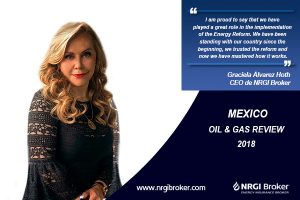
Interview with Graciela Álvarez, CEO of NRGI Broker

en Pipelines

Mexico Oil & Gas Review / July 18


Company bio: NRGI Broker specializes in insurance and surety bonds for the Mexican energy sector. It develops custom-made solutions for companies operating in the energy sector, including vessel, construction and engineering and catastrophic risks.


Q: How has NRGI Broker created market opportunities to expand the reach of its services?

A: I am proud to say that we have played a great role in the implementation of the Energy Reform. We have been standing with our country since the beginning, we trusted the reform and now we have mastered how it works. We are a Mexican broker that  has a broad services portfolio and we have consolidated as the best one in the market We have also established “Voces de Energía”, a forum where experts discuss the reform’s environmental, social and fiscal regulations.

Q: How will NRGI Broker benefit its potential clients and partners going forward?

A: In the long term, we see the company as a consolidated reference in the fields of insurance and sureties for the oil and gas industry. We are savvy about the needs of the companies along the entire value chain in hydrocarbons and we are an established adviser for risk management and on financial regulations. We started strong in offshore, ever since activity began in that area, and now we are talking about moving into onshore. The trend is to set new partnerships for storage, pipelines, clean energies and alike. We are investing in putting our brand’s name out there and showcasing that we offer a full range of services few other companies offer.

Q: What are the Top 3 successes of the Energy Reform?

A: I have a vivid memory of observing the Energy Reform’s application when I was acting as an adviser for ASEA in 2014, which gave me the chance to understand how the reform was set in motion. The first success was the implementation itself, which was accomplished according to the same spectrum of norms, rules and opportunities. The second success was the establishment of strong and transparent organisms to guide the implementation that facilitated the cohabitation of all different players in a single environment, which has grown to represent 18 operators. The third is the 72 percent rate of successful allocation of everything that has been tendered in the licensing rounds, demonstrating the genuine interest that local and foreign companies have in Mexico.

Q: How have local and foreign companies adapted to the new regulations and what have been the major hurdles in this process?

A: Everything comes down to an understanding that we need a unified regulatory framework and this cannot be implemented without looking at international standards. The reform’s planning was based on the experiences of seven countries that underwent similar processes, so it is molded to global requirements. Those international players that recently entered the market are used to these types of regulations since they apply to other territories, while many Mexican companies have previously worked with foreign partners that use those standards. For most local companies, application was not an issue. On the contrary, companies operating in the hydrocarbons sector now have the certainty of working in an environment protected by a well-established regulatory framework.

Q: How has NRGI Broker contributed to changing the local mindset and raising awareness about the need for insurance?

A: We advised ASEA when it conducted a three-year study on the best practices and experiences of Australia, Brazil, Canada, Colombia, Norway, the UK and the US that could be applied to the Mexican case. We worked with it every step of the way to establish these rules, from offshore platforms to setting up gas stations, and we developed the administrative dispositions for insurance in the upstream, midstream and downstream sectors. Insurance is required if this industry is to function properly and this mandatory status made things easier for us in terms of application. We are certain about the need to transform the attitude toward insurance and to combine that with our experience, specialization and innovation to offer personalized solutions to our clients.

Q: How will PEMEX’s migration projects make the company more competitive and productive?

A: This is a great strategy for PEMEX to establish investment partnerships that are specialists in how fields work, the reserves included in those fields and the different options to exploit them. This is a long-term investment business that opens the door to new opportunities to turn PEMEX into a more competitive entity. It is a win-win situation. It is important to note that PEMEX gets to keep the land ownership for these migrations; they only allow investment from third parties. One of the company’s future strengths lies in its capitalization and the establishment of partnerships with technology-driven companies. By binding all the parties involved in these type of projects, the companies are forced to bring their A game and deliver on their promises because they would harm themselves if they fell short due to the interdependence ingrained in this framework.

Q: What direction would you like the next administration to follow related to the industry?

A: I hope the next administration understands the implication of keeping the Energy Reform afloat. The reform was meant to contribute to the country and it has been set in motion successfully. The next president should push for new partnerships to continue deepening the reform’s outreach. What is important to understand is that reversing this process would be harmful to the country and it would hurt many companies that have supported and invested in its application.


To read the 2018 edition click here.


Mexico Oil & Gas Review / July 18


https://nrgibroker.com/wp-content/uploads/2018/07/inglés-2018-1.jpg 400 600 Soporte https://nrgibroker.com/wp-content/uploads/2025/12/logo-nrgi.svg Soporte2026-05-11 19:25:092026-05-11 19:25:09Interview with Graciela Álvarez, CEO of NRGI Broker

First Phillips 66 Sites Open in Mexico

en Reforma energética de México

CSP Daily News / July 23 


EL PASO, Texas — Phillips 66 is opening its first retail sites in Mexico.

The Houston-based refiner, which owns the Phillips 66, 76 and Conoco brands, has a licensing agreement with fuel distributor Windstar LPG to open and operate branded sites in eight northern Mexican states, according to Arizona Public Media (AZPM). The first locations—three 76 branded sites—opened in Hermosillo, Sonora, on July 12. Another site was opening soon after in Chihuahua.

Reynold Gonzalez, CFO for El Paso, Texas-based Windstar, told AZPM that the company has «aggressive plans» for expanding in Mexico, with 25 to 30 branded locations slated for Sonora by the end of 2018.

Phillips 66 follows other U.S. and international refiners in entering the newly deregulated fuel market in Mexico, including ExxonMobil, Shell, Andeavor and BP.

Some industry observers have questioned whether Mexico’s new president-elect, Andres Manuel Lopez Obrador, might reverse the energy reforms launched in 2013 by his predecessor, Enrique Pena Nieto, which included opening up the fuel market to foreign companies. Lopez Obrador said he would review the reforms if he discovered corruption in how contracts were awarded, Reuters reported; however, he has not announced any plans for rollbacks since winning the election in July.

Gonzalez of Windstar told AZPM that his company would not be opening locations in Mexico if it was concerned about a rollback, and that he believes U.S. competitors could help improve the quality of gasoline for fuel customers in Mexico.

«We are an example of a positive result of the energy reform act,» he said.


CSP Daily News / July 23 


https://nrgibroker.com/wp-content/uploads/2018/07/First-Phillips-66-Sites-Open-in-Mexico.png 400 600 Soporte https://nrgibroker.com/wp-content/uploads/2025/12/logo-nrgi.svg Soporte2018-07-24 11:41:522026-05-11 19:51:19First Phillips 66 Sites Open in Mexico

Amlo and the realities of Mexico’s oil reform

en Mercados internacionales, Reforma energética de México

Petroleum Economist / Craig Guthrie / July 9


The Mexican president-elect needs a strong oil and gas sector to fund a promised social transformation

The investor-friendly tone Mexican president-elect Andres Manuel Lopez Obrador, widely known as Amlo, struck in the run-up to his landslide victory on 1 July is fueling confidence he will tweak rather than dismantle the energy reforms that are enticing international oil companies to the country.

Prospects of an Amlo presidency had stirred concerns among investors for months ahead of the vote—he’s the first leftist Mexican president since the 1930s, and has forged an anti-elitist platform calling for a reordering of the political landscape. And yet the peso gained more than 2% against the US dollar in the hours after the result.

«This can be a presidency ruled by reason and legality,» Ixchel Castro, manager of Latin American oils and refining markets research with Wood Mackenzie, tells Petroleum Economist, while pointing to the currency market’s reaction and the links he’s built with Mexican business elites. «There may be change in the emphasis of the energy reforms, but we see a reversal as highly unlikely».

Launched by outgoing President Enrique Peña Nieto in 2013, the reforms ended Pemex’s 75-year monopoly over the energy sector. So far, auctions in January and March jointly lured at least $100bn in oil exploration investment commitments from more than 70 different firms—useful revenue for a president who has promised sweeping social changes to tackle crime, corruption and poverty.

Amlo made opposition to the reforms a bedrock of his failed 2013 presidential bid, and told a rally just four months ago that he would never allow Mexican crude to return to the hands of foreigners. But a reversal in tack since has seen his top business adviser and nominee for chief of staff, Alfonso Romo, lead a pro-business public relations drive towards international investors.

Romo told Reuters on 25 June that there could be more auctions of oil drilling rights, as long as a review of contracts that have already been awarded to private companies showed no problems. «We will revise them and everything good will remain,» he said, noting that Amlo had said this directly to investors in New York.

But it’s not expected to be all smooth sailing for foreign oil investment under Amlo’s watch. Uncertainty over the long-term goals of his populist agenda will likely continue to unnerve companies looking to establish a steady pipeline of projects.

«Amlo will likely enjoy the benefits from the existing contracts that have been awarded, especially in terms of oil barrels produced, fiscal revenue received and jobs created. By the third year of his administration he can claim that Mexico is producing more oil under his presidency,» Duncan Wood, director of the Mexico Institute at the Woodrow Wilson International Centre wrote in an e-mail.

«But he will be reluctant to continue the bidding rounds. The one possible exception that I see would be in deep waters and in farm-outs from Pemex.»

Mexico plans to auction 37 onshore areas and nine in the shale gas-rich Burgos Basin on 27 September, as well as the farm-out of seven onshore areas with Pemex on 31 October.

Amlo’s approach to a planned re-shaping of Pemex is seen as the next critical indicator of his eventual intentions on the country’s energy direction.

While the president has pledged to resurrect Pemex into a strong national oil company through cost-cutting, this comes amid a significant decline in domestic energy production—from 3.4m barrels of oil a day in 2004 to 1.9m b/d in 2018.

«Pemex must be forced to compete in order to become stronger,» said Wood. «If the reform process is stopped, Pemex would gain from a strengthening of its position in the short-term. But in the long term its competitiveness and productivity could be severely damaged.»


Petroleum Economist / Craig Guthrie / July 9


https://nrgibroker.com/wp-content/uploads/2018/07/Fotolia_8365763_Subscription_L-e1531247131209.jpg 469 600 Soporte https://nrgibroker.com/wp-content/uploads/2025/12/logo-nrgi.svg Soporte2018-07-10 13:26:062026-05-11 19:51:19Amlo and the realities of Mexico’s oil reform

Mexico Likely To Keep Making The World’s Biggest Oil Hedge

en Reforma energética de México

Baystreet Staff / Tsvetana Paraskova / Oilprice / July 9


The Mexican oil hedge, or the Hacienda Hedge, is considered the biggest hedging bet on Wall Street as well as perhaps the most secretive. It has earned Mexico—and a few large investment banks—billions of U.S. dollars.

Mexico buys put options from investment banks and typically hedges a whopping 200-300 million barrels of oil a year. With the put options, it has the right, but not the obligation, to sell oil at a previously set price and timing. But will this tradition continue under the newly elected administration?

Throughout his campaign, Mexico’s now president-elect Andres Manuel Lopez Obrador kept the oil industry on edge with comments and promises that he would review the landmark 2013 energy reform of outgoing President Enrique Peña Nieto that ended seven decades of oil monopoly in the country.

But the first signals from Lopez Obrador’s staff and advisors after he won Mexico’s presidential election last weekend are that the new president would not seek to backtrack on the energy reform, which allowed foreign oil firms to win contracts to pump Mexican oil.

Leftist Lopez Obrador and the new government, set to take office on December 1, will also likely continue with Mexico’s annual oil hedging program—considered to be the biggest annual oil hedge deal on Wall Street—an economic advisor to the president-elect told Bloomberg this week.

For 2018, Mexico locked in last year an average export price of US$46 per barrel of crude oil with its oil hedge. According to data by Mexico’s Finance Ministry, the country spent the equivalent of around US$1.25 billion on the oil hedge program for 2018, which was 21 percent higher than the oil hedge in 2016 to lock in prices for 2017. Mexico’s spending on the world’s biggest oil hedge has been at around US$1 billion over the past few years. State-run Petroleos Mexicanos (Pemex) is also hedging part of its production.

According to a member of president-elect Lopez Obrador’s economic team, Mexico’s oil hedge and the Pemex hedge are “working fine” and are likely to be left unchanged.

“The formula by which the government is calculating the price of oil is a very stable formula,” Abel Hibert told Bloomberg. “Using the hedges reduces uncertainty in financial markets,” the economic advisor said, adding, however, that the hedging program was not mentioned when energy policies were discussed at a meeting of the transition team this week.

Reducing uncertainty seems to be the key message from Lopez Obrador’s team after the election, even beyond the hedging program for oil.

Alfonso Romo, who is tipped to be the next president’s chief of staff, says that the new administration doesn’t want to create uncertainty and that there won’t be rescinding of the energy reform.

“What do we want to do? We want to take advantage of all of the enthusiasm we’ve generated to fix everything we can,” Romo told Bloomberg in an interview. “What don’t we want? To create uncertainty. Zero. I’m terrified of that.”

The incoming president’s chief of staff also said that he didn’t see changes to the 2013 reform.

“If anything happens, it would be done without hurting private investment,” Romo told Bloomberg.

With the energy reform of the outgoing president Peña Nieto, Mexico has attracted oil majors of the likes of ExxonMobil, Chevron, Shell, and Eni to its offshore areas, as it seeks to reverse a decline in its oil production.

Mexico needs a lot of money for offshore drilling, and “no one will fight success” if it manages to boost oil production, according to Romo.

The president-elect Lopez Obrador has said that he would have the already awarded contracts scrutinized for irregularities. But neither Romo nor the likely incoming finance minister Carlos Urzua expects the review of the contracts to reveal acts of corruption.

“If it looks good, on we go. It’s a contract we have to respect,” Urzua told Mexican television on Wednesday.

We are still five months away from the new president and government taking office, but the first messages after the election point that Mexico wants to reassure foreign oil investors and seek reconciliation rather than confrontation.


Baystreet Staff / Tsvetana Paraskova / Oilprice / July 9


https://nrgibroker.com/wp-content/uploads/2018/07/shutterstock_372051175-e1531246699862.jpg 384 600 Soporte https://nrgibroker.com/wp-content/uploads/2025/12/logo-nrgi.svg Soporte2018-07-10 13:18:372026-05-11 19:51:19Mexico Likely To Keep Making The World’s Biggest Oil Hedge

Mexico’s incoming leftist President could open US-Mexico energy relations

en Mercados internacionales, Reforma energética de México

The Daily Caller /Jason Hopkins / July 2


The election of Andrés Manuel López Obrador as Mexico’s next president has investors around the world on edge, waiting to see how the leftist leader will approach the oil and gas industry.

López Obrador handily won Mexico’s presidential election Sunday, capturing over 53 percent of the vote — more than double the percentage of the second-place finisher. His victory brings a new era of progressive populism to the U.S.’ southern neighbor. A member of the National Regeneration Movement Party, López Obrador touts a far-left pedigree: universal access to public colleges, an expansion of welfare programs, increased investment in industries and other big government proposals.

The president-elect’s calls for energy reform, however, has been the most striking to international observers. López Obrador pledged during the campaign to hold a referendum on reforms the country made several years ago that embraced measured degrees of privatization of the country’s oil sector.

Outgoing President Peña Nieto opened the country’s petroleum industry in 2013 to foreign investment, ending a decades-old monopoly held by Pemex, the country’s state-run petroleum company. The move was intended to revive Mexico’s oil and gas production, which is plagued with rampant inefficiency, debt and outdated equipment.

During the 2018 campaign, López Obrador derided these pro-market reforms. While promising to honor existing oil contracts, he believes the country should prioritize nationalization of the industry once again.

“As a long-time ally of national labor unions and a supporter of a strong [Pemex], [López Obrador] may seek to maximize national investment and employment in the sector, hedging Mexico’s political risk, even at the cost of economic efficiency,” David Goldwyn, chairman of the Atlantic’s Global Energy Center Advisory Group, noted Sunday.

Such reforms could have major implications for Mexico-U.S. energy relations, which hold very deep ties.

The U.S. currently exports a large amount of gas across the border and the Mexican government, in turn, sends heavy crude to American consumers. As crude oil imports to the U.S. has declined over the years, the trade imbalance between the two countries has shifted. U.S. energy exports to Mexico now exceeds its imports, according to the Energy Information Administration. These issues may come up as the Trump administration is set to renegotiate key agreements within the North American Trade Agreement with Mexico and Canada.

López Obrador, for his part, is no fan of Trump. The longtime Mexican politician wrote a book entitled “Oye, Trump” (“Listen, Trump”) that blasts the American leader for his calls to build a border wall and his “attempts to persecute migrant workers.” The book includes a number of speeches López Obrador has given. In one such speech, he compared Trump to Hiter, saying “Trump and his advisers speak of the Mexicans the way Hitler and the Nazis referred to the Jews, just before undertaking the infamous persecution and the abominable extermination.”


The Daily Caller /Jason Hopkins / July 2


https://nrgibroker.com/wp-content/uploads/2017/07/shutterstock_292231469.jpg 2000 3000 Soporte https://nrgibroker.com/wp-content/uploads/2025/12/logo-nrgi.svg Soporte2018-07-03 16:12:102026-05-11 19:51:20Mexico’s incoming leftist President could open US-Mexico energy relations

Competitive fuel market is still some years off, analysts say

en Pipelines, Reforma energética de México

Mexico News Daily / Mileno / June 25


Time, more investment required before gas prices will drop

It will take another two to five years to attain a truly competitive fuel market with lower gasoline prices for motorists, according to industry specialists.

The federal government’s 2013 energy reform opened up Mexico’s retail fuel market to foreign and private companies and there are now more than 2,000 gas stations that operate under a brand other than the state-owned Pemex.

But the increased competition hasn’t translated into cheaper fuel prices as had been expected.

“It was thought that it would be faster but that’s not the case,” said Rodrigo Favela, a consultant and fuel market analyst.

Favela told the newspaper Milenio that based on experiences in other countries, creating a competitive market takes time.

In addition, greater competition in the retail fuel market is not enough on its own to generate lower fuel prices, according to Mexico’s central bank.

In its regional economies report for the last quarter of 2017, the Bank of México said greater investment is needed in the entire gasoline supply chain from the refinery to the gas station in order for prices to drop.

Sebastián Figueroa, CEO of energy operator FullGas, told Milenio that gas stations in the north of the country could start competing on price within one to two years.

He cited proximity to the United States, the presence of existing pipelines, greater ease with which fuel can be imported and lower logistics costs as factors that will likely see fuel prices drop more quickly there than in other parts of the country.

In central states, Figueroa predicted that it would be another three to four years before competitiveness among gas stations increases due to the need for more infrastructure while in the southeast of Mexico, it could take up to five years or more.

In the latter region, the development of the new infrastructure that is needed — such as pipelines —is more complicated because of geological factors, he said.

Considering that fuel prices have actually risen since Mexico’s previously monopolized fuel market opened up, Milenio asked the president of the Senate’s energy committee whether energy reform should be considered a failure.

Salvador Vega Casillas, of the opposition National Action Party (PAN), rejected that suggestion but said it was a mistake to liberalize fuel prices at a time when the value of the US dollar was high against the peso. Gasoline prices were fully deregulated by November 30 last year.

However, Figueroa said that if the government had waited any longer to free prices, more problems could have been created for the sector because a subsidized model is not sustainable.

He maintained that the reform is a positive for Mexico, charging that having only one participant in the downstream sector led to inefficiency whereas competition forces gas stations to offer better deals to motorists.

Federal Energy Secretary Pedro Joaquín Coldwell has also contended that an open and competitive market is the best way to achieve gasoline prices that are accessible to all Mexicans.

Favela explained that there are three main factors that determine the price of petroleum at the pump: international crude oil prices, the prevailing exchange rate and logistics costs.

In order to generate a more competitive market, he argued, all petroleum companies should have non-discriminatory access to the nation’s oil terminals and ports.

Despite opening up the domestic fuel market to new players, the majority of Mexico’s petroleum infrastructure is still controlled by the state oil company Pemex.

The average price of regular — or Magna — gasoline has risen 17% this year, according to the consultancy PETROIntelligence, from 16.24 pesos per liter at the beginning of January to 19 pesos. Prices were as high as 19.11 pesos on Friday in Guadalajara.


Mexico News Daily / Mileno / June 25


https://nrgibroker.com/wp-content/uploads/2018/06/Mexico’s-petroleum-infrastructure-1.png 400 600 Soporte https://nrgibroker.com/wp-content/uploads/2025/12/logo-nrgi.svg Soporte2018-06-26 12:39:452026-05-11 19:51:20Competitive fuel market is still some years off, analysts say

Mexico Energy Reform Slowdown Would Be ‘A Shame,’ Pemex CEO Says

en Reforma energética de México

FROM: Bloomberg / Adam Williams / 7 de marzo de 2018

Mexico’s 2013 decision to end the government monopoly on energy has resulted in billions in investment and the arrival of dozens of international oil companies.

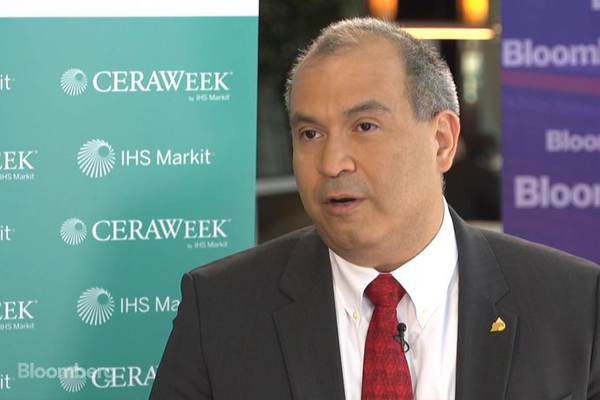
Carlos Trevino, Petroleos Mexicanos’s new chief executive officer, thinks it would be unfortunate for that to be interrupted by the next administration.

The top concern of Trevino, who took over at Pemex in November, is that Mexico will elect a president in July that will “slow down the energy reform pace,” he said in an interview with Bloomberg Television at the CERAWeek by IHS Markit event in Houston.

“Someone who doesn’t believe in the energy reform may reduce the speed very much and I think that would be a shame in Mexico,” Trevino said. “The energy reform has a lot of benefits to the country, to the people, so the the worst case scenario in my point of view is that the speed that we are implementing the energy reform will be reduced.”

Trevino’s concern matches that of many energy industry leaders in Mexico, which has signed more than 90 oil and gas production contracts with international majors such as Royal Dutch Shell Plc, Chevron Corp. and Exxon Mobil Corp. since a landmark 2015 crude auction. Presidential front-runner Andres Manuel Lopez Obrador, who leads polls ahead of the July 1 election, has vowed that his administration will slow the pace of the current oil auctions and review contracts signed by the current government.

A reversal or significant modification to the overhaul would be “almost impossible because to change the energy reform you will need to change the constitution,” Trevino said. It would require a majority in Mexico’s upper and lower houses and it “is really difficult for any president to have that amount” of support.

“It is possible but improbable,” Trevino said. “We have a lot of certainty on what is going to happen in the future no matter who wins the election.”

Refining partner
Pemex, which has reiterated that partners will improve crude production and refining margins, will formalize a joint-venture agreement with Mitsui & Co. at its flagship refinery this month, Trevino said. The partnership with Mitsui is an estimated $2.6 billion deal that will increase production to help reduce the nation’s reliance on imported fuels.

Pemex also expects to sign at least one additional refinery partnership as soon as this summer, Trevino said, without providing additional details. The company continues to seek partners for refinery auxiliary services in areas such as power generation, water treatment and steam generation, he said.

he partnership with Mitsui is an estimated $2.6 billion deal that will increase production to help reduce the nation’s reliance on imported fuels.

Pemex also expects to sign at least one additional refinery partnership as soon as this summer, Trevino said, without providing additional details. The company continues to seek partners for refinery auxiliary services in areas such as power generation, water treatment and steam generation, he said.

The company’s Salina Cruz refinery, which was offline for several months last year following a series of natural disasters, is operating at half of its capacity, processing around 150,000 daily barrels, according to Trevino. Pemex’s Madero refinery, which is in the process of a restart, is currently processing between 60,000 and 80,000 barrels, he said. The Madero refinery, which has the capacity to process 190,000 barrels per day, should ramp up to normal rates at the end of the month.

Oil Auctions
Pemex, which won rights to develop four deep water areas in Mexico’s Jan. 31 auction, is going to bid for a few block in the March 27 tender of 35 shallow water zones, he said. Pemex would prefer to bid in partnerships but is willing to go it alone if need be, Trevino said.

The company, which launched its own oil hedge last year to safeguard against a potential price drop, will continue the program next year, Trevino said.


FROM: Bloomberg / Adam Williams / 7 de marzo de 2018

https://nrgibroker.com/wp-content/uploads/2018/03/trevimc.jpg 400 600 Soporte https://nrgibroker.com/wp-content/uploads/2025/12/logo-nrgi.svg Soporte2018-03-13 11:44:322026-05-11 19:51:24Mexico Energy Reform Slowdown Would Be ‘A Shame,’ Pemex CEO Says

Buscador

Search Search

Categorías

  • Mexicanas Mujeres (14)
  • Mujeres (14)
  • Mujeres Exitosas (15)

Entradas Recientes

  • Rompiendo Barreras. Construyendo el Futuro
  • El Poder Femenino de la Perspicacia en el Mundo Empresarial Mexicano
  • La Secretaría de Marina reconoce a Graciela Alvarez Hoth en el día Internacional de la Mujer en el Sector Marítimo
  • Graciela Álvarez reconocida como una de las pioneras en la industria energética por la revista Oil and Gas Magazine
  • NRGI Broker Presente en el Congreso Mexicano de Petróleo 2022

NRGI Broker

Somos el enlace entre los riesgos que enfrentan las industrias del sector energético con las soluciones para administrarlos y respaldarlos mediante esquemas confiables de garantías financieras.

Contáctanos

Prolongación Paseo de la Reforma 1015 Torre A Piso 21. Col. Desarrollo Santa Fe, Contadero, C.P. 05348 CDMX, México

Tel: +52 (55) 9177 2100

Horario de Atención

Lunes – Viernes: 7:30-18:00
Contáctanos: [email protected]

© Copyright - NRGI Broker | Aviso de Privacidad | Términos y condiciones
  • Link to Facebook
  • Link to X
  • Link to LinkedIn
  • Link to Youtube
Desplazarse hacia arriba Desplazarse hacia arriba Desplazarse hacia arriba