Listado de la etiqueta: natural gas
Iran, India Sign MoU to Develop Oil, Gas Projects
enOPEC member Iran and India – one of Asia’s fastest growing source of energy demand – signed a memorandum of understanding (MoU) to develop oil and gas projects, including the Farzad B gas field, Iranian Petroleum Minister Bijan Zangeneh told the Iran-India business conference held at Teheran Chamber of Commerce Saturday, Shana – a media linked to Iran’s Ministry of Petroleum – reported Sunday. «We had thorough conversations today and signed an MoU for development of Farzad B gas field, refinery cooperation, export of crude oil and petroleum products and mutual cooperation in petrochemical industry,» Zangeneh said.
The MoU was signed during a visit to Teheran by Indian Petroleum and Natural Gas Minister Dharmendra Pradhan, who, the Ministry said on its website April 7, hoped to engage «with the Iranian political leadership to work with them, particularly in the hydrocarbon, petrochemicals and fertilizers sectors for mutual benefits, including strengthening of India’s energy security.» According to Zangeneh, Indian investors should consider the development of the Farzad B project as a top priority, adding that «we hope decisions regarding the project’s development will be made before 2017.»
He said the Farzad B gas field can produce 3 billion cubic feet per day (Bcf/d) of natural gas, but Iran has signed an MoU with Indian developers for the production of 1 Bcf/d of natural gas from the field. A consortium comprising three Indian companies, including ONGC Videsh Ltd. and Oil India Ltd., made a gas discovery at the offshore Farzad B field in 2008.
Meanwhile, Zangeneh said both nations have agreed to set up major joint ventures and enhance their strategic relations, adding that «we hope Iranian and Indian companies reach out to each other and, under the new circumstances, the two countries boost their investments.» Indian companies have indicated to Zangeneh their interests to purchase natural gas from Iran to feed their petrochemical and other energy-consuming industries, Shana reported. On its part, Iran could deliver gas to Indian customers in Chabahar or any other ports where the Indians are willing to invest to feed methanol, steel and aluminium plants.
Separately, shareholders of Turkmenistan-Afghanistan-Pakistan-India (TAPI) Pipeline Company Limited signed an agreement in Ashgabat, Turkmenistan Thursday to invest $200 million in the TAPI natural gas pipeline. According to the Asian Development Bank (ADB), the investment includes funds for detailed engineering and route surveys, environmental and social safeguard studies, and procurement and financing activities, to enable a final investment decision, after which construction can begin. Construction is estimated to take up to 3 years.
According to Pakistan’s Minister of State for Petroleum and Natural Resources Jam Kamal Khan, TAPI would supply 487.3 billion cubic feet (Bcf) or 13.8 billion cubic meters (Bcm) of gas from Turkmenistan to meet the South Asian country’s growing energy demand, Indian daily The Economic Times reported Friday. Sean O’ Sullivan, ADB’s Director General of Central and West Asia Department, said the gas pipeline will unlock economic opportunities and diversify the energy market for Turkmenistan and enhance energy security for the region.
Ground breaking of the 1,127 mile (1,814 kilometer) -long TAPI pipeline, a project seeking to ease energy shortages in South Asia, was carried out in December 2015 year in Turkmenistan. The pipeline will be equipped to transport 3.2 billion cubic feet per day (Bcf/d) or 90 million standard cubic meters a day (MMscm/d) gas for 30 years, with India and Pakistan originally expected to receive 1.3 Bscf/d (38 MMscm/d) each, while the remaining 494.4 million standard cubic feet per day (MMscf/d) or 14 MMscm/d was to be supplied to Afghanistan.
So far, Turkmenistan is the only country that has started work to build its section of the TAPI pipeline. The pipeline will travel 480 miles (773 kilometers) through Afghanistan and 514 miles (827 kilometers) in Pakistan before ending at Fazilka in Punjab, India, The Economic Times said.
Copyrigth: Rigzone
Will Natural Gas Go On another Run in 2017?
enFrom the multi-year slump of $1.611/MMBtu hit on 04 March 2016, to the highs of $3.902/MMBtu reached on December 28, 2016, natural gas prices have come a long way. Natural gas is 2016’s best performer among major commodities.
However, the big question is – Will the rally continue and what should be the strategy of the natural gas traders in 2017?
Until about November, the underground storage in the lower 48 states consistently stayed above the 5-year maximum levels, indicating a supply glut.
However, in December, the weather turned colder than normal, leading to a large drawdown in gas stocks. In the last six weeks of 2016, the U.S. working gas stocks in underground storage declined by 687 billion cubic feet, the largest seasonal decline since 2013, said John Kemp of Reuters.
In their Natural Gas Weekly Update released on December 22, 2016, the EIA said that in the first three weeks of December the U.S. natural gas consumption averaged 92 billion cubic feet per day (Bcf/d), 21 percent higher than the previous year and 17 percent higher than the five-year average (2011-2015), according to data from PointLogic.
As temperatures fell in December the consumption of natural gas increased from 80 Bcf/d in the first week of December to 98 Bcf/d between December 8-21.
The EIA report said: “Triple-digit consumption days are generally rare in December. However, from December 15–21, natural gas consumption has averaged 103 Bcf/d and topped 100 Bcf during 4 out of 6 days”.
Latest weather report stems the rally
A week ago, the weather reports were forecasting extremely below-normal temperatures in parts of the Northwest and solidly below-normal temperatures in at least half of the country, however, the weather did a ‘U’ turn of sorts and the latest reports are forecasting higher-than-normal temperatures.
As a result, natural gas prices fell about 11.4 percent on January 3, 2017. Prices are now down close to 16.5 percent since touching the high on December 28, 2016.
So, is this the end of the rally or is this a buying opportunity?
Rig count on the rise
Along with the weather, the natural gas production is also a key factor in determining gas prices. In 2016, gas drilling rigs are up from a low of 81 in August to 132 at the end of the year. Along with it, the increase in oil-well drilling and the U.S. President elect’s supportive policy can also give a boost to natural gas production.
Hence, production in 2017 is likely to surprise on the upside compared to the previous year if prices remain supportive. The EIA forecasts natural gas marketed production to reach 79.94 Bcf/d) in 2017, an increase of 2.46 Bcf/d over 2016 and 1.166 Bcf/d above the 2015 level.
On the other hand, consumption is expected to rise to 75.96 Bcf/d in 2017, an increase of 0.74 Bcf/d over 2016 and 1.31 Bcf/d over 2015 levels.
Price forecast for 2017
The EIA expects natural gas prices to average $3.27/MMBtu in 2017 compared to the average of $2.49/MMBtu in 2016.
The World Bank and IMF, on the other hand, forecast natural gas to average $3/MMBtu in 2017.
The natural gas futures are rising within the uptrending channel. Two attempts to breakout of the channel have been unsuccessful; hence, we don’t see a sharp spike in prices in the near-term and expect the intraday highs of $3.90/MMBtu to be a major hurdle to cross.
Nonetheless, a drop to $2.8/MMBtu levels is a good opportunity to accumulate long positions for a target of $3.8/MMBtu. Traders should wait for dips to accumulate long positions, rather than buying the breakouts.
However, a lot will depend on the policy announcements from the President-elect Donald Trump, which will decide the trajectory of natural gas prices in 2017.
By Rakesh Upadhyay for Oilprice.com
Value of U.S. Energy Trade with Mexico Doubles
enEnergy trade between Mexico and the U.S. has historically been driven by Mexico’s sales of crude oil to the U.S. and by U.S. net exports of refined petroleum products to Mexico. The value balance has now tipped in favor of the U.S.
Through 2014, Mexico’s exports of crude oil were the most valuable component of bilateral energy trade, with the overall value of Mexico’s U.S. crude oil sales far exceeding the value of U.S. net sales of petroleum products, primarily gasoline and diesel fuel, to Mexico. From 2006 through 2010, for example, the value of U.S. energy imports from Mexico was two to three times greater than the value of U.S. energy exports to Mexico.
However, the bilateral energy trade situation with Mexico has changed significantly in recent years. In 2015 and 2016, the value of U.S. energy exports to Mexico, including rapidly growing volumes of both petroleum products and natural gas, exceeded the value of U.S. energy imports from Mexico as volumes of Mexican crude oil sold in the U.S. continued to decline. For 2016, the value of U.S. energy exports to Mexico was $20.2 billion, while the value of U.S. energy imports from that country was $8.7 billion.
Import and export values each reflect commodity volumes and their prices. Monthly trends in volumes through 2016 showed increasing U.S. petroleum product and natural gas exports to Mexico, with a generally declining trend in U.S. crude oil imports from Mexico.
Mexico is second only to Canada in energy trade with the U.S. Based on the latest annual data from the U.S. Census Bureau, energy accounted for about nine percent of all U.S. exports to Mexico and three percent of all U.S. imports from Mexico in 2016.
Crude oil makes up most of the energy imports from Mexico, averaging 688,000 barrels per day (b/d) in 2015 and 588,000 b/d in the first 11 months of 2016. In 2015, Mexico was the source of nine percent of crude oil imported by the U.S., providing the fourth-largest share behind Canada, Saudi Arabia and Venezuela.
From 2006 through 2014, U.S. crude oil imports from Mexico were valued at an annual average of about $30 billion, but more recently, as both the volume of crude oil imports from Mexico and world oil prices declined, U.S. crude oil imports from Mexico were valued at $12.5 billion in 2015 and $7.6 billion in 2016.
Mexico’s total crude oil exports have been declining as its oil production falls. Because Mexico has been sending more oil to countries in Europe and Asia, crude oil exports to the U.S. have been declining more rapidly than overall crude oil exports.
Petroleum products account for most of the value of energy exports from the U.S. to Mexico. In 2015, Mexico was the destination for 690,000 b/d of petroleum products, or 16 percent of all petroleum products exported from the U.S. These exports were valued at more than $16 billion. In 2015, even though the U.S. exported more petroleum products to Mexico than in 2014, the value of those products was lower because of lower prices for fuels such as gasoline, distillate fuel oil and liquefied petroleum gases.
In the first 11 months of 2016, petroleum product exports rose in both volume (averaging 849,000 b/d) and value relative to the first 11 months of 2015. Changes in Mexico’s utilization of petroleum refineries have created a widening gap between its domestic supply and demand, and U.S. gasoline exports now make up more than half of Mexico’s gasoline consumption. Compared with petroleum product exports, 2016 petroleum product imports from Mexico to the U.S. were relatively small, accounting for about 87,000 b/d and valued at $0.9 billion through November.
Bilateral natural gas trade is dominated by pipeline shipments between the United States and Mexico. U.S. natural gas exports to Mexico totaled nearly 2.9 billion cubic feet per day (Bcf/d) in 2015, or almost 60 percent of all U.S. natural gas exports, and are growing rapidly.
Based on data through November, U.S. natural gas exports to Mexico averaged 3.8 Bcf/d in 2016, and reports indicate that daily flows during early 2017 are already exceeding 4.2 Bcf/d.
In 2017 and 2018, natural gas pipelines currently under construction or in the planning stages are expected to nearly double the pipeline natural gas exporting capacity from the U.S. to Mexico. Much of this natural gas will likely be used to generate electricity, as Mexico’s energy ministry expects to add significant natural gas-fired electricity generating capacity through 2029.
Copyright: The Maritime Executive
Mexico’s Natural Gas Dilemma
en Pipelines, Reforma energética de MéxicoFROM: OilPrice / Jude Clemente / 12 de febrero
Mexico’s 2013 energy reforms are based on bringing in more competition for the two state-owned monopolies that had become too stagnant, Pemex (oil and gas) and CFE (electricity). One of the key areas with huge upside for foreign firms is the very expensive process of natural gas storage, which is critical for Mexico as it moves to replace overused fuel oil and reduce GHG emissions to meet climate change goals.
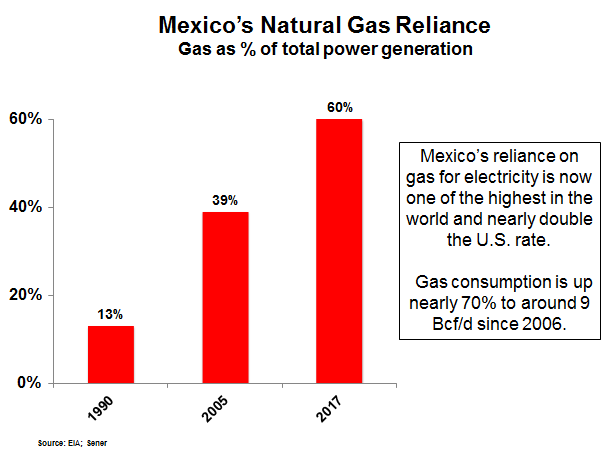
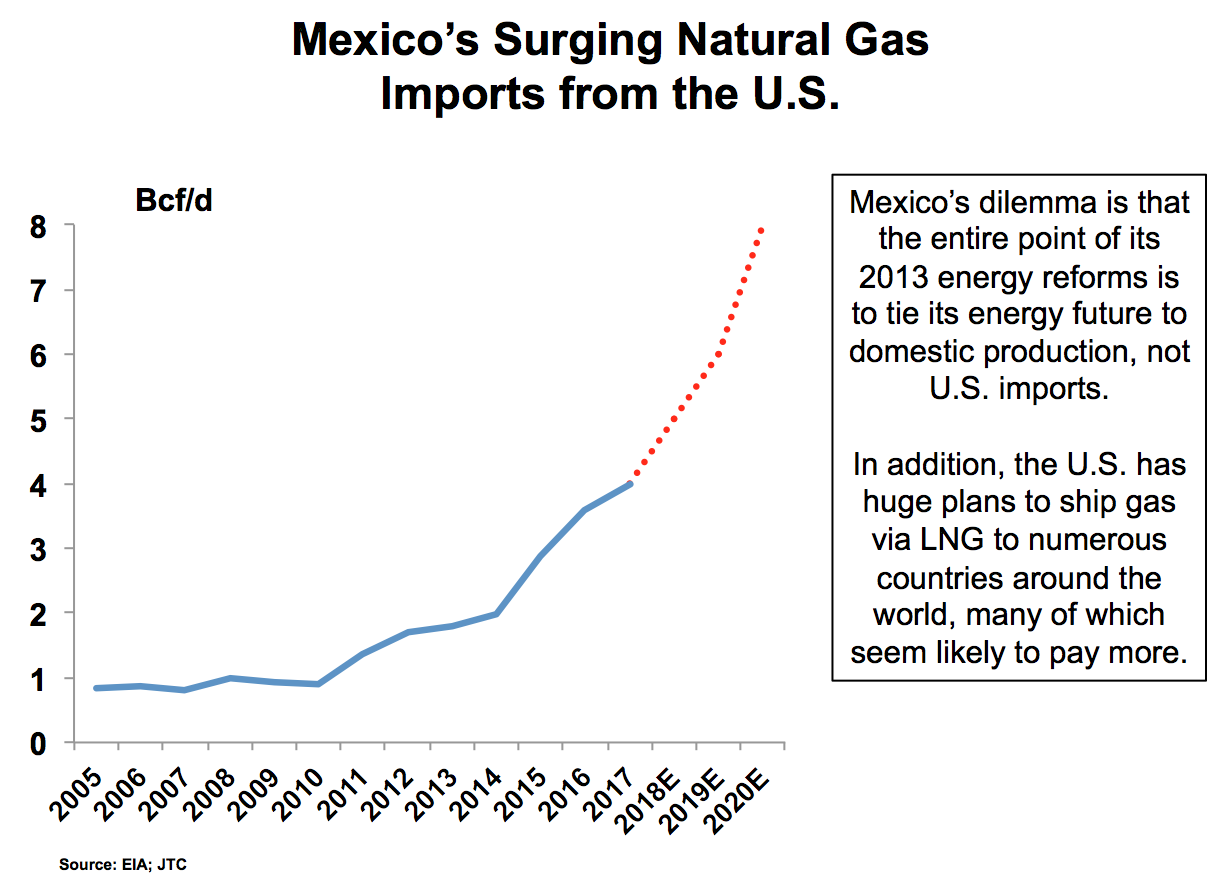
Despite rapidly declining production, Mexico is one of the most natural gas dependent nations on Earth. Gas now supplies 45 percent of all energy and 60 percent of electricity. Mexico has been forced to increasingly depend on cheaper piped imports from the U.S., which at 4.5 Bcf/d now account for about 55 percent of Mexico’s total gas usage. Much more gas will be required. Per capita, Mexico’s 130 million citizens consume just a third of the electricity that other OECD nations do. Additionally, there is a manufacturing boom in Mexico, namely in the automotive industry that will use increasing amounts of natural gas.
Currently with no underground sites, gas storage in Mexico will help even the market out — especially during high-demand times — and smooth bottlenecks that needlessly increase prices. Mexico now utilizes three LNG import terminals for short-term balancing, but this pricier supply is a problem for a nation where 50 percent of the people live below the poverty line. Mexico has been the largest buyer of U.S. LNG due to its dearth of pipelines. As seen during Hurricane Harvey, where officials had to force industrials to curtail operations, Mexico remains vulnerable to supply disruptions north of the border.
Today, the promotion of strategic gas inventories by the Mexican government should eventually lead to a commercial storage business with long-term, large-scale options. To start, the Energy Ministry (Sener) has been crafting a draft on storage policy, with the key proposal being a strategic reserve mandate for Sistrangas, the state-owned operator of Mexico’s largest pipeline network. The main policy requires the National Gas Control Center (Cenagas) to hold 45 Bcf of working gas in storage, which is still just what the country consumes in five days. So obviously, much more needs to be done in Mexico. Other OECD nations hold an average of at least 80 days’ worth of gas in storage.
For a sufficient storage market to emerge, Mexico needs to first better understand the seasonality of its own gas demand. Consumption in the U.S., for instance, can double in winter from summer because of heating needs, and the gas storage market has two phases: a “withdrawal season” from November–March and an “injection season” from April–October. Although not as dramatic, Mexico’s gas demand does peak in summer when hot temperatures surge electricity demand for air conditioners. To illustrate, U.S. gas exports to Mexico have typically been 35–50 percent higher in summer than winter.
Following the U.S. model, gas storage in Mexico also hinges on the private sector developing price indexes at pipeline interconnections and allowing regional price differences to materialize. Long reliant on U.S. gas based on price points at Henry Hub and Houston Ship Channel, Mexico seeks its own hub pricing system. This should occur sometime this year, likely first starting in the manufacturing hub of Monterrey, the capital city of the northeastern state Nuevo León. Going forward, rising trading volumes should help grow the immature market as well. Ultimately, commercial gas storage could become a viable business in Mexico within three to five years at the earliest.
Mexico wants a domestic gas storage option that can offer attractive prices that don’t include transport adders, like users must now pay to import gas from the U.S. But it will be difficult to compete with the U.S. storage market, which is the largest and most dynamic in the world. Existing U.S. gas storage sites are immense, with a working capacity of ~4,700 Bcf at 385 storage fields. Many of these have been operating for decades and enhance liquidity by offering short-term contracts.
The U.S. South Central is the closest source of storage for Mexico, and the region’s working gas in storage currently sits at 703 Bcf, which is 293 Bcf lower than this time last year and 199 Bcf below the previous five-year average. And opening up more opportunities for American sellers, U.S. gas pipeline gas capacity into Mexico will reach 15 Bcf/d by 2020, a 50 percent rise from today.
But Mexico’s deregulation is about upgrading energy security with increased self-sufficiency, not spiraling dependence on the U.S. Andrés Manuel López Obrador, the current favorite for Mexico’s July presidential election, has made this clear and has suggested a return to the old days of resource nationalism. Mexico also realizes that the huge U.S. LNG export build-out means that loads of gas will be leaving the country, destined for the booming markets in Asia. Both China and India have proven willing to pay more for energy and sign long-term contracts to ensure supply.
As such, the good news is that Mexico’s recent reforms have widened investment opportunities and brought in new producers. For example, although still small-scale, there are now about 18 non-Pemex and non-CFE gas sellers in the nation. And with an EIA-reported 550,000 Bcf of recoverable shale gas, development should start in Mexico in the early-2020s, especially bolstered by more suppliers, rising prices, and enhanced security against narco-traffickers.
Additionally, current and potential non-state producers were encouraged by Mexico’s Energy Regulatory Commission’s (CRE) decision last June to eliminate the maximum price that natural gas can be sold at “first-hand sales.” Freed from the hands of state control, this is another step for the immature market to finally incorporate the true value of natural gas — increasingly Mexico’s most vital fuel.

The strategic value of the pipelines
en Pipelines, Reforma energética de MéxicoThe Five-Year Expansion Plan of the National Integrated Natural Gas Transportation and Storage System 2015-2019 contemplates the construction of more than 5,000 km of natural gas pipelines, with an estimated investment of close to 10,000 million dollars. For its elaboration, the National Infrastructure Program 2014-2018 was taken as a basis, in which the gas pipeline construction projects are planned, with an approach that seeks to guide the integral functionality of the new infrastructure of the country.
On the other hand, the main objective of the Quinquennial Plan is to bring natural gas, considered the most efficient fuel and of intensive use, to different areas of the country, among which are Hidalgo, Puebla, Veracruz, Aguascalientes, Durango, Michoacán, Guerrero, San Luis Potosi, Chihuahua, Sonora, Oaxaca, Tamaulipas and Nuevo Leon, especially in industrial areas and those where up to now this hydrocarbon has not been accessed.
The foregoing is in line with one of the objectives of the Energy Reform, consisting of the safe, reliable and competitive supply of natural gas.
These new gas pipelines will be added to the more than 10,000 km already existing, and will increase the capacity of transportation of natural gas by 50%.
It is worth mentioning that the expansion of the gas pipeline network can bring with it a greater possibility of accidents, considering that the pipelines are one of the means of transport that present a greater frequency and severity of accidents, due to the fact that they are exposed to various hazards as: explosion, fire, natural phenomena and ill-intentioned acts.
Therefore, it is very important that during the construction and operation of the pipelines, the insurance coverage is adequate for the complexity of this means of transport, for which it must be taken into account that the damages may affect the infrastructure, people, their assets and the environment.
In NRGI Broker we are experts in designing comprehensive insurance schemes for the Hydrocarbons Sector, come to us.

Unfinished business: Putting the final touches on the USMCA
en Mercados internacionales, Reforma energética de MéxicoThe Hill / David L. Goldwyn / October 29
The proposed US Mexico Canada Agreement (USMCA) makes important, but incomplete, progress in securing an integrated North American energy market.
In terms of progress, the agreement preserves zero tariffs for trade in oil, gas and petroleum products across North America. It effectively locks in Mexico’s historic energy reforms by ensuring that Mexico cannot reinstate restrictions on US investment in the oil and gas sector. A “ratchet” clause ensures that if Mexico decides to further liberalize the sector, then that higher floor becomes the new USMCA commitment.
While Investor-state dispute settlement (ISDS) mechanisms are weaker, they remain in force for certain “covered sectors,” including oil and gas investments in Mexico and power generation and pipeline investments where the investor has a contract with the government.
These are all positive steps for North American energy security. Mexico and Canada provide the United States with the heavy grades of oil not produced domestically, helping US refineries produce gasoline at the lowest possible cost. Thanks to this relationship, the United States is an efficient net exporter of petroleum products.
However, while this progress is laudable, it remains incomplete.
In the rush to conclude the agreement, effective protection for power generation investments like new wind and solar plants, refining and natural gas infrastructure, and power transmission lines were left out, perhaps inadvertently. Contracts for these investments are with state owned enterprises (SOEs) like Mexico’s CFE and PEMEX, which do not now fall within the definition of “federal government” because they are not disposing of assets but signing a contract for service. These essential investments, in the gas and refined product infrastructure which carry US products to and through Mexico, transmission lines which carry US electricity south, and investments in power generation are not permitted to bring ISDS claims to enforce their rights.
This is an oversight, and a protection these investments should enjoy. Rather, the proposed agreement creates an uneven playing field as investors who do have a contract with the Federal government, say for exploration, are entitled to bring an ISDS claim for any of their businesses, while those who do not have such contract do not. The problem can be easily fixed by expanding the definition of federal government to include these wholly owned SOEs.
These (for now) unprotected investments are critical to North American energy security. They secure US exports of electricity and natural gas and assure the continued reliability of the North American electricity system. They are the lifelines which carry US exports to Mexico – currently our number one customer for natural gas and petroleum products.
Protecting investments in Mexico’s electricity sector improves US national security by supporting Mexico’s prosperity through a more resilient power system.
Finally, if US power sector investments in Mexico are not protected and thus potentially hindered or lost, China is certain to fill the gap.
Chinese investment in all forms of power generation, transmission, and distribution is rapidly accelerating throughout Latin America. According to a recent Atlantic Council report, cumulative flows of Chinese foreign direct investment in Latin America have reached $110 billion, with $25 billion in oil and gas investment, and $13 billion in electricity, utilities and alternative energy. China’s State Grid has invested $7 billion in Brazil, through a combination of greenfield investments and acquisitions.
If the Mexican government is willing to offer these investments protections (and they are), and create a level playing field for American companies investing in our closest neighbor, the US should not object.
Fortunately, there is still time to correct the definition of eligible claimants as both sides ready the agreement for ratification. With these modest steps, the United States, Mexico and Canada can improve the resilience of North America’s energy system, and the US can simultaneously advance its economic and national security interests.
David L. Goldwyn is president of Goldwyn Global Strategies, an international energy advisory consultancy and serves as chairman of the Atlantic Council Global Energy Center Energy Advisory Group. He served as the U.S. State Department’s special envoy and coordinator for international energy affairs from 2009 to 2011; he previously served as assistant secretary of energy for international affairs and as national security deputy to U.S. Ambassador to the United Nations Bill Richardson. He is a member of the U.S. National Petroleum Council and the Council on Foreign Relations.
The Hill / David L. Goldwyn / October 29

Oil industry encouraged by Trump’s trade deal with Mexico
en Mercados internacionales, Reforma energética de México
President Trump’s announcement with Mexico on Monday is being taken as an encouraging sign by the U.S. oil and natural gas industry.
“We are encouraged that negotiators have reached a preliminary agreement to modernize our trade relationships,” said Mike Sommers, the new president and CEO of the American Petroleum Institute, the oil industry’s top lobbyist in Washington.
“America’s natural gas and oil industry depends on trade to continue to grow U.S. jobs and our economy, and deliver for consumers,” he added.
Trump announced Monday morning that progress had been made toward a deal with Mexico on renegotiating the North American Free Trade Agreement. Negotiations with Canada, the final piece in the agreement, are still ongoing.
Trump called it a «big day for trade» and the nation in an Oval Office announcement in which he teleconferenced with outgoing Mexican President Enrique Pena Nieto.
Energy has been a key aspect of the negotiations on a revamped version of NAFTA. However, no announcement on energy trade was made on Monday. The agreement with Mexico centered on ensuring that a higher percentage of automobiles sold in North America are made with parts produced on the continent.
Negotiations on an update to the free trade agreement had stalled in recent months amid disagreements over, among other things, provisions related to the automotive and energy industries. U.S. and Mexican negotiators, however, had made breakthroughs on those issues ahead of Monday’s announcement.
Jesus Seade, the incoming Mexican government’s chief NAFTA negotiator, said Sunday the energy issues have been “ironed out,” without going into detail, Reuters reported.
Mexico has become a large importer of U.S. natural gas and oil in recent years. Energy Secretary Rick Perry had visited Mexico ahead of Monday’s announcement. He was there to discuss «how the U.S. and Mexico can continue to work together to make North America a world-wide leader in energy production and exports,» Perry said last week in a tweet.
Washington Examiner/ John Siciliano / August 27

NRGI Broker
Somos el enlace entre los riesgos que enfrentan las industrias del sector energético con las soluciones para administrarlos y respaldarlos mediante esquemas confiables de garantías financieras.
Contáctanos
Prolongación Paseo de la Reforma 1015 Torre A Piso 21. Col. Desarrollo Santa Fe, Contadero, C.P. 05348 CDMX, México
Tel: +52 (55) 9177 2100
Horario de Atención
Lunes – Viernes: 7:30-18:00
Contáctanos: [email protected]