• Link to Facebook
  • Link to X
  • Link to LinkedIn
  • Link to Youtube
  • Inicio
  • NOSOTROS
  • SECTORES
    • ENERGÍA
      • Eléctrico
      • Petróleo y Gas
      • Renovables
    • Marítimo
    • INFRAESTRUCTURA
      • Puertos
      • Ductos
      • Carreteras
      • Edificios
      • Vías Férreas
      • Terminales de almacenamiento
  • SEGUROS
    • EMPRESAS
      • RESPONSABILIDAD CIVIL
        • Responsabilidad Ambiental
        • Responsabilidad Civil
        • Responsabilidad Civil Profesional
      • MARÍTIMO
        • Puertos y Terminales
        • Responsabilidad Civil Portuaria
        • Casco y P&I
        • Carga
        • Responsabilidad Civil del Fletador
      • DAÑOS
        • Daño Material
        • Múltiple Empresarial
        • Pérdida de Beneficios
      • CONSTRUCCIÓN
        • Construcción y Montaje
        • Obra Civil Terminada
      • MAQUINARIA Y EQUIPO
        • Equipo de Contratistas
      • EXPLORACIÓN Y EXTRACCIÓN
        • Control de Pozos
      • Aviación y Drones
      • Transporte
    • PERSONAS / BENEFICIOS
      • Vida Colectivo
      • Gastos Médicos Mayores Colectivo
      • Accidentes Personales
    • Hogar
    • AUTOS
      • Flotillas Autos y Camiones
      • Autos, Pickups y Camiones individuales
    • LINEAS FINANCIERAS
      • Cyber
      • Errores y Omisiones (E&O)
      • Directores D&O
      • Crime
  • FIANZAS
    • Licitación
    • Anticipo
    • Cumplimiento
    • Buena Calidad
    • Contingencias Laborales
    • Arrendamiento
    • Fiscales
    • Daños y Perjuicios
    • Fidelidad
    • Suministro Combustibles
    • Aduanales
  • BLOG
  • Noticias
  • CONTACTO
  • Click to open the search input field Click to open the search input field Buscar
  • Menú Menú

Listado de la etiqueta: US

Mexico to Discuss Security With U.S. in Parallel to Nafta

en Mercados internacionales

From: Bloomberg / Eric Martin / 11 de Diciembre de 2017


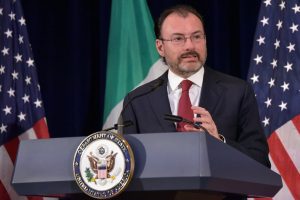
Mexico’s top diplomatic and interior officials will visit Washington this week to discuss security cooperation with their U.S. counterparts at the same time that negotiators work to overhaul Nafta, according to four people familiar with the plans.


The visit by Mexican Foreign Relations Minister Luis Videgaray and Interior Minister Miguel Angel Osorio Chong to meet with Secretary of State Rex Tillerson and Homeland Security Secretary Kirstjen Nielsen on Thursday is a follow-up to meetings in May, according to the people, who asked not to be named before the agenda is made public. It’s aimed at coming up with strategies to combat transnational criminal organizations, the people said. The press office of the Mexican Foreign Ministry and the U.S. State Department declined to immediately comment.


The meetings coincide with a sitdown by negotiators from the U.S., Mexico and Canada to update the North American Free Trade Agreement at the demand of U.S. President Donald Trump, who says the deal is responsible for hundreds of thousands of lost manufacturing jobs in the U.S. In an interview last month, Videgaray said that if the Nafta renegotiation encounters trouble, it could impact other areas of cooperation with the U.S. such as security and immigration. Mexico this year has seen homicides surge to the highest levels of this century, surpassing the previous record levels of the drug war from 2010 to 2012.

“It’s good for Mexico that we cooperate with the U.S. on security and also on migration and many other issues,” Videgaray said in the interview in Vietnam on Nov. 11. “But it’s a fact of life and there is a political reality that a bad outcome on Nafta will have some impact on that,” he said. “We don’t want that to happen, and we’re working hard to get to a good outcome.”

Videgaray told reporters last month that Mexico is prepared for the end of Nafta if it can’t reach a deal with the U.S. and Canada that benefits the nation. The three countries in August began talks to rework the pact after Trump pledged during the 2016 campaign to overhaul or end it.

This Week’s Talks

The latest meetings to revamp Nafta, taking place at the Mayflower Hotel, will run through Friday, largely out of the spotlight. Cabinet-level officials aren’t scheduled to attend for the second time since negotiations began, and the Trump administration is preoccupied with efforts to push through tax cuts by year-end and avoid a government shutdown. Videgaray’s portfolio includes the broad bilateral relationship with the U.S., while a team led by Economy Minister Ildefonso Guajardo has been focused on the commercial details of the Nafta negotiation.

videgaray


From: Bloomberg / Eric Martin / 11 de Diciembre de 2017

https://nrgibroker.com/wp-content/uploads/2017/12/videgaray.jpg 684 1024 admin https://nrgibroker.com/wp-content/uploads/2025/12/logo-nrgi.svg admin2026-05-11 19:27:032026-05-11 19:51:13Mexico to Discuss Security With U.S. in Parallel to Nafta

Canada trade minister pushes quick ratification of trade deal with Asia Pacific

en Mercados internacionales

The Business Times / AFP / September 18


[OTTAWA] Canada’s trade minister on Monday signalled that the government will push ratification of the Trans Pacific Partnership quickly through parliament, as stalled North American free trade talks have raised concerns it could lose its privileged access to the US market.

«Rapid ratification of the TPP» will mean «farmers, ranchers, entrepreneurs and workers across the country can finally tap into new markets,» trade minister Jim Carr said in a speech to parliament.

Signed in March without the United States, the Trans-Pacific Partnership will come into effect 60 days after ratification by at least six of the 11 signatories – Australia, Brunei, Canada, Chile, Japan, Malaysia, Mexico, New Zealand, Peru, Singapore and Vietnam.

The trading bloc represents 500 million consumers and 13 percent of the world’s economic output.

Ottawa wants to be among the first six TPP signatories, but is facing pushback from the powerful union representing Canadian auto workers. Unifor wants stricter labour standards written into the pact and for negotiations with the United States and Mexico to revamp the North American Free Trade Agreement completed first.

High-level talks ended last week with no deal, and no date has been set yet for Canada’s foreign minister Chrystia Freeland to return to Washington to continue negotiations.

For Canada, implementing the TPP is «of paramount importance,» said Mr Carr, if only to act as a counterbalance to growing US protectionism under US President Donald Trump, who has threatened to cut Canada out of a new continental trade deal if Ottawa didn’t give in to his demands.

«This is not just a new trade agreement for Canada, it is also a message we send to the rest of the world: trade is important, the rules are important and we will not give in to protectionism,» the minister said.


The Business Times / AFP / September 18


https://nrgibroker.com/wp-content/uploads/2018/09/Canada-1.png 597 960 Soporte https://nrgibroker.com/wp-content/uploads/2025/12/logo-nrgi.svg Soporte2018-09-18 15:42:062026-05-11 19:51:16Canada trade minister pushes quick ratification of trade deal with Asia Pacific

Oil industry encouraged by Trump’s trade deal with Mexico

en Mercados internacionales, Reforma energética de México
Washington Examiner/ John Siciliano / August 27


President Trump’s announcement with Mexico on Monday is being taken as an encouraging sign by the U.S. oil and natural gas industry.

“We are encouraged that negotiators have reached a preliminary agreement to modernize our trade relationships,” said Mike Sommers, the new president and CEO of the American Petroleum Institute, the oil industry’s top lobbyist in Washington.

“America’s natural gas and oil industry depends on trade to continue to grow U.S. jobs and our economy, and deliver for consumers,” he added.

Trump announced Monday morning that progress had been made toward a deal with Mexico on renegotiating the North American Free Trade Agreement. Negotiations with Canada, the final piece in the agreement, are still ongoing.

Trump called it a «big day for trade» and the nation in an Oval Office announcement in which he teleconferenced with outgoing Mexican President Enrique Pena Nieto.

Energy has been a key aspect of the negotiations on a revamped version of NAFTA. However, no announcement on energy trade was made on Monday. The agreement with Mexico centered on ensuring that a higher percentage of automobiles sold in North America are made with parts produced on the continent.

Negotiations on an update to the free trade agreement had stalled in recent months amid disagreements over, among other things, provisions related to the automotive and energy industries. U.S. and Mexican negotiators, however, had made breakthroughs on those issues ahead of Monday’s announcement.

Jesus Seade, the incoming Mexican government’s chief NAFTA negotiator, said Sunday the energy issues have been “ironed out,” without going into detail, Reuters reported.

Mexico has become a large importer of U.S. natural gas and oil in recent years. Energy Secretary Rick Perry had visited Mexico ahead of Monday’s announcement. He was there to discuss «how the U.S. and Mexico can continue to work together to make North America a world-wide leader in energy production and exports,» Perry said last week in a tweet.


Washington Examiner/ John Siciliano / August 27


https://nrgibroker.com/wp-content/uploads/2018/08/Oil-industry-encouraged-by-Trumps-trade-deal-with-Mexico.png 400 600 Soporte https://nrgibroker.com/wp-content/uploads/2025/12/logo-nrgi.svg Soporte2018-08-28 13:17:152026-05-11 19:51:17Oil industry encouraged by Trump’s trade deal with Mexico

Trump deal with Mexico eases fears of trade wars, offers template to end other conflicts

en Mercados internacionales

Market Watch / Jeffry Barthash / August 27


That sound of ice thawing? It’s the Trump administration’s tentative deal with Mexico to rewrite the controversial Nafta free-trade pact, the first clear evidence the White House is willing to compromise on its hardline demands and avert ruinous trade wars.

News of the deal sent U.S. markets surging Monday. The Nasdaq Composite IndexCOMP, +0.17%  topped 8,000 points and the S&P 500 SPX, +0.06%  index almost hit 2,900, both touching record highs. The Dow Jones Industrial AverageDJIA, +0.15%   jumped nearly 260 points to surpass 26,000.

Details of the pending agreement are sketchy for now. Senior White House officials suggested the new pact would result in more new cars and trucks being made in the U.S. using steel and other materials produced in North America. That was one of President Donald Trump’s chief goals.

Other key provisions could lead to higher wages for Mexican auto workers and even give them greater rights to unionize, moves meant to reduce the incentive for U.S. automakers to shift operations south of the border due to lower labor costs.

The new agreement also puts greater emphasis on crafting rules to govern the “digital economy” and protect copyrights and intellectual-property rights, areas in which the U.S. is a global leader.

“I think this is an extremely historic time,” said Robert Lighthizer, the chief U.S. trade negotiator, in a call with reporters. “We had a Nafta agreement that got seriously out of whack … and needed modern updating.”

A deal is far from done, of course. Canada is the third country that was party to the original North American Free Trade Agreement signed in 1994, but negotiations have been at a standstill. The White House hopes Canada will now rejoin the talks and quickly join with the U.S. and Mexico to ratify a successor agreement to Nafta.

“We hope that Canada can join in now,” Lighthizer told reporters Monday. Talks are expected to resume soon, and at this point, it’s unlikely that any Nafta successor would be voted upon until the next Congress convenes in early 2019.

The Canadians and no doubt the Europeans and Chinese are likely to comb over the details of the agreement. The U.S. is sure to use the deal with Mexico as a template for negotiations in talks with other countries to update trade rules that Trump has long complained are unfair.

What the Mexico deal also shows, though, is the Trump administration is ready to compromise on some of its toughest demands. The U.S., for instance, dropped its insistence on a hard “sunset” clause that would cause the trade deal to expire after a certain number of years.

“Despite the Trump administration’s intransigence over trade disputes in recent months, it is willing to negotiate in good faith and accept a compromise, which will be welcomed in both China and Europe,” contended Paul Ashworth, chief U.S. economist at Capital Economics.

The new pact calls for the U.S. and Mexico to review an updated North American free-trade deal six years into a 16-year window. The countries could extend the pact another 16 years at any point after that six-year period.

The U.S. also appears to have softened its demand for an end to an arbitration process for determining if a country was violating the trade agreement. Industries in the U.S. mostly support the current process for resolving problems and lobbied the White House to back off.

Yet even if the agreement is not entirely what the White House wanted, the deal with Mexico allows Trump to claim partial victory for his “America First” policy.

What’s more, the deal will go a long way in easing tensions on Wall Street and in Washington that Trump’s tough talk on trade would ignite a conflagration damaging to economies all around the world.

Major industry lobbying group and trade experts were cautiously optimistic after the White House deal.

It’s “a victory for rationality over rhetoric,” said Steve Nelson, a partner at the law firm Dorsey & Whitney and a former state department lawyer.


Market Watch / Jeffry Barthash / August 27


https://nrgibroker.com/wp-content/uploads/2018/08/Captura-de-pantalla-2018-08-28-a-las-13.06.33.png 399 599 Soporte https://nrgibroker.com/wp-content/uploads/2025/12/logo-nrgi.svg Soporte2018-08-28 13:07:122026-05-11 19:51:17Trump deal with Mexico eases fears of trade wars, offers template to end other conflicts

Mexican energy sector overhaul could reduce U.S. export demand

en Reforma energética de México

Chron / Katherine Blunt / August 6


An ambitious plan to boost Mexico’s oil and gas production could potentially slow the country’s energy sector reforms and hinder trade opportunities for U.S. refiners and pipeline companies that have ramped up exports to meet growing demand there, according to research firm Morningstar.

Mexican president-elect Andrés Manuel López Obrador announced late last month a plan to invest billions of dollars in Pemex, the country’s state-owned energy company, in an effort to  reverse years of declining production. He also reaffirmed his intent to review more than 100 exploration and production contracts awarded to private oil and gas companies since the 2013 reforms, which opened the country’s energy sector to foreign investment for the first time in decades.

Mexico’s energy reforms are enshrined in its constitution, and López Obrador has said that he will he will honor existing contracts so long as they don’t reveal corruption. But Morningstar noted that any effort to scale back the reforms or increase Mexican energy production could jeopardize some $200 billion in outside investments planned for the country’s oil and gas, power, refining and distribution sectors.

Part of López Obrador’s plan involves investing $2.6 billion to upgrade the nation’s six existing refineries as well as building a new, $8.6 billion refinery at the oil port of Dos Bocas in Tabasco. The country’s existing refineries have been operating at less than 70 percent capacity since 2012, according to Mexico’s energy department, requiring the country to import more gasoline, diesel, jet fuel and other refined products.


Chron / Katherine Blunt / August 6


https://nrgibroker.com/wp-content/uploads/2018/08/shutterstock_186351839-e1533665411749.jpg 433 600 Soporte https://nrgibroker.com/wp-content/uploads/2025/12/logo-nrgi.svg Soporte2018-08-07 13:10:482026-05-11 19:51:18Mexican energy sector overhaul could reduce U.S. export demand

California-based energy company building $150 million Mexico fuels terminal

en Reforma energética de México

Chron / Rye Druzin, Staff Writer / July 12


A California energy company is moving ahead with a $150 million fuels terminal in the Mexican state of Sinaloa.

Sempra Energy of San Diego is building the fuels terminal in Topolobampo, Mexico through its Mexican subsidiary Infraestructura Energética Nova, S.A.B. de C.V. or IEnova after the company secured a 20 year contract with the Topolobampo Port Administration.

The first phase of the project will have a storage capacity of 1 million barrels for fuels including gasoline and diesel. Sempra Energy expects operations to start in the fourth quarter of 2020.

In April Sempra Energy announced that IEnova would build a $130 million, 1 million barrel fuels terminal at Ensenada, a city in the Mexican state of Baja California.

San Antonio refiner Valero Energy Corp., the largest independent refiner in the U.S., signed a deal in August with IEnova to export refined product into Mexico. The gasoline, diesel and jet fuel would ship to new $155 million storage terminals IEnova will build in the Gulf of Mexico port city of Veracruz. Other storage terminals will be constructed in Puebla, southeast of Mexico City, and in Mexico city itself, to the tune of $120 million.


Chron / Rye Druzin, Staff Writer / July 12


https://nrgibroker.com/wp-content/uploads/2018/07/Copia-de-Fotolia_6161179_Subscription_L-e1531860393677.jpg 399 600 Soporte https://nrgibroker.com/wp-content/uploads/2025/12/logo-nrgi.svg Soporte2018-07-17 15:46:572026-05-11 19:51:19California-based energy company building $150 million Mexico fuels terminal

US launches five dispute actions in WTO challenging China, EU, Canada, Mexico and Turkey

en Mercados internacionales

Merco Press / REUTERS / Yuri Gripas / 17 July


The United States launched five separate World Trade Organization dispute actions on Monday challenging retaliatory tariffs imposed by China, the European Union, Canada, Mexico and Turkey following U.S. duties on steel and aluminum. The retaliatory tariffs on up to a combined US$28.5 billion worth of U.S. exports are illegal under WTO rules, U.S. Trade Representative Robert Lighthizer said in a statement.

“These tariffs appear to breach each WTO member’s commitments under the WTO Agreement,” he said. “The United States will take all necessary actions to protect our interests, and we urge our trading partners to work constructively with us on the problems created by massive and persistent excess capacity in the steel and aluminum sectors.”

Lighthizer’s office has maintained that the tariffs the United States has imposed on imports of steel and aluminum are acceptable under WTO rules because they were imposed on the grounds of a national security exception.

Mexico said it would defend its retaliatory measures, saying the imposition of U.S. tariffs was “unjustified.”

“The purchases the United States makes of steel and aluminum from Mexico do not represent a threat to the national security,” Mexico’s Economy Ministry said in a statement.

“On the contrary, the solid trade relationship between Mexico and the U.S. has created an integrated regional market where steel and aluminum products contribute to the competitiveness of the region in various strategic sectors, such as automotive, aerospace, electrical and electronic,” the ministry added.

Lighthizer said last month that retaliation had no legal basis because the EU and other trading partners were making false assertions that the U.S. steel and aluminum tariffs are illegal “safeguard” actions intended to protect U.S. producers.


Merco Press / REUTERS / Yuri Gripas / 17 July


https://nrgibroker.com/wp-content/uploads/2016/10/shutterstock_349461494.jpg 400 600 Soporte https://nrgibroker.com/wp-content/uploads/2025/12/logo-nrgi.svg Soporte2018-07-17 14:06:512026-05-11 19:51:19US launches five dispute actions in WTO challenging China, EU, Canada, Mexico and Turkey

Amlo and the realities of Mexico’s oil reform

en Mercados internacionales, Reforma energética de México

Petroleum Economist / Craig Guthrie / July 9


The Mexican president-elect needs a strong oil and gas sector to fund a promised social transformation

The investor-friendly tone Mexican president-elect Andres Manuel Lopez Obrador, widely known as Amlo, struck in the run-up to his landslide victory on 1 July is fueling confidence he will tweak rather than dismantle the energy reforms that are enticing international oil companies to the country.

Prospects of an Amlo presidency had stirred concerns among investors for months ahead of the vote—he’s the first leftist Mexican president since the 1930s, and has forged an anti-elitist platform calling for a reordering of the political landscape. And yet the peso gained more than 2% against the US dollar in the hours after the result.

«This can be a presidency ruled by reason and legality,» Ixchel Castro, manager of Latin American oils and refining markets research with Wood Mackenzie, tells Petroleum Economist, while pointing to the currency market’s reaction and the links he’s built with Mexican business elites. «There may be change in the emphasis of the energy reforms, but we see a reversal as highly unlikely».

Launched by outgoing President Enrique Peña Nieto in 2013, the reforms ended Pemex’s 75-year monopoly over the energy sector. So far, auctions in January and March jointly lured at least $100bn in oil exploration investment commitments from more than 70 different firms—useful revenue for a president who has promised sweeping social changes to tackle crime, corruption and poverty.

Amlo made opposition to the reforms a bedrock of his failed 2013 presidential bid, and told a rally just four months ago that he would never allow Mexican crude to return to the hands of foreigners. But a reversal in tack since has seen his top business adviser and nominee for chief of staff, Alfonso Romo, lead a pro-business public relations drive towards international investors.

Romo told Reuters on 25 June that there could be more auctions of oil drilling rights, as long as a review of contracts that have already been awarded to private companies showed no problems. «We will revise them and everything good will remain,» he said, noting that Amlo had said this directly to investors in New York.

But it’s not expected to be all smooth sailing for foreign oil investment under Amlo’s watch. Uncertainty over the long-term goals of his populist agenda will likely continue to unnerve companies looking to establish a steady pipeline of projects.

«Amlo will likely enjoy the benefits from the existing contracts that have been awarded, especially in terms of oil barrels produced, fiscal revenue received and jobs created. By the third year of his administration he can claim that Mexico is producing more oil under his presidency,» Duncan Wood, director of the Mexico Institute at the Woodrow Wilson International Centre wrote in an e-mail.

«But he will be reluctant to continue the bidding rounds. The one possible exception that I see would be in deep waters and in farm-outs from Pemex.»

Mexico plans to auction 37 onshore areas and nine in the shale gas-rich Burgos Basin on 27 September, as well as the farm-out of seven onshore areas with Pemex on 31 October.

Amlo’s approach to a planned re-shaping of Pemex is seen as the next critical indicator of his eventual intentions on the country’s energy direction.

While the president has pledged to resurrect Pemex into a strong national oil company through cost-cutting, this comes amid a significant decline in domestic energy production—from 3.4m barrels of oil a day in 2004 to 1.9m b/d in 2018.

«Pemex must be forced to compete in order to become stronger,» said Wood. «If the reform process is stopped, Pemex would gain from a strengthening of its position in the short-term. But in the long term its competitiveness and productivity could be severely damaged.»


Petroleum Economist / Craig Guthrie / July 9


https://nrgibroker.com/wp-content/uploads/2018/07/Fotolia_8365763_Subscription_L-e1531247131209.jpg 469 600 Soporte https://nrgibroker.com/wp-content/uploads/2025/12/logo-nrgi.svg Soporte2018-07-10 13:26:062026-05-11 19:51:19Amlo and the realities of Mexico’s oil reform

Trump and Mexico’s New Leader, Both Headstrong, Begin With a ‘Good Conversation’

en Mercados internacionales

The New York Times / Michael D. Shear and Ana Swanson / July 2


WASHINGTON — President Trump reached out to Mexico’s new populist president-elect on Monday in an early, but potentially short-lived, show of détente, saying the two leaders engaged in a “good conversation” about border security and the North American Free Trade Agreement.

The two countries remain locked in a heated dispute over the fraught issues of immigration and trade, areas that may face difficult complications from the election of Andrés Manuel López Obrador, a leader known for being as strong-headed and nationalist-minded as Mr. Trump — and just as willing to engage in a public clash of ideas.

Mr. López Obrador, who has said Mexico will not be a “piñata” for foreign governments, has said he will stand up to Mr. Trump to protect his country’s interests. And he may find himself under pressure by an electorate that, weary of Mr. Trump’s hectoring and disparaging comments about Mexico, will demand that he cede no ground, leaving little room to manage the relationship.

“There are going to be so many opportunities for this to go wrong,” said Duncan Wood, the director of the Wilson Center’s Mexico Institute. “If there are too many provocations, if there are too many insults against Mexico, López Obrador will not be able to just sit back and take it. His character shows that he will respond, and that could lead us down a dark path.”

Relations between Mexico and the United States are already tense, particularly over trade and the future of Nafta, which has enabled companies to create critical supply chains across North America. Talks to revise the trade pact among Mexico, the United States and Canada have stalled over dramatic changes proposed by the Trump administration, including altering protections for investors and rules for manufacturing automobiles in North America.

Mr. López Obrador has been a longtime critic of the 1994 trade pact and has given no indiction he will be more willing to accommodate Mr. Trump’s demands than the current Mexican government. Among other things, Mr. López Obrador has blamed Nafta for triggering an influx of grain from the United States that ultimately forced Mexican farmers off their land.

But Mr. López Obrador has pledged to continue to renegotiate Nafta — a promise that could ultimately put him in the position of defending the trade agreement against the frequent criticisms of Mr. Trump, who has called it the “worst” trade deal in history and blamed Mexico for siphoning off American jobs. Mr. López Obrador’s advisers have said they will start working with the current Nafta negotiators soon to ensure a smooth transition when the new administration takes office on Dec. 1.

The president-elect has also taken a far more critical view than his predecessor of corporations — which have among the most to win or lose with a revised Nafta. He has long criticized the role of multinational corporations in Mexico and once promised to turn the presidential palace into a public park. He has promised to review dozens of outstanding oil and gas exploration contracts for corruption, potentially delaying hundreds of billions of dollars in foreign investment. His election has put the value of the peso and Mexican government bonds on a more volatile path.

During the campaign, Mr. López Obrador and his advisers worked to reassure voters and industry that he would provide continuity for the private sector.

Known as an anti-establishment candidate, Mr. López Obrador is a divisive figure with Mr. Trump’s flare for capturing attention. After a failed bid for the presidency in 2006 against Felipe Calderón, Mr. López Obrador held a faux inauguration ceremony for himself, appointed a shadow cabinet and protested in the middle of the capital for weeks.

Mr. Trump and Mr. López Obrador spoke for 30 minutes Monday morning after the latter ’s landslide victory Sunday night. The call came just hours after Mr. Trump congratulated Mr. López Obrador in a rare, friendly tweet that said: “I look very much forward to working with him.”

The incoming Mexican president in turn pledged never to “disrespect” the United States government. In a tweet of his own, Mr. López Obrador said there was “respectful treatment” on the call.

Any period of gracious talk may be short lived, however, with Mr. Trump almost certain to continue his tirade about the 2,000-mile border with Mexico, and Mr. López Obrador virtually guaranteed to fire back in ways that his predecessors did not.

Mr. López Obrador “has committed to a louder, more combative posture with the U.S.,” said Carlos M. Gutiérrez, the former secretary of commerce under President George W. Bush. “He’s getting ready to take it up a notch.”

Mr. Trump campaigned for the presidency by demanding a wall across the southern border and suggesting that people being “sent” from Mexico into the United States are “bringing drugs. They’re bringing crime. They’re rapists.”

More recently, Mr. Trump has escalated his language against Mexico, accusing Democrats in a tweet of wanting “illegal immigrants, no matter how bad they may be, to pour into and infest our Country, like MS-13.”


The New York Times / Michael D. Shear and Ana Swanson / July 2


https://nrgibroker.com/wp-content/uploads/2018/04/EST13133484c784908_0.jpg 617 980 Soporte https://nrgibroker.com/wp-content/uploads/2025/12/logo-nrgi.svg Soporte2018-07-03 16:24:142026-05-11 19:51:20Trump and Mexico’s New Leader, Both Headstrong, Begin With a ‘Good Conversation’

Mexico’s incoming leftist President could open US-Mexico energy relations

en Mercados internacionales, Reforma energética de México

The Daily Caller /Jason Hopkins / July 2


The election of Andrés Manuel López Obrador as Mexico’s next president has investors around the world on edge, waiting to see how the leftist leader will approach the oil and gas industry.

López Obrador handily won Mexico’s presidential election Sunday, capturing over 53 percent of the vote — more than double the percentage of the second-place finisher. His victory brings a new era of progressive populism to the U.S.’ southern neighbor. A member of the National Regeneration Movement Party, López Obrador touts a far-left pedigree: universal access to public colleges, an expansion of welfare programs, increased investment in industries and other big government proposals.

The president-elect’s calls for energy reform, however, has been the most striking to international observers. López Obrador pledged during the campaign to hold a referendum on reforms the country made several years ago that embraced measured degrees of privatization of the country’s oil sector.

Outgoing President Peña Nieto opened the country’s petroleum industry in 2013 to foreign investment, ending a decades-old monopoly held by Pemex, the country’s state-run petroleum company. The move was intended to revive Mexico’s oil and gas production, which is plagued with rampant inefficiency, debt and outdated equipment.

During the 2018 campaign, López Obrador derided these pro-market reforms. While promising to honor existing oil contracts, he believes the country should prioritize nationalization of the industry once again.

“As a long-time ally of national labor unions and a supporter of a strong [Pemex], [López Obrador] may seek to maximize national investment and employment in the sector, hedging Mexico’s political risk, even at the cost of economic efficiency,” David Goldwyn, chairman of the Atlantic’s Global Energy Center Advisory Group, noted Sunday.

Such reforms could have major implications for Mexico-U.S. energy relations, which hold very deep ties.

The U.S. currently exports a large amount of gas across the border and the Mexican government, in turn, sends heavy crude to American consumers. As crude oil imports to the U.S. has declined over the years, the trade imbalance between the two countries has shifted. U.S. energy exports to Mexico now exceeds its imports, according to the Energy Information Administration. These issues may come up as the Trump administration is set to renegotiate key agreements within the North American Trade Agreement with Mexico and Canada.

López Obrador, for his part, is no fan of Trump. The longtime Mexican politician wrote a book entitled “Oye, Trump” (“Listen, Trump”) that blasts the American leader for his calls to build a border wall and his “attempts to persecute migrant workers.” The book includes a number of speeches López Obrador has given. In one such speech, he compared Trump to Hiter, saying “Trump and his advisers speak of the Mexicans the way Hitler and the Nazis referred to the Jews, just before undertaking the infamous persecution and the abominable extermination.”


The Daily Caller /Jason Hopkins / July 2


https://nrgibroker.com/wp-content/uploads/2017/07/shutterstock_292231469.jpg 2000 3000 Soporte https://nrgibroker.com/wp-content/uploads/2025/12/logo-nrgi.svg Soporte2018-07-03 16:12:102026-05-11 19:51:20Mexico’s incoming leftist President could open US-Mexico energy relations
Página 1 de 212

Buscador

Search Search

Categorías

  • Mexicanas Mujeres (14)
  • Mujeres (14)
  • Mujeres Exitosas (15)

Entradas Recientes

  • Rompiendo Barreras. Construyendo el Futuro
  • El Poder Femenino de la Perspicacia en el Mundo Empresarial Mexicano
  • La Secretaría de Marina reconoce a Graciela Alvarez Hoth en el día Internacional de la Mujer en el Sector Marítimo
  • Graciela Álvarez reconocida como una de las pioneras en la industria energética por la revista Oil and Gas Magazine
  • NRGI Broker Presente en el Congreso Mexicano de Petróleo 2022

NRGI Broker

Somos el enlace entre los riesgos que enfrentan las industrias del sector energético con las soluciones para administrarlos y respaldarlos mediante esquemas confiables de garantías financieras.

Contáctanos

Prolongación Paseo de la Reforma 1015 Torre A Piso 21. Col. Desarrollo Santa Fe, Contadero, C.P. 05348 CDMX, México

Tel: +52 (55) 9177 2100

Horario de Atención

Lunes – Viernes: 7:30-18:00
Contáctanos: [email protected]

© Copyright - NRGI Broker | Aviso de Privacidad | Términos y condiciones
  • Link to Facebook
  • Link to X
  • Link to LinkedIn
  • Link to Youtube
Desplazarse hacia arriba Desplazarse hacia arriba Desplazarse hacia arriba