• Link to Facebook
  • Link to X
  • Link to LinkedIn
  • Link to Youtube
  • Inicio
  • NOSOTROS
  • SECTORES
    • ENERGÍA
      • Eléctrico
      • Petróleo y Gas
      • Renovables
    • Marítimo
    • INFRAESTRUCTURA
      • Puertos
      • Ductos
      • Carreteras
      • Edificios
      • Vías Férreas
      • Terminales de almacenamiento
  • SEGUROS
    • EMPRESAS
      • RESPONSABILIDAD CIVIL
        • Responsabilidad Ambiental
        • Responsabilidad Civil
        • Responsabilidad Civil Profesional
      • MARÍTIMO
        • Puertos y Terminales
        • Responsabilidad Civil Portuaria
        • Casco y P&I
        • Carga
        • Responsabilidad Civil del Fletador
      • DAÑOS
        • Daño Material
        • Múltiple Empresarial
        • Pérdida de Beneficios
      • CONSTRUCCIÓN
        • Construcción y Montaje
        • Obra Civil Terminada
      • MAQUINARIA Y EQUIPO
        • Equipo de Contratistas
      • EXPLORACIÓN Y EXTRACCIÓN
        • Control de Pozos
      • Aviación y Drones
      • Transporte
    • PERSONAS / BENEFICIOS
      • Vida Colectivo
      • Gastos Médicos Mayores Colectivo
      • Accidentes Personales
    • Hogar
    • AUTOS
      • Flotillas Autos y Camiones
      • Autos, Pickups y Camiones individuales
    • LINEAS FINANCIERAS
      • Cyber
      • Errores y Omisiones (E&O)
      • Directores D&O
      • Crime
  • FIANZAS
    • Licitación
    • Anticipo
    • Cumplimiento
    • Buena Calidad
    • Contingencias Laborales
    • Arrendamiento
    • Fiscales
    • Daños y Perjuicios
    • Fidelidad
    • Suministro Combustibles
    • Aduanales
  • BLOG
  • Noticias
  • CONTACTO
  • Click to open the search input field Click to open the search input field Buscar
  • Menú Menú

Listado de la etiqueta: Canada

Trump deal with Mexico eases fears of trade wars, offers template to end other conflicts

en Mercados internacionales

Market Watch / Jeffry Barthash / August 27


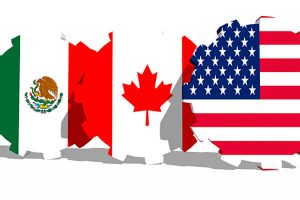
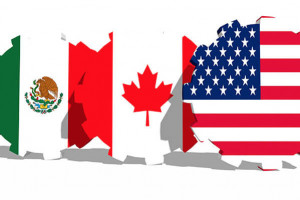
That sound of ice thawing? It’s the Trump administration’s tentative deal with Mexico to rewrite the controversial Nafta free-trade pact, the first clear evidence the White House is willing to compromise on its hardline demands and avert ruinous trade wars.

News of the deal sent U.S. markets surging Monday. The Nasdaq Composite IndexCOMP, +0.17%  topped 8,000 points and the S&P 500 SPX, +0.06%  index almost hit 2,900, both touching record highs. The Dow Jones Industrial AverageDJIA, +0.15%   jumped nearly 260 points to surpass 26,000.

Details of the pending agreement are sketchy for now. Senior White House officials suggested the new pact would result in more new cars and trucks being made in the U.S. using steel and other materials produced in North America. That was one of President Donald Trump’s chief goals.

Other key provisions could lead to higher wages for Mexican auto workers and even give them greater rights to unionize, moves meant to reduce the incentive for U.S. automakers to shift operations south of the border due to lower labor costs.

The new agreement also puts greater emphasis on crafting rules to govern the “digital economy” and protect copyrights and intellectual-property rights, areas in which the U.S. is a global leader.

“I think this is an extremely historic time,” said Robert Lighthizer, the chief U.S. trade negotiator, in a call with reporters. “We had a Nafta agreement that got seriously out of whack … and needed modern updating.”

A deal is far from done, of course. Canada is the third country that was party to the original North American Free Trade Agreement signed in 1994, but negotiations have been at a standstill. The White House hopes Canada will now rejoin the talks and quickly join with the U.S. and Mexico to ratify a successor agreement to Nafta.

“We hope that Canada can join in now,” Lighthizer told reporters Monday. Talks are expected to resume soon, and at this point, it’s unlikely that any Nafta successor would be voted upon until the next Congress convenes in early 2019.

The Canadians and no doubt the Europeans and Chinese are likely to comb over the details of the agreement. The U.S. is sure to use the deal with Mexico as a template for negotiations in talks with other countries to update trade rules that Trump has long complained are unfair.

What the Mexico deal also shows, though, is the Trump administration is ready to compromise on some of its toughest demands. The U.S., for instance, dropped its insistence on a hard “sunset” clause that would cause the trade deal to expire after a certain number of years.

“Despite the Trump administration’s intransigence over trade disputes in recent months, it is willing to negotiate in good faith and accept a compromise, which will be welcomed in both China and Europe,” contended Paul Ashworth, chief U.S. economist at Capital Economics.

The new pact calls for the U.S. and Mexico to review an updated North American free-trade deal six years into a 16-year window. The countries could extend the pact another 16 years at any point after that six-year period.

The U.S. also appears to have softened its demand for an end to an arbitration process for determining if a country was violating the trade agreement. Industries in the U.S. mostly support the current process for resolving problems and lobbied the White House to back off.

Yet even if the agreement is not entirely what the White House wanted, the deal with Mexico allows Trump to claim partial victory for his “America First” policy.

What’s more, the deal will go a long way in easing tensions on Wall Street and in Washington that Trump’s tough talk on trade would ignite a conflagration damaging to economies all around the world.

Major industry lobbying group and trade experts were cautiously optimistic after the White House deal.

It’s “a victory for rationality over rhetoric,” said Steve Nelson, a partner at the law firm Dorsey & Whitney and a former state department lawyer.


Market Watch / Jeffry Barthash / August 27


https://nrgibroker.com/wp-content/uploads/2018/08/Captura-de-pantalla-2018-08-28-a-las-13.06.33.png 399 599 Soporte https://nrgibroker.com/wp-content/uploads/2025/12/logo-nrgi.svg Soporte2018-08-28 13:07:122026-05-11 19:51:17Trump deal with Mexico eases fears of trade wars, offers template to end other conflicts

Mexican president-elect outlines oil sector rescue plans

en

Financial Times / Jude Webber / July 29

Mexico’s incoming president has begun fleshing out his rescue plan for the country’s long-neglected oil sector.

Andrés Manuel López Obrador’s proposals include a $4bn capital injection for state oil company Pemex to boost exploration, a new refinery to slash reliance on US fuel imports and a 600,000 barrel-a-day increase in crude production in two years.

But analysts warn that his nationally focused energy policy risks putting unsustainable pressure on the world’s most indebted oil company. In particular, they point to plans for a 160bn peso ($8.6bn) refinery to be built in his home state of Tabasco over the next three years — an investment equal to the size of Pemex’s loss in the second quarter.

Mr López Obrador has not spelt out how he would fund his proposals but has named Octavio Romero Oropeza, a long-time confidante and agronomist from Tabasco, to take the helm of Pemex. “We are estimating overall investment to rescue the sector of 175bn pesos next year,” said the president-elect, who takes office on December 1.

The cash injection comes as Pemex has seen output fall from a peak of 3.4m barrels a day in 2004 to 1.866m in the second quarter this year.

Mr López Obrador said output was plunging because “the energy sector and oil industry were abandoned”, and has pledged to lift production to 2.5m b/d in two years.

He has yet to make clear whether he intends to continue with oil tenders that have seen more than 100 contracts awarded to 73 companies since 2015 under a landmark reform designed to lift Mexico’s oil output from a four-decade low. The new administration wants at least a temporary pause to oil tenders.

“Four billion dollars is a significant amount, there’s no doubt. But it is important to put it in perspective . . . One single tender round can inject more investment,” said Pablo Zárate at think-tank Pulso Energético.

Mr López Obrador has promised to achieve energy self-sufficiency by spending 49bn pesos upgrading Pemex’s six lossmaking refineries, where output has halved since May 2013, and building two new ones to halt dependence on US gasoline imports, which have increased by a third in the past two years.

But investors are alarmed at the potential for snowballing costs. The price tag for the first new refinery, to be built in Dos Bocas, has already risen from the $6bn Mr López Obrador’s team had previously indicated. “I don’t know of a single refinery that’s ever been done to budget,” said an investor at a large fund who follows Pemex closely.

Pemex, a monopoly for eight decades, has spent the past two years putting its finances in order and making huge outlays on new refineries could be a serious risk, say analysts.

“Pemex today does not have the cash or free cash flow to take on the construction of new refineries, and if the company decided to finance such an investment with debt or shift capital from exploration and production to refining, its credit metrics would weaken,” cautioned Moody’s Investors Service.

Ramping up refinery capacity could lead to Pemex halving the value of lucrative oil exports, it added.

But Mr López Obrador has said his government would keep its promise of halting gasoline imports in three years and would lower fuel prices.

Pemex has net debt of about $106bn and is expected to post earnings before interest, tax, depreciation and amortisation of approximately $25bn this year. With the state taking about 70 per cent of profits in tax, Pemex could bump up its debt to pay for refineries — but it already has hefty debt repayments due in 2019 and 2020.

Mr López Obrador’s team has indicated that it wants to halt oil tenders while it reviews contracts awarded to date and decides on whether and how fast to continue auctions.

Indeed, the government has delayed two upcoming tenders, which include joint ventures with Pemex, until next February.

Adrián Lajous, a former Pemex chief executive, has called for a moratorium on oil auctions until 2020 but said joint ventures with Pemex should resume next year.

Even if oil tenders are put on ice, analysts are urging the new administration to allow Pemex to continue forging joint ventures.

“Partnerships will be needed to grow output — international companies bring capital and technical expertise,” said Ruaraidh Montgomery at Wood Mackenzie.

Above all “Pemex should start partnering with companies that specialise in enhanced oil recovery, given the maturity of its portfolio”, to allow it to squeeze more oil from existing fields, said Pablo Medina at Welligence Energy Analytics.

One radical revamp for Pemex could be to follow the “China model”, said Juan Carlos Zepeda, head of Mexico’s oil regulator, keeping the parent company in state hands, but spinning some assets into a partially listed unit, as China National Petroleum Corp has done.

“I would like us to do the same with Pemex but that would require changing the constitution,” he said.

This article has been amended to correct the amount of oil Pemex plans to increase production by in the next two years.


Financial Times / Jude Webber / July 29


https://nrgibroker.com/wp-content/uploads/2018/07/shutterstock_396121846-e1533075072764.jpg 570 600 Soporte https://nrgibroker.com/wp-content/uploads/2025/12/logo-nrgi.svg Soporte2018-07-31 17:12:082026-05-11 19:51:18Mexican president-elect outlines oil sector rescue plans

US launches five dispute actions in WTO challenging China, EU, Canada, Mexico and Turkey

en Mercados internacionales

Merco Press / REUTERS / Yuri Gripas / 17 July


The United States launched five separate World Trade Organization dispute actions on Monday challenging retaliatory tariffs imposed by China, the European Union, Canada, Mexico and Turkey following U.S. duties on steel and aluminum. The retaliatory tariffs on up to a combined US$28.5 billion worth of U.S. exports are illegal under WTO rules, U.S. Trade Representative Robert Lighthizer said in a statement.

“These tariffs appear to breach each WTO member’s commitments under the WTO Agreement,” he said. “The United States will take all necessary actions to protect our interests, and we urge our trading partners to work constructively with us on the problems created by massive and persistent excess capacity in the steel and aluminum sectors.”

Lighthizer’s office has maintained that the tariffs the United States has imposed on imports of steel and aluminum are acceptable under WTO rules because they were imposed on the grounds of a national security exception.

Mexico said it would defend its retaliatory measures, saying the imposition of U.S. tariffs was “unjustified.”

“The purchases the United States makes of steel and aluminum from Mexico do not represent a threat to the national security,” Mexico’s Economy Ministry said in a statement.

“On the contrary, the solid trade relationship between Mexico and the U.S. has created an integrated regional market where steel and aluminum products contribute to the competitiveness of the region in various strategic sectors, such as automotive, aerospace, electrical and electronic,” the ministry added.

Lighthizer said last month that retaliation had no legal basis because the EU and other trading partners were making false assertions that the U.S. steel and aluminum tariffs are illegal “safeguard” actions intended to protect U.S. producers.


Merco Press / REUTERS / Yuri Gripas / 17 July


https://nrgibroker.com/wp-content/uploads/2016/10/shutterstock_349461494.jpg 400 600 Soporte https://nrgibroker.com/wp-content/uploads/2025/12/logo-nrgi.svg Soporte2018-07-17 14:06:512026-05-11 19:51:19US launches five dispute actions in WTO challenging China, EU, Canada, Mexico and Turkey

NAFTA negotiations: Mixed feelings for US companies on Mexican border

en Mercados internacionales

America CGTN / Steve Mort / June 18


The U.S., Canada, and Mexico say talks on the North American Free Trade Agreement (NAFTA) will press ahead despite Washington’s steel and aluminum tariffs. But recent tensions between the U.S. and Canada are casting doubt on whether a deal is possible.

At Allen Russell’s warehouse in the border city of El Paso, materials are processed for shipment to factories in Mexico. His company depends on those shipments being tariff-free under NAFTA, so he rejects President Trump’s claim that the trade deal is the worst ever made.

“It is not the worst trade deal. It has done more for North America than could even have anticipated.”

Russell’s business provides U.S. corporations with manufacturing facilities employing around 8,000 people in Mexico, where labor costs are lower. He fears that without NAFTA, his cost of doing business will rise.

“The American consumer is going to pay the bill,” according to Russell. “The product is just going to be more expensive. It doesn’t mean anybody is going to move from Mexico to the US to produce the product.”

The US-Mexico border region is one of the largest in the world. Its population exceeds 2.5 million, with an economy to match. Mexico is Texas’ largest export market, with cross-border trade worth hundreds of billions annually.

More than 1/5 of that trade crosses the border in El Paso.

Thomas Fullerton, a professor at the University of Texas at El Paso, studies the region’s economy and the potential impact should NAFTA talks fail.

“It will throw a monkey wrench into how things operate rather seamlessly at this point,” he explained. “Existing operations will probably remain in place, but the level of investment and business formation will plummet.”

But not everyone is so sure. Nicole Grado’s company sells packaging. Up to 90 percent of her customers ship internationally. She’s looking for ways to diversify her business and says she’s confident other US companies could thrive without NAFTA.

“There would be changes, but I think it’s like everything: you adjust to those changes and you adapt,” the CEO said. “You figure out ways to continue moving forward.”

While the outcome of the NAFTA talks remains far from certain, business on the border continues. El Paso’s economy is projected to grow two percent in 2018.

But most here hope a long-term deal can be reached soon, to avoid the lingering uncertainty hanging over this region’s economy.


America CGTN / Steve Mort / June 18


https://nrgibroker.com/wp-content/uploads/2018/06/shutterstock_394500997-e1529435504896.jpg 400 600 Soporte https://nrgibroker.com/wp-content/uploads/2025/12/logo-nrgi.svg Soporte2018-06-19 14:12:002026-05-11 19:51:20NAFTA negotiations: Mixed feelings for US companies on Mexican border

Canada’s Freeland to visit Washington this week for NAFTA talks

en Mercados internacionales

Reuters / Reuters Staff / May 28


OTTAWA (Reuters) – Canada’s Foreign Minister Chrystia Freeland will go to Washington on Tuesday to meet with the U.S. trade chief, officials said on Monday, as officials press for a deal on reworking the North American Free Trade Agreement (NAFTA).

Freeland will be in Washington on Tuesday and Wednesday, said her spokesman Adam Austen. The United States, Mexico and Canada have spent months struggling to settle deep differences over what a new NAFTA should look like.

“We’ve said all along we are ready to go (to Washington) at any time,” Austen said by phone, but declined to comment when asked about the chances of the three nations sealing a deal.

A spokesman for U.S. Trade Representative Robert Lighthizer said Freeland would meet the U.S. trade chief on Tuesday, but did not give details of the meeting. A Canadian official said that NAFTA would be on the agenda during the talks.

Mexican Economy Minister Ildefonso Guajardo said last week there was about a 40-percent chance of concluding the NAFTA talks before Mexico’s July 1 presidential election.

Guajardo will not be at the Tuesday meeting in Washington.

The Mexican minister’s office said that he and his deputy Juan Carlos Baker would be in Paris through Thursday for high level meetings of the Organization for Economic Co-operation and Development (OECD) and the World Trade Organization.

Earlier, the European Commission said Lighthizer and U.S. Commerce Secretary Wilbur Ross are scheduled to be in Paris on Wednesday for meetings with Europe’s top trade official on the sidelines of the OECD event.

Meanwhile, the Mexican economy ministry said Guajardo and Baker would be holding bilateral talks with ministers from Mexico’s top trade partners while in Paris. The United States is easily Mexico’s most important trading partner.

Guajardo and Freeland have held several rounds of talks with Lighthizer, who says he wants a quick deal to avoid the talks overlapping with election campaigning in Mexico.

The negotiations are moving slowly as Mexico and Canada try to grapple with U.S. demands to impose tougher minimum content requirements for autos built in the region, along with several other contentious proposals.


Reuters / Reuters Staff / May 28


https://nrgibroker.com/wp-content/uploads/2018/05/UsCanada.jpeg 395 599 Soporte https://nrgibroker.com/wp-content/uploads/2025/12/logo-nrgi.svg Soporte2018-05-29 16:50:482026-05-11 19:51:21Canada’s Freeland to visit Washington this week for NAFTA talks

NAFTA negotiations enter critical week with the U.S. still pushing a hard line

en

From: Financial Post / Thomson Reuters / Veronica Gomez and Anthony Esposito / May 7


Sources close to the talks have suggested there is a creeping feeling of uncertainty and pessimism because of gridlock on the most critical issues

WASHINGTON — Talks to update the NAFTA trade deal enter a make-or-break week on Monday, as ministers from Canada, the United States and Mexico seek to resolve an impasse in key areas before elections in Mexico and the United States complicate the process.

Discussions in Washington will center on rules of origin that govern what percentage of a car needs to be built in the North American Free Trade Agreement region to avoid tariffs, the dispute-resolution mechanism and U.S. demands for a sunset clause that could automatically kill the trade deal after five years.

U.S. Trade Representative Robert Lighthizer warned last week that if the talks took too long, approval by the Republican-controlled Congress may be on “thin ice.” The aim is to complete a vote during the “lame-duck” period before a new Congress is seated after November’s congressional elections.

Mexico holds its presidential election on July 1 and the front-runner, leftist Andres Manuel Lopez Obrador, says he wants a hand in redrafting NAFTA if he wins.

“We have a window of opportunity in the next two or three weeks … considering two things: where the talks are now and the political calendars” in Mexico and the United States, said Moises Kalach, head of the international negotiating arm of Mexico’s CCE business lobby, which is leading the private sector’s involvement in the talks.

Sources close to the talks have suggested there is a creeping feeling of uncertainty and pessimism going into the new round because of gridlock on the most critical issues.

At the heart of the NAFTA revamp is U.S. President Donald Trump’s desire to retool rules for the automotive sector in order to try to bring jobs and investment back north from lower-cost Mexico. Despite months of talks on the issue, the sides remain far apart.

A round of talks among Canadian Foreign Minister Chrystia Freeland, Mexican Economy Minister Ildefonso Guajardo and Lighthizer scheduled for last week was cancelled to allow consultations with the Mexican car industry and for the American to go on a trade mission to China.

Mexico’s main auto sector lobby has described the latest U.S. demands, which include raising the North American content to 75 per cent from the current 62.5 per cent over a period of four years for light vehicles, as “not acceptable.”

“The positive momentum on the rules of origin appears to be counterbalanced by the opposite movement on labour wage treatment proposals,” said Flavio Volpe, president of Canada’s Automotive Parts Manufacturers Association.

The U.S. proposal also would require that 40 per cent of the value of light-duty passenger vehicles and 45 per cent for pickup trucks be built in areas with wages of US$16 per hour or higher.

That is seen as a hard pill to swallow for Mexico, where the Ann Arbor, Michigan-based Center for Automotive Research has estimated auto assembly workers average under US$6 an hour, and auto parts plants workers average less than US$3 an hour.

Critics also say it would create a bureaucratic nightmare of paperwork.


From: Financial Post / Thomson Reuters / Veronica Gomez and Anthony Esposito / May 7


https://nrgibroker.com/wp-content/uploads/2018/01/naftamc.jpg 400 600 Soporte https://nrgibroker.com/wp-content/uploads/2025/12/logo-nrgi.svg Soporte2018-05-08 17:53:482026-05-11 19:51:22NAFTA negotiations enter critical week with the U.S. still pushing a hard line

Trudeau meets with Mexican president at critical time in NAFTA talks

en

From: Lee Berthiaume / The Canadian Press / Times Colonist / 13 April


LIMA, Peru — Two of the three political leaders with the most at stake at the NAFTA table huddled Friday behind closed doors, their most senior trade lieutenants alongside, in hopes of unlocking a mutually beneficial solution to the cross-border conundrum posed by U.S. President Donald Trump.

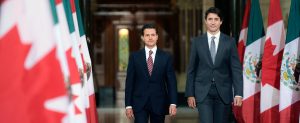
Prime Minister Justin Trudeau and Mexican President Enrique Pena Nieto gathered on the sidelines of a major international summit in Peru’s capital, along with Foreign Affairs Minister Chrystia Freeland and Mexico’s economy secretary Ildefonso Guajardo.

 U.S. Trade Representative Robert Lighthizer pulled out of the summit at the last minute, sending his deputy, C. J. Mahoney, in his place.

The sit-down, the first face-to-face between the two leaders since November, comes at a critical time, with Canada, Mexico and the U.S. all looking for a breakthrough in the ongoing effort to update the North American Free Trade Agreement — and Trump’s wild-card trade strategies doing little to clear the air.

It was also a chance for Trudeau to take stock of Mexico’s position — and perhaps share strategies — before the prime minister heads into a meeting Saturday with U.S. Vice-President Mike Pence.

Pence is in Peru instead of Trump, who was originally scheduled to attend but decided against it at the last minute, ostensibly to deal with the American response to a chemical attack in Syria. Earlier this week, Trump said he was prepared to «renegotiate forever» to get a good NAFTA deal.

Trudeau and Pena Nieto made small talk as members of the media captured the start of their meeting.

But the presence of several senior Mexican trade officials, as well as Freeland — Trudeau’s most trusted point person on NAFTA — left little doubt about the subject that would dominate the agenda once the doors were closed.

Trudeau’s meetings with Pena Nieto and Pence come as the three are attending the Summit of the Americas, which is held every four years and brings together leaders from across the Western Hemisphere.

The prime minister started his day Thursday by meeting Peruvian President Martin Vizcarra, who served as Peru’s ambassador to Canada before the previous president was forced to resign over a scandal last month.

Trudeau delivered a 10-minute address to business leaders from across the Americas encouraging them to invest in Canada, noting that the country has free trade agreements with dozens of countries around the world.

Even as his government struggles to deal with a pipeline crisis at home, one that has forced him to return to Canada on Sunday before resuming his travels to Europe, Trudeau pitched his country as a great place to invest, telling hundreds of business leaders «that big things can get done in Canada.»

More than half the countries with which Canada has free trade agreements are in the Americas, Trudeau said, and the hope is to add a deal with Latin America’s largest trading bloc, Mercosur, to that tally.

«Even in this age where the value of trade is being questioned by some, we have successfully negotiated landmark agreements with Europe and with Asia,» Trudeau added — a not-so subtle dig at protectionists like Trump.

The prime minister went on to emphasize Canada’s skilled labour force, low unemployment and debt-to-GDP ratio, recent federal investments in infrastructure and a new investment agency as proof that Canada is open for business.

The message appeared well received, and Kenneth Frankel, president of the Canadian Council for the Americas, said the region offers a natural opportunity for Canada — particularly as it looks for a northern partner who isn’t Trump.

Yet Siegfried Kiefer, president of Calgary-based engineering firm Atco Ltd., said Latin American leaders have told him they need massive new investments in infrastructure to grow their economies first.

On that front, Canada’s own record on infrastructure and «national-interest projects» has room for improvement, Kiefer said, including Kinder Morgan’s Trans Mountain pipeline, which is at the centre of a fierce battle between the Alberta and B.C. governments.

«The business community is generally looking for proof in the pudding,» he said.

«The public unrest relative to some of these projects is really what you’re trying to deal with. And that in my mind deals with how do you gain the trust of the people of the country that you have looked at the merits of the project objectively.»

Trudeau’s day also included hosting a lunch with representatives from the 15-country Caribbean Community, where he announced $25 million in new funding to help the region deal with natural disasters such as hurricanes.

The prime minister is also scheduled to meet with Chilean President Sebastien Pinera, who took office in March and whose country is an important political and trade partner with Canada.

From: Lee Berthiaume / The Canadian Press / Times Colonist / 13 April

https://nrgibroker.com/wp-content/uploads/2018/04/Captura-de-pantalla-2018-04-17-a-las-16.12.10.png 1023 1142 Soporte https://nrgibroker.com/wp-content/uploads/2025/12/logo-nrgi.svg Soporte2018-04-17 16:13:272026-05-11 19:51:23Trudeau meets with Mexican president at critical time in NAFTA talks

LA CUARTA RONDA DEL TLCAN 2.0 SE EXTENDERÁ DOS DÍAS

en Economía

FROM: Expansión / Martes, 10 de octubre de 2017 a las 3:03 PM


CIUDAD DE MÉXICO (Reuters) – La cuarta ronda de modernización del Tratado de Libre Comercio de América del Norte (TLCAN) fue extendida por dos días, hasta el 17 de octubre, cuando se llevará a cabo una reunión de ministros, dijeron el martes dos fuentes mexicanas.

Representantes de Canadá, Estados Unidos y México se reunirán en Washington desde el 11 de octubre para tratar de avanzar en varios temas del tratado, que el presidente estadounidense, Donald Trump, ha amenazado con abandonar argumentando que ha sido dañino para su país.

“Pienso que el TLCAN tiene que ser cancelado si queremos hacerlo bueno para nosotros. De otra forma no creo que podamos negociar un buen acuerdo”, dijo Trump en una entrevista publicada este martes por la revista estadounidense Forbes.

Después de estas declaraciones, el canciller mexicano, Luis Videgaray aseguró que México solo seguirá con las negociaciones si el TLCAN es del interés nacional.

https://nrgibroker.com/wp-content/uploads/2017/08/Flag_of_the_North_American_Free_Trade_Agreement_standard_version.svg-2.png 790 1280 admin https://nrgibroker.com/wp-content/uploads/2025/12/logo-nrgi.svg admin2017-10-10 19:27:102026-05-22 09:46:07LA CUARTA RONDA DEL TLCAN 2.0 SE EXTENDERÁ DOS DÍAS
Página 4 de 41234

Buscador

Search Search

Categorías

  • Mexicanas Mujeres (14)
  • Mujeres (14)
  • Mujeres Exitosas (15)

Entradas Recientes

  • Rompiendo Barreras. Construyendo el Futuro
  • El Poder Femenino de la Perspicacia en el Mundo Empresarial Mexicano
  • La Secretaría de Marina reconoce a Graciela Alvarez Hoth en el día Internacional de la Mujer en el Sector Marítimo
  • Graciela Álvarez reconocida como una de las pioneras en la industria energética por la revista Oil and Gas Magazine
  • NRGI Broker Presente en el Congreso Mexicano de Petróleo 2022

NRGI Broker

Somos el enlace entre los riesgos que enfrentan las industrias del sector energético con las soluciones para administrarlos y respaldarlos mediante esquemas confiables de garantías financieras.

Contáctanos

Prolongación Paseo de la Reforma 1015 Torre A Piso 21. Col. Desarrollo Santa Fe, Contadero, C.P. 05348 CDMX, México

Tel: +52 (55) 9177 2100

Horario de Atención

Lunes – Viernes: 7:30-18:00
Contáctanos: [email protected]

© Copyright - NRGI Broker | Aviso de Privacidad | Términos y condiciones
  • Link to Facebook
  • Link to X
  • Link to LinkedIn
  • Link to Youtube
Desplazarse hacia arriba Desplazarse hacia arriba Desplazarse hacia arriba