• Link to Facebook
  • Link to X
  • Link to LinkedIn
  • Link to Youtube
  • Inicio
  • NOSOTROS
  • SECTORES
    • ENERGÍA
      • Eléctrico
      • Petróleo y Gas
      • Renovables
    • Marítimo
    • INFRAESTRUCTURA
      • Puertos
      • Ductos
      • Carreteras
      • Edificios
      • Vías Férreas
      • Terminales de almacenamiento
  • SEGUROS
    • EMPRESAS
      • RESPONSABILIDAD CIVIL
        • Responsabilidad Ambiental
        • Responsabilidad Civil
        • Responsabilidad Civil Profesional
      • MARÍTIMO
        • Puertos y Terminales
        • Responsabilidad Civil Portuaria
        • Casco y P&I
        • Carga
        • Responsabilidad Civil del Fletador
      • DAÑOS
        • Daño Material
        • Múltiple Empresarial
        • Pérdida de Beneficios
      • CONSTRUCCIÓN
        • Construcción y Montaje
        • Obra Civil Terminada
      • MAQUINARIA Y EQUIPO
        • Equipo de Contratistas
      • EXPLORACIÓN Y EXTRACCIÓN
        • Control de Pozos
      • Aviación y Drones
      • Transporte
    • PERSONAS / BENEFICIOS
      • Vida Colectivo
      • Gastos Médicos Mayores Colectivo
      • Accidentes Personales
    • Hogar
    • AUTOS
      • Flotillas Autos y Camiones
      • Autos, Pickups y Camiones individuales
    • LINEAS FINANCIERAS
      • Cyber
      • Errores y Omisiones (E&O)
      • Directores D&O
      • Crime
  • FIANZAS
    • Licitación
    • Anticipo
    • Cumplimiento
    • Buena Calidad
    • Contingencias Laborales
    • Arrendamiento
    • Fiscales
    • Daños y Perjuicios
    • Fidelidad
    • Suministro Combustibles
    • Aduanales
  • BLOG
  • Noticias
  • CONTACTO
  • Click to open the search input field Click to open the search input field Buscar
  • Menú Menú

Listado de la etiqueta: México

US launches five dispute actions in WTO challenging China, EU, Canada, Mexico and Turkey

en Mercados internacionales

Merco Press / REUTERS / Yuri Gripas / 17 July


The United States launched five separate World Trade Organization dispute actions on Monday challenging retaliatory tariffs imposed by China, the European Union, Canada, Mexico and Turkey following U.S. duties on steel and aluminum. The retaliatory tariffs on up to a combined US$28.5 billion worth of U.S. exports are illegal under WTO rules, U.S. Trade Representative Robert Lighthizer said in a statement.

“These tariffs appear to breach each WTO member’s commitments under the WTO Agreement,” he said. “The United States will take all necessary actions to protect our interests, and we urge our trading partners to work constructively with us on the problems created by massive and persistent excess capacity in the steel and aluminum sectors.”

Lighthizer’s office has maintained that the tariffs the United States has imposed on imports of steel and aluminum are acceptable under WTO rules because they were imposed on the grounds of a national security exception.

Mexico said it would defend its retaliatory measures, saying the imposition of U.S. tariffs was “unjustified.”

“The purchases the United States makes of steel and aluminum from Mexico do not represent a threat to the national security,” Mexico’s Economy Ministry said in a statement.

“On the contrary, the solid trade relationship between Mexico and the U.S. has created an integrated regional market where steel and aluminum products contribute to the competitiveness of the region in various strategic sectors, such as automotive, aerospace, electrical and electronic,” the ministry added.

Lighthizer said last month that retaliation had no legal basis because the EU and other trading partners were making false assertions that the U.S. steel and aluminum tariffs are illegal “safeguard” actions intended to protect U.S. producers.


Merco Press / REUTERS / Yuri Gripas / 17 July


https://nrgibroker.com/wp-content/uploads/2016/10/shutterstock_349461494.jpg 400 600 Soporte https://nrgibroker.com/wp-content/uploads/2025/12/logo-nrgi.svg Soporte2018-07-17 14:06:512026-05-11 19:51:19US launches five dispute actions in WTO challenging China, EU, Canada, Mexico and Turkey

NAFTA negotiations: Mixed feelings for US companies on Mexican border

en Mercados internacionales

America CGTN / Steve Mort / June 18


The U.S., Canada, and Mexico say talks on the North American Free Trade Agreement (NAFTA) will press ahead despite Washington’s steel and aluminum tariffs. But recent tensions between the U.S. and Canada are casting doubt on whether a deal is possible.

At Allen Russell’s warehouse in the border city of El Paso, materials are processed for shipment to factories in Mexico. His company depends on those shipments being tariff-free under NAFTA, so he rejects President Trump’s claim that the trade deal is the worst ever made.

“It is not the worst trade deal. It has done more for North America than could even have anticipated.”

Russell’s business provides U.S. corporations with manufacturing facilities employing around 8,000 people in Mexico, where labor costs are lower. He fears that without NAFTA, his cost of doing business will rise.

“The American consumer is going to pay the bill,” according to Russell. “The product is just going to be more expensive. It doesn’t mean anybody is going to move from Mexico to the US to produce the product.”

The US-Mexico border region is one of the largest in the world. Its population exceeds 2.5 million, with an economy to match. Mexico is Texas’ largest export market, with cross-border trade worth hundreds of billions annually.

More than 1/5 of that trade crosses the border in El Paso.

Thomas Fullerton, a professor at the University of Texas at El Paso, studies the region’s economy and the potential impact should NAFTA talks fail.

“It will throw a monkey wrench into how things operate rather seamlessly at this point,” he explained. “Existing operations will probably remain in place, but the level of investment and business formation will plummet.”

But not everyone is so sure. Nicole Grado’s company sells packaging. Up to 90 percent of her customers ship internationally. She’s looking for ways to diversify her business and says she’s confident other US companies could thrive without NAFTA.

“There would be changes, but I think it’s like everything: you adjust to those changes and you adapt,” the CEO said. “You figure out ways to continue moving forward.”

While the outcome of the NAFTA talks remains far from certain, business on the border continues. El Paso’s economy is projected to grow two percent in 2018.

But most here hope a long-term deal can be reached soon, to avoid the lingering uncertainty hanging over this region’s economy.


America CGTN / Steve Mort / June 18


https://nrgibroker.com/wp-content/uploads/2018/06/shutterstock_394500997-e1529435504896.jpg 400 600 Soporte https://nrgibroker.com/wp-content/uploads/2025/12/logo-nrgi.svg Soporte2018-06-19 14:12:002026-05-11 19:51:20NAFTA negotiations: Mixed feelings for US companies on Mexican border

Enbridge (ENB) Commences Mex-Border Pipeline’s Offshore Work

en Pipelines, Reforma energética de México

Zacks Equity Research / June 14


Enbridge Inc. (ENB – Free Report) recently started construction work on its Valley Crossing natural gas pipeline’s border crossing offshore part, per Reuters. The $1.6 billion pipeline that lies between Mexico and Texas is scheduled to come online in October.

The energy infrastructure company is currently working on a 305-meter part of the pipeline’s offshore section, while the rest 165-mile onshore and offshore section is ready for operation. The company has plans to start the pipeline’s commissioning process soon.

Significance of the Pipeline

The Valley Crossing pipeline has a shipping capacity of 2.6 billion cubic feet of natural gas per day (Bcf/d). It will transport gas from Texas to Mexico’s growing energy market. Following the energy reform in Mexico, the country witnessed a rising interest from international oil and gas companies.

Energy-related imports have risen in the country over the past few years. Mexico’s year-to-date average gas import from the United States currently stands at 4 Bcf/d.

The pipeline is designed to supply clean burning gas primarily to the Mexican state-run utility company, Federal Electricity Commission aka CFE, which has around 37 million clients. Moreover, the pipeline is expected to open new market opportunities for the gas producers in Texas. As a result, Enbridge’s cash flow is expected to benefit immensely.

There’s More

The Valley Crossing pipeline would to be connected to the Sur de Texas-Tuxpan pipeline in the Gulf of Mexico, and is expected to create a huge pipeline network between the United States and Mexico. The Sur de Texas-Tuxpan pipeline is currently being built by a joint venture between Sempra Energy (SRE – Free Report) and TransCanada Corp. (TRP – Free Report) .

Price Performance

Calgary Canada-based Enbridge has lost 14% in the past year compared with 7.4% decline of its industry.

Zacks Rank and One Stock to Consider

Enbridge Energy carries a Zacks Rank #3 (Hold). Investors interested in the Energy sector can opt for a better-ranked stock like Delek US Holdings, Inc. (DK– Free Report) that sports a Zacks Rank #1 (Strong Buy). You can see the complete list of today’s Zacks #1 Rank stocks here.

Brentwood, TN-based Delek is an energy company. The company’s top line for 2018 is anticipated to improve 39.2% year over year, while its bottom line is expected to increase 230.2%.


Zacks Equity Research / June 14


https://nrgibroker.com/wp-content/uploads/2018/06/Copia-de-shutterstock_33324862-2.png 400 600 Soporte https://nrgibroker.com/wp-content/uploads/2025/12/logo-nrgi.svg Soporte2018-06-19 13:59:282026-05-11 19:51:20Enbridge (ENB) Commences Mex-Border Pipeline’s Offshore Work

Netherland Sewell Adds Mexico City to the 2018 Oil & Gas Property Evaluation Seminar Lineup

en Reforma energética de México

Oil & Gas 360º / May 29


NSAI Oil & Gas Property Evaluation seminars coming to London, Singapore and Mexico City this summer

Netherland Sewell & Associates (NSAI) has again expanded the reach of its popular Oil & Gas Property Evaluation Seminars for financial professionals, with the new addition of a seminar in Mexico City on September 5-6, 2018.

“We are very excited to introduce the NSAI Oil & Gas Property Evaluation seminars to Mexico,” said NSAI SVP & CFO Scott Frost. “With the country opening its hydrocarbon sector to foreign investors and international partners, the time is right for NSAI to host a seminar in Mexico.”

Seminars deliver a basic understanding of the upstream oil and gas industry

The two-day seminars are designed to help energy finance professionals gain a deeper understanding of the various aspects of the evaluation of hydrocarbon reserves and learn how to use reserves reports and studies.  Participants can expect to gain a basic understanding of the upstream oil and gas industry, including basic geology of different plays, reservoir evaluation basics, reserves and resources definitions, understanding hydrocarbons-in-place, recovery factors and rates, operating expenses and capital costs, and more.

The seminar speakers are NSAI professionals that have significant career expertise in reserves determination methods, the economics of hydrocarbon extraction, and petroleum geology. The seminars are popular with financial institutions that invest in energy development as well as banks that are involved in making lending decisions for oil and gas exploration and production projects.

Below is the 2018 NSAI Oil & Gas Property Evaluation seminar calendar:

  • May 7 & 8 and 9 & 10, 2018 – Dallas (Both sessions had record attendance with a waiting list)
  • June 26 & 27, 2018 – London: Grange City Hotel
  • July 10 & 11, 2018 – Singapore: Singapore Exchange – SGX Auditorium
  • September 5 – 6, 2018 – Mexico City: Asturiano Polanco Banquet Room

NSAI encourages energy industry and oil and gas financial professionals to pass this information on to colleagues who may benefit from attending. “We are excited about the opportunity to meet again with petroleum industry financial professionals and would like to thank you for recommending our seminars to your colleagues,” said NSAI SVP Joseph Spellman.

Scott Rees, NSAI Chairman and CEO, told Oil & Gas 360® that the firm has graduated about 6,500 people during 38 cumulative years of seminars in Dallas, London and Singapore. “We are glad to be adding Mexico City to that list,” Rees said.

Interested parties may learn more and register at NSAI’s website.


Oil & Gas 360º / May 29


https://nrgibroker.com/wp-content/uploads/2018/05/NSAI-Oil-Gas-Property-Evaluation-seminars.jpeg 853 1280 Soporte https://nrgibroker.com/wp-content/uploads/2025/12/logo-nrgi.svg Soporte2018-05-29 17:03:542026-05-11 19:51:21Netherland Sewell Adds Mexico City to the 2018 Oil & Gas Property Evaluation Seminar Lineup

NAFTA negotiations enter critical week with the U.S. still pushing a hard line

en

From: Financial Post / Thomson Reuters / Veronica Gomez and Anthony Esposito / May 7


Sources close to the talks have suggested there is a creeping feeling of uncertainty and pessimism because of gridlock on the most critical issues

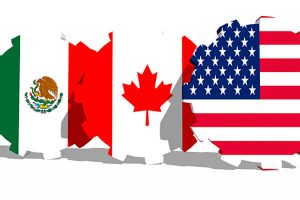
WASHINGTON — Talks to update the NAFTA trade deal enter a make-or-break week on Monday, as ministers from Canada, the United States and Mexico seek to resolve an impasse in key areas before elections in Mexico and the United States complicate the process.

Discussions in Washington will center on rules of origin that govern what percentage of a car needs to be built in the North American Free Trade Agreement region to avoid tariffs, the dispute-resolution mechanism and U.S. demands for a sunset clause that could automatically kill the trade deal after five years.

U.S. Trade Representative Robert Lighthizer warned last week that if the talks took too long, approval by the Republican-controlled Congress may be on “thin ice.” The aim is to complete a vote during the “lame-duck” period before a new Congress is seated after November’s congressional elections.

Mexico holds its presidential election on July 1 and the front-runner, leftist Andres Manuel Lopez Obrador, says he wants a hand in redrafting NAFTA if he wins.

“We have a window of opportunity in the next two or three weeks … considering two things: where the talks are now and the political calendars” in Mexico and the United States, said Moises Kalach, head of the international negotiating arm of Mexico’s CCE business lobby, which is leading the private sector’s involvement in the talks.

Sources close to the talks have suggested there is a creeping feeling of uncertainty and pessimism going into the new round because of gridlock on the most critical issues.

At the heart of the NAFTA revamp is U.S. President Donald Trump’s desire to retool rules for the automotive sector in order to try to bring jobs and investment back north from lower-cost Mexico. Despite months of talks on the issue, the sides remain far apart.

A round of talks among Canadian Foreign Minister Chrystia Freeland, Mexican Economy Minister Ildefonso Guajardo and Lighthizer scheduled for last week was cancelled to allow consultations with the Mexican car industry and for the American to go on a trade mission to China.

Mexico’s main auto sector lobby has described the latest U.S. demands, which include raising the North American content to 75 per cent from the current 62.5 per cent over a period of four years for light vehicles, as “not acceptable.”

“The positive momentum on the rules of origin appears to be counterbalanced by the opposite movement on labour wage treatment proposals,” said Flavio Volpe, president of Canada’s Automotive Parts Manufacturers Association.

The U.S. proposal also would require that 40 per cent of the value of light-duty passenger vehicles and 45 per cent for pickup trucks be built in areas with wages of US$16 per hour or higher.

That is seen as a hard pill to swallow for Mexico, where the Ann Arbor, Michigan-based Center for Automotive Research has estimated auto assembly workers average under US$6 an hour, and auto parts plants workers average less than US$3 an hour.

Critics also say it would create a bureaucratic nightmare of paperwork.


From: Financial Post / Thomson Reuters / Veronica Gomez and Anthony Esposito / May 7


https://nrgibroker.com/wp-content/uploads/2018/01/naftamc.jpg 400 600 Soporte https://nrgibroker.com/wp-content/uploads/2025/12/logo-nrgi.svg Soporte2018-05-08 17:53:482026-05-11 19:51:22NAFTA negotiations enter critical week with the U.S. still pushing a hard line

Mexican Oil Giant Pemex Seeks Partners to Drill in 7 Southern Areas

en

FROM: Sputnik News / 27 April 2017


MEXICO CITY (Sputnik) – Mexico’s state oil giant Pemex is looking for partners in joint ventures that will drill at seven onshore areas in the country’s south, the national hydrocarbons authority said Thursday.

Contracts for drilling in the states of Veracruz, Chiapas and Tabasco will be signed for a period of 35 to 40 years with a possibility of a ten-year extension, according to the National Hydrocarbons Commission.

Mexico has been overhauling its energy sector since late 2013. The reform ended almost 80 years of Pemex’s monopoly by allowing foreign investments and contracts with private businesses.


FROM: Sputnik News / 27 April 2017


https://nrgibroker.com/wp-content/uploads/2015/11/TERCERA-LICITACION-TABASCO1.jpeg 200 300 Soporte https://nrgibroker.com/wp-content/uploads/2025/12/logo-nrgi.svg Soporte2018-05-02 16:01:542026-05-11 19:51:22Mexican Oil Giant Pemex Seeks Partners to Drill in 7 Southern Areas

Trudeau meets with Mexican president at critical time in NAFTA talks

en

From: Lee Berthiaume / The Canadian Press / Times Colonist / 13 April


LIMA, Peru — Two of the three political leaders with the most at stake at the NAFTA table huddled Friday behind closed doors, their most senior trade lieutenants alongside, in hopes of unlocking a mutually beneficial solution to the cross-border conundrum posed by U.S. President Donald Trump.

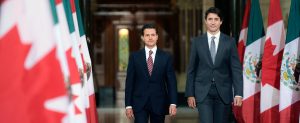
Prime Minister Justin Trudeau and Mexican President Enrique Pena Nieto gathered on the sidelines of a major international summit in Peru’s capital, along with Foreign Affairs Minister Chrystia Freeland and Mexico’s economy secretary Ildefonso Guajardo.

 U.S. Trade Representative Robert Lighthizer pulled out of the summit at the last minute, sending his deputy, C. J. Mahoney, in his place.

The sit-down, the first face-to-face between the two leaders since November, comes at a critical time, with Canada, Mexico and the U.S. all looking for a breakthrough in the ongoing effort to update the North American Free Trade Agreement — and Trump’s wild-card trade strategies doing little to clear the air.

It was also a chance for Trudeau to take stock of Mexico’s position — and perhaps share strategies — before the prime minister heads into a meeting Saturday with U.S. Vice-President Mike Pence.

Pence is in Peru instead of Trump, who was originally scheduled to attend but decided against it at the last minute, ostensibly to deal with the American response to a chemical attack in Syria. Earlier this week, Trump said he was prepared to «renegotiate forever» to get a good NAFTA deal.

Trudeau and Pena Nieto made small talk as members of the media captured the start of their meeting.

But the presence of several senior Mexican trade officials, as well as Freeland — Trudeau’s most trusted point person on NAFTA — left little doubt about the subject that would dominate the agenda once the doors were closed.

Trudeau’s meetings with Pena Nieto and Pence come as the three are attending the Summit of the Americas, which is held every four years and brings together leaders from across the Western Hemisphere.

The prime minister started his day Thursday by meeting Peruvian President Martin Vizcarra, who served as Peru’s ambassador to Canada before the previous president was forced to resign over a scandal last month.

Trudeau delivered a 10-minute address to business leaders from across the Americas encouraging them to invest in Canada, noting that the country has free trade agreements with dozens of countries around the world.

Even as his government struggles to deal with a pipeline crisis at home, one that has forced him to return to Canada on Sunday before resuming his travels to Europe, Trudeau pitched his country as a great place to invest, telling hundreds of business leaders «that big things can get done in Canada.»

More than half the countries with which Canada has free trade agreements are in the Americas, Trudeau said, and the hope is to add a deal with Latin America’s largest trading bloc, Mercosur, to that tally.

«Even in this age where the value of trade is being questioned by some, we have successfully negotiated landmark agreements with Europe and with Asia,» Trudeau added — a not-so subtle dig at protectionists like Trump.

The prime minister went on to emphasize Canada’s skilled labour force, low unemployment and debt-to-GDP ratio, recent federal investments in infrastructure and a new investment agency as proof that Canada is open for business.

The message appeared well received, and Kenneth Frankel, president of the Canadian Council for the Americas, said the region offers a natural opportunity for Canada — particularly as it looks for a northern partner who isn’t Trump.

Yet Siegfried Kiefer, president of Calgary-based engineering firm Atco Ltd., said Latin American leaders have told him they need massive new investments in infrastructure to grow their economies first.

On that front, Canada’s own record on infrastructure and «national-interest projects» has room for improvement, Kiefer said, including Kinder Morgan’s Trans Mountain pipeline, which is at the centre of a fierce battle between the Alberta and B.C. governments.

«The business community is generally looking for proof in the pudding,» he said.

«The public unrest relative to some of these projects is really what you’re trying to deal with. And that in my mind deals with how do you gain the trust of the people of the country that you have looked at the merits of the project objectively.»

Trudeau’s day also included hosting a lunch with representatives from the 15-country Caribbean Community, where he announced $25 million in new funding to help the region deal with natural disasters such as hurricanes.

The prime minister is also scheduled to meet with Chilean President Sebastien Pinera, who took office in March and whose country is an important political and trade partner with Canada.

From: Lee Berthiaume / The Canadian Press / Times Colonist / 13 April

https://nrgibroker.com/wp-content/uploads/2018/04/Captura-de-pantalla-2018-04-17-a-las-16.12.10.png 1023 1142 Soporte https://nrgibroker.com/wp-content/uploads/2025/12/logo-nrgi.svg Soporte2018-04-17 16:13:272026-05-11 19:51:23Trudeau meets with Mexican president at critical time in NAFTA talks

Mexico’s Sureste Basin Returns To Super Basin Spotlight

en

From: Hartenergy / 6 April

HOUSTON—The flurry of bidding activity from oil and gas companies willing to shell out millions of dollars for drilling rights in the shallow waters of the Gulf of Mexico (GoM) during Mexico’s latest bidding round showed there must still be something special about the Sureste (Southeast) Basin.

“I’ve never seen a structure like it in my career,” Mark Shann, subsurface director for Sierra Oil and Gas, said of Sureste during the AAPG’s recent Global Super Basins Leadership conference.

The multiplay basin, which includes prolific sub-basins such as Sonda de Campeche and Chiapas-Tabasco, spans about 65,000 sq km and is believed to hold 50 billion barrels of recoverable oil in the GoM’s shallow water and beyond. Its oil-prone prowess gained prominence in 1976 with Mexico’s game-changing Cantarell oil field discovery. Since then the basin has served as the main hydrocarbon-bearing province for Mexico, which is working to reverse declining production with global players eagerly chomping at the bit in search of oil.

RELATED: Southeast Basin Lures Oil Companies To Mexico’s Shallow Water

The historic Zama discovery made in 2017 by a Talos Energy-led consortium that includes Sierra and Premier Oil and another discovery—Amoca—by Italy’s Eni in 2017 have kept the basin in the spotlight, indicating it still has more to give. The Zama well, the first well drilled by the private sector since Mexico opened its doors to foreign investors, hit 170 m to 200 m (558 ft to 656 ft) of net oil pay in Upper Miocene sandstones. Initial gross original oil in place estimates ranged from 1.4 billion barrels (Bbbl) to 2 Bbbl.

Some would call it the rebirth of a super basin.

Shann said the basin—along with neighboring Tampico-Misantla—has all the qualities of a super basin.

“If you’re going to go into a super basin, you need at least one fantastic source rock and it has to be a mature source rock,” Shann said. He added that multiple reservoirs are also needed. “Having multiple reservoirs takes away the dependency of one reservoir working out or not, and you need seals to hold back hydrocarbons in their reservoirs.”

Having a diversity of traps is fantastic, he added, noting other attributes also define a super basin. These include having a regulatory framework in which to make the entire business work and super data, something Shann said Sureste Basin has plenty.

“Four years ago when we started our company we couldn’t get all seismic data from the country. Today you can access all the seismic,” Shann said. “You can access any well that is older than two years, and there are 39,000 wells in the country. The ability mine data and therefore to compete on an equal level playing field is hugely important,” especially for a small company competing against supermajors.

Sierra has picked up 11,000 sq km of wide azimuth data from Schlumberger and source rock is visible, he said. “The super data has really helped to underpin a story of success in one of the world’s greatest super basins.”

Today Sierra is focused mainly on Sureste, which Shann said extends beyond shallow and into deepwater.

The company said on its website that Sureste’s original oil and gas in place is about 220 Bboe, and the fact that it has numerous mature fields—including Ku Maloob Zaap and Sihil—and little reinvestment signals “significant opportunity for growth.”

Its reservoirs are associated with structural, salt tectonics, stratigraphic and combined traps, and the main structural styles include normal faulting with rotated blocks (Late Miocene-Holocene), salt cored anticlines and salt rollers and diapirs (Jurassic-Late Cretaceous), according to Mexico’s National Hydrocarbons Commission.

In terms of source rock potential, Shann said “we’re definitely in a super basin.” He spoke about how the Zama discovery shed more light on source rock thickness. Taking into account a conservative 50% migration loss among other factors, the company was able to determine the source rock must be about 200 m thick.

Shann said the company and its partners’ plan to test the Jurassic next year.

“Sureste is one of those amazing salt-related basins,” he added, speaking highly of the carbonate potential of the basin in Mexican waters and on the U.S. side. “I think we can still find some big carbonate fields in the Campeche Slope.”

Located about 37 miles offshore, Zama is between Eni’s Amoca appraisal well in the Lower Pliocene and Pan American’s Hokchi 2 in the Middle Miocene.

“Between the three of us, we’re exploiting different parts of this basin, which helps the industry’s understanding of the whole basin,” Talos CEO Tim Duncan told Hart Energy’s Oil and Gas Investor last summer.

RELATED: Talos Energy CEO Talks About Historic Zama Well

Talos, which will merge with Stone Energy, said in its March 15 fourth-quarter earnings release that the company is in the appraisal planning stages for the Zama-1 discovery. Zama-1 is located in Block 7 of the Sureste Basin at a water depth of about 165 m.

Other exploration opportunities exist, according to Talos.

Talos holds a 35% participating interest with Sierra holding 40% and Premier, 25%.

From: Hartenergy / 6 April


https://nrgibroker.com/wp-content/uploads/2016/08/shutterstock_199017701-e1472503200645.jpg 268 400 Soporte https://nrgibroker.com/wp-content/uploads/2025/12/logo-nrgi.svg Soporte2018-04-10 16:45:392026-05-11 19:51:23Mexico’s Sureste Basin Returns To Super Basin Spotlight

Mexico’s economy minister says odds of a Nafta deal ‘in principle’ at 80%

en

From: Market Watch / 9 April

Mexico’s economy minister, Ildefonso Guajardo, said in a TV interview on Monday that the likelihood of signing a renegotiated pact ‘in principle’ on the North American Free Trade Agreement is about 80%. Guajardo, however, said he didn’t expect a Nafta deal would be struck this week, but would likely be signed around the first week of May. He speculated that the U.S. and would be inclined to complete a deal ahead of coming midterm elections. Nafta negotiators are currently meeting in Washington, D.C., for their eighth round of talks. Last week, President Donald Trump said he was looking for a deal in principle at the Summit of the Americas in Lima, Peru, next week. The Mexican peso USDMXN, -0.3324% which started Monday’s session weaker, climbed 0.2% higher versus the dollar, with one buck fetching 18.2450 pesos. The iShares MSCI Mexico ETF EWW, +1.29% was up 0.5% in response.

From: Market Watch / 9 April


https://nrgibroker.com/wp-content/uploads/2018/04/EST13133484c784908_0.jpg 617 980 Soporte https://nrgibroker.com/wp-content/uploads/2025/12/logo-nrgi.svg Soporte2018-04-10 16:16:052026-05-11 19:51:23Mexico’s economy minister says odds of a Nafta deal ‘in principle’ at 80%

The economic relationship between Mexico and the United States

en Mercados internacionales

FROM: Oup Blog / Roderic Al Camp / 17 de febrero de 2018

Mexico and the United States share a highly integrated economic relationship. There seems to be an assumption among many Americans, including officials in the current administration, that the relationship is somehow one-sided, that is, that Mexico is the sole beneficiary of commerce between the two countries. Yet, economic benefits to both countries are extensive.

Mexico has played a significant role in the rapid expansion of US exports in the 1990s and 2000s. It alternated between the second and third most important trade partner of the United States in the last decade. In 2014, the United States exported a total of $240 billion worth of goods to Mexico, with the largest  products coming from the computers and electronics, transportation, petroleum, and machinery sectors. By contrast, China only purchased $124 billion of US exports. Exports to Mexico accounted for approximately 1,344,000 jobs in the United States.

California alone, boasting the eighth largest economy in the world, exported more than 15% of its products to Mexico by 2014, exceeding what it trades with Canada, Japan, or China. As of 2014, Mexico’s purchases of California exports supported nearly 200,000 jobs in the state. In fact, 17% of all export-supported jobs in California, which account for a fifth of all individuals employed in the state, are linked to the state’s economic relationship with Mexico. More than half of those export-related positions can be traced to the North American Free Trade Agreement. California and Texas – the two largest economies in the United States, and two of the three largest state/provincial economies in the world – are significantly influenced economically by Mexico.

In 2014, a heavy portion of exports from six US states were purchased by Mexico: 41% in Arizona, 41% in New Mexico, 36% in Texas, 25% in New Hampshire, 23% in South Dakota, and 23% in Nebraska. As Senator John McCain noted several weeks ago, the Trump administration’s decision to renegotiate, rather than withdraw from NAFTA, prevented a horrific economic impact on Arizona. The GDP of the United States and Mexican border states accounts for a fourth of the national economy of both countries combined, exceeding the GDP of all the countries in the world except for the United States, Japan, China, and Germany.

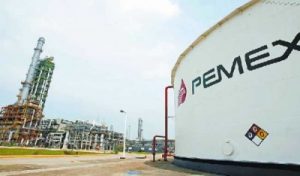
The United States provides the single largest amount of direct foreign investment in Mexico, but what I want to stress, and to educate Americans about, is that Mexican entrepreneurs and venture capitalists invest heavily in the United Sates. By 2013, Mexico had invested $33 billion, the only emerging economy among the top fifteen countries with direct foreign investments in the United States. In 2015, Pemex, the government oil company, opened the first retail gasoline station in the United States, in Houston, and plans on opening four more in that city. This is a pilot project to test the American market nationally. OXXO, another Mexican firm, has opened two convenience stores in Texas, and plans on investing $850 million to open 900 stores in the United States.

Finally, Mexico also influences the US economy through tourism in the same way that American tourists play a central role in Mexico’s economy. In 2014, 75 million foreigners visited the United States, generating $221 billion dollars. Canada accounts for the largest number of visitors each year, followed by Mexico, which provided 17 million tourists in 2014, who spent $19 billion. Along the border, at the end of the decade, Mexican visitors generated somewhere around $8 billion to $9 billion dollars in sales and supported approximately 150,000 jobs.

Another way to look at the relationship between Mexico and the United States is through cultural influences.  Mexico exerts impact through music, food, film, and language. For example, there are multiple fast-food chains that spe­cialize in Mexican food. Grocery stores stock more items originating from Mexico than any other ethnic cuisine in the world, including beers, beans, hot sauces, peppers, and torti­llas. Corona is the best-selling foreign beer in the United States. Mexican foods such as guacamole and caesar salad are so com­monplace that they have lost their identity as Mexican cuisine.

The use of Spanish words and Mexican slang is evident in ev­eryday language in the United States; such terms range from “mano a mano” to “macho,” “enchilada” to “margarita,” and “rancho” to “hacienda.” According to a Pew Center study in 2011, 38 million individuals in the United States five years or older showed that the majority of them were Mexican, and were speaking Spanish at home. Spanish is also the most widely spoken non-English language among Americans who are not from a Hispanic country. The size of the Spanish-speaking audience in the United States has also influenced the growth of Mexican films. The musical influence has kept pace with cuisine. In 2010, the New Yorker magazine ran an extensive article about Los Tigres del Norte, a musical group from San Jose, California, who represent the norteño musical style. They boast a huge following among music fans. Selena, who died two decades ago, has sold more than 60 million albums, including songs representing the mariachi and ranch­era genres, and the number of copies of her posthumous best-selling album of all time, Dreaming of You, reached five million by 2015. Among young adults (18 to 34 years of age) who listen to the radio, Mexican regional music ranks seventh in popularity.

The relationship between the United States and Mexico has become more complex over time, incorporating cultural, musical, economic, familial, political, and security relationships beneficial to both countries and its citizens. But the most dramatic change in those many facets of our relationship with each other is the degree to which Mexico’s impact on and within the United States has grown in importance. Equally important to consider is that in spite of President Trump’s public criticisms of Mexico, our relationship at numerous levels, public and private, remains strong.



FROM: Oup Blog / Roderic Al Camp / 17 de febrero de 2018

https://nrgibroker.com/wp-content/uploads/2018/02/chocmc.jpg 400 600 Soporte https://nrgibroker.com/wp-content/uploads/2025/12/logo-nrgi.svg Soporte2018-02-20 12:18:402026-05-11 19:51:24The economic relationship between Mexico and the United States
Página 8 de 9«‹6789›

Buscador

Search Search

Categorías

  • Mexicanas Mujeres (14)
  • Mujeres (14)
  • Mujeres Exitosas (15)

Entradas Recientes

  • Rompiendo Barreras. Construyendo el Futuro
  • El Poder Femenino de la Perspicacia en el Mundo Empresarial Mexicano
  • La Secretaría de Marina reconoce a Graciela Alvarez Hoth en el día Internacional de la Mujer en el Sector Marítimo
  • Graciela Álvarez reconocida como una de las pioneras en la industria energética por la revista Oil and Gas Magazine
  • NRGI Broker Presente en el Congreso Mexicano de Petróleo 2022

NRGI Broker

Somos el enlace entre los riesgos que enfrentan las industrias del sector energético con las soluciones para administrarlos y respaldarlos mediante esquemas confiables de garantías financieras.

Contáctanos

Prolongación Paseo de la Reforma 1015 Torre A Piso 21. Col. Desarrollo Santa Fe, Contadero, C.P. 05348 CDMX, México

Tel: +52 (55) 9177 2100

Horario de Atención

Lunes – Viernes: 7:30-18:00
Contáctanos: [email protected]

© Copyright - NRGI Broker | Aviso de Privacidad | Términos y condiciones
  • Link to Facebook
  • Link to X
  • Link to LinkedIn
  • Link to Youtube
Desplazarse hacia arriba Desplazarse hacia arriba Desplazarse hacia arriba