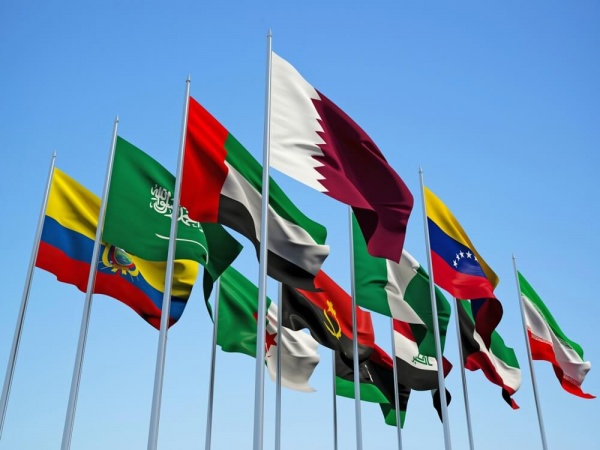
Major oil producers are likely to meet in April to discuss a proposal to freeze output at January levels to stabilize the market, according to four Gulf OPEC delegates.
Ministers from some members of the Organization of Petroleum Exporting Countries had suggested that such a meeting would take place this month in Russia. The talks are now most likely to occur in Qatar’s capital Doha, said three of the delegates, who asked not to be identified because the matter isn’t public.
The probability that Doha will play to host the meeting is high as Qatar is president of the OPEC ministerial conference this year, even as Russia is the country that called for the meeting, two of the delegates said. The meeting may still not take place if there aren’t many important producers attending and agreeing beforehand to freeze production, three delegates said.
Saudi Arabia, Russia, Venezuela and Qatar in February proposed an accord to cap oil output and reduce a worldwide surplus. Crude prices extended gains after their initial meeting on Feb. 16 and have climbed more than 40 percent since slumping to a 12-year low in January. Prices may have passed their lowest point as shrinking supplies outside OPEC and disruptions inside the group erode global oversupply, the International Energy Agency said on March 11.
Russia-Iran Talks
Iran plans to boost crude output to 4 million barrels a day, the highest level since 2008, before it will consider joining other suppliers in seeking ways to re-balance the global oil market. Russian Energy Minister Alexander Novak met Monday with Iranian Oil Minister Bijan Zanganeh in Tehran.
Saudi Oil Minister Ali al-Naimi said last month in Houston that the process of devising a freeze agreement would continue with more discussions in March. Nigerian Petroleum Minister Emmanuel Kachikwu said two weeks later that talks would convene in Russia on March 20. Russia’s Novak told state television channel Rossiya 24 on March 4 that a meeting could take place between March 20 and April 1 in Russia, Doha or Vienna, where OPEC has its headquarters.
So far no countries have received invitations or an agenda for a meeting, the four OPEC delegates said.
https://nrgibroker.com/wp-content/uploads/2016/03/shutterstock_1452206711-e1457988618132.jpg300400adminhttps://nrgibroker.com/wp-content/uploads/2025/12/logo-nrgi.svgadmin2026-05-11 19:30:412026-05-11 19:36:50Oil Producers Likely to Meet in April on Output Freeze
Even as U.S. oil production started to slide in the second half of 2015, the downside risks to oil prices continued to dominate.
In the third quarter, broad-based manufacturing softness and financial market turmoil threatened to derail growth in developed markets, bringing some focus back to the demand side of the ledger. Annual oil demand growth proceeded to drop off in the fourth quarter from above 2 percent to 1.2 percent with acute cracks in China and advanced economies, seemingly confirming analysts’ worst fears.
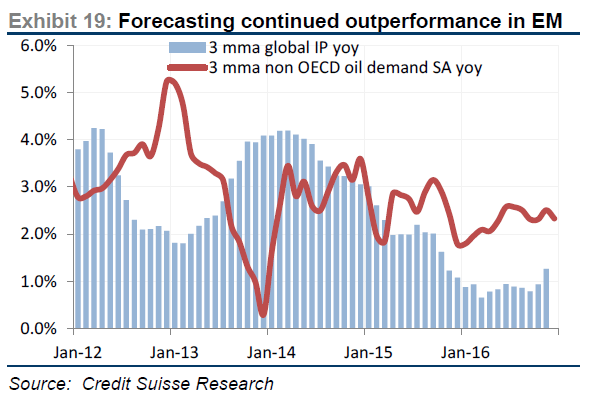
But Credit Suisse Group AG Global Energy Economist Jan Stuart concludes that oil demand «growth appears to be re-accelerating» in 2016, with the recent bout of softness attributable to a warm winter, subdued activity in resource-extracting industries, and persistent weakness in select sputtering emerging markets like Russia and Brazil.
«Oil demand growth is alive and well,» he writes in a recent note. «We think that with hindsight this winter will look like a dip in an otherwise still unfolding fairly strong growth trend that is partly fueled by the ongoing economic recovery of in North America and Europe and longer standing trends across key emerging market economies.»
While concerns about global growth linger, demand for crude doesn’t match the narrative that a worldwide recession is imminent. In particular, for the world’s two largest economies, the U.S. and China, Stuart notes that oil demand growth has rebounded following a sluggish fourth quarter.
«While on balance oil demand growth appears relatively sluggish still in the first quarter; February data either improved on January (e.g. Brazil, the U.S.); or extended strong growth (e.g. India, South Korea), while in China demand appeared to have rebounded as well,» he writes.
Demand for oil has been increasingly attributable to passenger vehicles rather than its use as an input in the production process, as the middle classes in emerging markets swell.
In light of this, Credit Suisse anticipates that crude demand will keep running hotter than industrial production:
«We forecast modestly re-accelerating demand growth over the course of this year, so long as a recession continues to be avoided,» asserts Stuart. «We project in fact that oil demand should continue to outperform historic correlations with industrial production.»
This outlook for demand bolsters the analyst’s confidence that oil prices could hit $50 per barrel in May.
https://nrgibroker.com/wp-content/uploads/2016/03/Captura-de-pantalla-2016-03-28-a-las-17.22.331-e1459207449258.png271400adminhttps://nrgibroker.com/wp-content/uploads/2025/12/logo-nrgi.svgadmin2026-05-11 19:30:402026-05-11 19:36:52Credit Suisse: The Death of Oil Demand has been Greatly Exaggerated
Oil fell around 3 percent on Monday after Iran dashed hopes of a coordinated production freeze any time soon, returning bearish sentiment over a supply glut that has sent prices crashing.
Global benchmark Brent crude futures LCOc1 fell back below $40 a barrel, trading at $39.27 at 1308 GMT, down $1.12 on Friday’s close. Brent hit a 12-year low of $27.10 in January.
U.S. crude CLc1 was down $1.09 at $37.41 a barrel.
«Oil is down because Iran said they would only join the output freeze group once they reached production of 4 million barrels a day,» said Tamas Varga, oil analyst at London brokerage PVM Oil Associates.
He was referring to comments by Iran’s oil minister Bijan Zanganeh on Sunday that the OPEC member would join discussions after its output reached that level.
Iran’s oil exports are due to reach 2 million bpd in the Iranian month that ends on March 19, up from 1.75 million in the previous month, he said.
Zanganeh met Russian counterpart Alexander Novak in Tehran on Monday but talks focused on long-running discussions about an oil and gas swap mechanism.
According to the Shana news agency, Zanganeh said Iran and Russia could cooperate on the swap, which would see Russia send oil and gas to northern Iran in return for Iranian supply to Russian customers in the Gulf.
Saudi Arabia appeared to have stuck to a preliminary deal with some other producers to freeze output, as its crude production held steady in February at 10.22 million barrels per day (bpd), an industry source told Reuters.
OPEC members and non-OPEC producers are likely to meet again in mid-April in Doha to discuss freezing output, OPEC sources told Reuters.
A March 20 meeting in Russia, which was part of an earlier plan, now looks unlikely.
Worries about demand fundamentals moved back into the spotlight as investment bank Morgan Stanley warned that a slowing global economy and high production would prevent any sharp rises in oil prices.
«Oil prices now seem to have bottomed, even though they are likely to stay subdued for the rest of this year before starting to move higher in 2017,» the U.S. bank said in a research note. It added that cheap oil had not provided the boost to growth that many had hoped for.
In a sign that investors are growing more skeptical about a rebound in oil prices, ICE data showed on Monday that speculators had cut net long positions in Brent crude by 9,500 contracts in the week to March 8.
Bjarne Schieldrop, chief commodities analyst at SEB Markets in Oslo, said a roughly 2 million bpd oil surplus would weigh down oil prices in the short term. The imminent restart of a pipeline between Iraq and Turkey and the breakdown in talks about a production freeze would add further downside, he said.
«We are likely to see $35 a barrel before we see $45 a barrel.»
https://nrgibroker.com/wp-content/uploads/2016/03/shutterstock_1885517661-e1457989426526.jpg225400adminhttps://nrgibroker.com/wp-content/uploads/2025/12/logo-nrgi.svgadmin2026-05-11 19:30:402026-05-11 19:36:51Oil back below $40 as Iran dashes hopes for quick deal on output
Oil prices edged up in Asia on Monday, recovering slightly from last week s decline, but analysts said traders would likely delay any big moves until next month s meeting of key producers.
Hopes for an agreement between Russia, Saudi Arabia and other crude giants to at least freeze output sent both main contracts racing above $40 earlier this month, helped by a dive in the strength of the dollar.
At around 0620 GMT US benchmark West Texas Intermediate was up 50 cents, or 1.27 percent, to $39.96. Brent was up 45 cents, or 1.11 percent, at $40.89.
Members of the Organization of the Petroleum Exporting Countries (OPEC) and key non-members led by Russia are due to discuss a proposed output freeze at a meeting in Doha on April 17.
Bernard Aw at IG Markets told AFP a dip in the number of US oil rigs in operation provided some buying incentives, although business had been slim due to the long Easter break across most world markets.
However, he warned that “the fundamental picture of oil is still a little bit bearish” owing to a global supply glut and a slowdown in the global economy, particularly China.
“Everything hinges on the meeting between OPEC and non-OPEC producers,” Aw said. “If it takes place and they come to some agreement of a production freeze, we could see some gains well beyond $40.”
Qatar s energy minister Mohammed al-Sada, who also serves as OPEC president, earlier said the initiative was backed by 15 countries accounting for 73 percent of worldwide output.
Sanjeev Gupta, who heads the Asia-Pacific oil and gas practice at professional services firm EY, said traders would also be looking at upcoming US and Chinese economic data for direction.
https://nrgibroker.com/wp-content/uploads/2016/03/shutterstock_378249955-e1459210335169.jpg130200adminhttps://nrgibroker.com/wp-content/uploads/2025/12/logo-nrgi.svgadmin2026-05-11 19:30:392026-05-11 19:36:52Oil prices edge up on lower US rig numbers
Oil markets will probably balance by the end of next year, with prices rising in the medium term, according to Sultan Al Jaber, the new head of Abu Dhabi National Oil Co.
Prices, which have swung between highs of about $42 a barrel and lows of about $27 this year, will continue to be volatile in the short term, Al Jaber said in an interview with Abu Dhabi dailies The National and Al Ittihad.
Al Jaber, named the company’s chief executive officer last month, expects “to see a slow but upwards improvement in prices in the medium term,” according to a transcript of his comments published in The National. “2016 and 2017 will be the years during which markets will start to rebalance the gap between demand and supply.”
Abu Dhabi, the capital of the United Arab Emirates, holds about 6 percent of the world’s oil reserves. The U.A.E., a member of the Organization of Petroleum Exporting Countries, is among at least a dozen states that have said they’ll meet in Doha, Qatar, on April 17 to discuss a potential freeze in oil output to stabilize prices. European benchmark Brent crude slipped 0.7 percent to $38.41 a barrel as of 9:34 a.m. in London.
Adnoc, as the state company is known, is taking “into consideration prevailing market conditions” as it works toward a target to boost production capacity to 3.5 million barrels a day, Al Jaber said, without specifying the date when that level would be reached. The company is maintaining its current production level and aims to “remain a reliable supplier.”
The U.A.E. pumped about 2.89 million barrels a day last month, according to data compiled by Bloomberg. Abu Dhabi had been seeking to boost capacity to 3.5 million barrels daily by the end of 2017, while company officials have said the target may not beachieved until 2019.
https://nrgibroker.com/wp-content/uploads/2016/04/shutterstock_275170592-baja-e1459800451573.jpg261400adminhttps://nrgibroker.com/wp-content/uploads/2025/12/logo-nrgi.svgadmin2026-05-11 19:30:392026-05-11 19:36:52Abu Dhabi’s Oil Chief Sees Crude Market Balancing by End of 2017
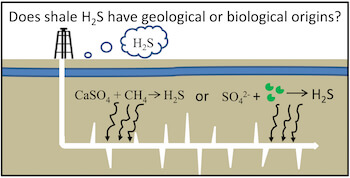
Rice University researchers have developed a technique to model oil and gas formations to determine the cause of souring. Credit: Jason Gaspar/Alvarez Lab
In at least one—and probably many—oil and gas drilling operations, the use of biocides to prevent the souring of hydrocarbons wastes money and creates an unnecessary environmental burden, according to researchers at Rice University.
The Rice lab of environmental engineer Pedro Alvarez reported that soured hydrocarbons found in the Bakken Formation underneath the Northwest United States and Canada are caused by primarily geochemical reactions rather than microbial ones; the researchers questioned the need to pump costly biocides into the well to kill sulfide-producing microbes.
The team’s finding offers a way to cut costs at wellheads where biocides may be unnecessary while keeping them out of the environment, where they may promote the development of biocide-resistant bacteria, Alvarez said.
The research appears in the American Chemical Society journal Environment Science and Technology Letters.
Soured hydrocarbons are those with high concentrations of hydrogen sulfide gas. The hydrogen sulfide gives oil and natural gas the smell of rotten eggs, can be toxic to breathe and is highly corrosive. For this reason, the gas has to be removed from crude oil before it can be transported or refined.
Curtailing the use of biocides when the source of souring is not from microbes would reduce operation costs and mitigate potential impacts to microbial ecosystems, Alvarez said.
The Rice-led team set out to solve a long-standing puzzle over what in an individual formation makes hydrocarbons go sour. Either microbial life or the geochemical environment can catalyze the reaction, but engineers are rarely able to determine which is happening.
Alvarez and his co-authors developed an improved map of temperatures to about 2 miles below the surface in eight representative Bakken Formation fracture wells. They showed that downhole temperatures in the formation are equal to or exceed the upper known temperature limit—252 degrees Fahrenheit—for microorganisms’ survival.
The team also analyzed isotopes of sulfur isolated from hydrogen sulfide taken from the wells. They found all of the isotopes tested suggested geochemical origins. Water samples from the same wells failed to yield DNA concentrations that would indicate the presence of microorganisms.
«The combination of temperature, sulfur isotope and microbial analyses makes scientific, environmental and financial sense,» said Jason Gaspar, a Rice graduate student and lead author of the paper. «Using our method, we could characterize hydrogen sulfide for dozens of wells in a given shale play for less than the cost of adding biocide to one well alone.»
More information: Jason Gaspar et al. Biogenic versus Thermogenic H S Source Determination in Bakken Wells: Considerations for Biocide Application , Environmental Science & Technology Letters (2016). DOI: 10.1021/acs.estlett.6b00075
https://nrgibroker.com/wp-content/uploads/2016/04/4-environmenta1-e1459805109530.jpg102200adminhttps://nrgibroker.com/wp-content/uploads/2025/12/logo-nrgi.svgadmin2026-05-11 19:30:392026-05-11 19:36:52Environmental engineers develop method to ID cause of sour hydrocarbons in wells
OPEC member Iran and India – one of Asia’s fastest growing source of energy demand – signed a memorandum of understanding (MoU) to develop oil and gas projects, including the Farzad B gas field, Iranian Petroleum Minister Bijan Zangeneh told the Iran-India business conference held at Teheran Chamber of Commerce Saturday, Shana – a media linked to Iran’s Ministry of Petroleum – reported Sunday. «We had thorough conversations today and signed an MoU for development of Farzad B gas field, refinery cooperation, export of crude oil and petroleum products and mutual cooperation in petrochemical industry,» Zangeneh said.
The MoU was signed during a visit to Teheran by Indian Petroleum and Natural Gas Minister Dharmendra Pradhan, who, the Ministry said on its website April 7, hoped to engage «with the Iranian political leadership to work with them, particularly in the hydrocarbon, petrochemicals and fertilizers sectors for mutual benefits, including strengthening of India’s energy security.» According to Zangeneh, Indian investors should consider the development of the Farzad B project as a top priority, adding that «we hope decisions regarding the project’s development will be made before 2017.»
He said the Farzad B gas field can produce 3 billion cubic feet per day (Bcf/d) of natural gas, but Iran has signed an MoU with Indian developers for the production of 1 Bcf/d of natural gas from the field. A consortium comprising three Indian companies, including ONGC Videsh Ltd. and Oil India Ltd., made a gas discovery at the offshore Farzad B field in 2008.
Meanwhile, Zangeneh said both nations have agreed to set up major joint ventures and enhance their strategic relations, adding that «we hope Iranian and Indian companies reach out to each other and, under the new circumstances, the two countries boost their investments.» Indian companies have indicated to Zangeneh their interests to purchase natural gas from Iran to feed their petrochemical and other energy-consuming industries, Shana reported. On its part, Iran could deliver gas to Indian customers in Chabahar or any other ports where the Indians are willing to invest to feed methanol, steel and aluminium plants.
Separately, shareholders of Turkmenistan-Afghanistan-Pakistan-India (TAPI) Pipeline Company Limited signed an agreement in Ashgabat, Turkmenistan Thursday to invest $200 million in the TAPI natural gas pipeline. According to the Asian Development Bank (ADB), the investment includes funds for detailed engineering and route surveys, environmental and social safeguard studies, and procurement and financing activities, to enable a final investment decision, after which construction can begin. Construction is estimated to take up to 3 years.
According to Pakistan’s Minister of State for Petroleum and Natural Resources Jam Kamal Khan, TAPI would supply 487.3 billion cubic feet (Bcf) or 13.8 billion cubic meters (Bcm) of gas from Turkmenistan to meet the South Asian country’s growing energy demand, Indian daily The Economic Times reported Friday. Sean O’ Sullivan, ADB’s Director General of Central and West Asia Department, said the gas pipeline will unlock economic opportunities and diversify the energy market for Turkmenistan and enhance energy security for the region.
Ground breaking of the 1,127 mile (1,814 kilometer) -long TAPI pipeline, a project seeking to ease energy shortages in South Asia, was carried out in December 2015 year in Turkmenistan. The pipeline will be equipped to transport 3.2 billion cubic feet per day (Bcf/d) or 90 million standard cubic meters a day (MMscm/d) gas for 30 years, with India and Pakistan originally expected to receive 1.3 Bscf/d (38 MMscm/d) each, while the remaining 494.4 million standard cubic feet per day (MMscf/d) or 14 MMscm/d was to be supplied to Afghanistan.
So far, Turkmenistan is the only country that has started work to build its section of the TAPI pipeline. The pipeline will travel 480 miles (773 kilometers) through Afghanistan and 514 miles (827 kilometers) in Pakistan before ending at Fazilka in Punjab, India, The Economic Times said.
https://nrgibroker.com/wp-content/uploads/2016/04/shutterstock_2949286131-e1460413962157.jpg150200adminhttps://nrgibroker.com/wp-content/uploads/2025/12/logo-nrgi.svgadmin2026-05-11 19:30:382026-05-11 19:36:52Iran, India Sign MoU to Develop Oil, Gas Projects
Oil prices ended steady on Friday after hitting 2016 highs but finished April trading about 20 percent higher, with Brent crude having its best monthly gain in seven years. A weaker dollar and optimism that a global oil glut will ease have lifted crude futures by more than $20 a barrel since they plumbed 12-year lows below $30 in the first quarter. Brent futures settled just a penny lower at $48.13 a barrel, after reaching a 2016 peak at $48.50. It rose 21.5 percent in April, its largest monthly advance since May 2009. U.S. crude futures closed 11 cents lower at $45.92 a barrel, after hitting a year-to-date high at $46.78. It gained 20 percent in April, the biggest monthly gain in a year.
With prices less than $5 away from $50 a barrel, investment bank Jefferies said the market «is coming into better balance» and would flip into undersupply in the second half of the year. But others warned that the rally was driven by investors holding large speculative positions, while oil stockpiles were still high, with a Reuters survey showing OPEC output in April rising to its most in recent history. «The issue is that we haven’t seen price rallies … correlate with fundamentals,» said Hamza Khan, senior commodity strategist at ING. «The fundamentals – high stocks, high production – haven’t changed.» Technical analysts said crude could cruise to $50 a barrel but stiffer resistance before $55 could spark profit-taking on the market’s biggest rebound in two years. Analysts polled by Reuters raised their average forecast for Brent in 2016 to $42.30 per barrel, the second consecutive month of increases.
Bank of America Merrill Lynch said in a note that «non-OPEC oil supply is indeed hanging off a cliff», and estimated that global output would contract year-on-year in April or May for the first time since 2013. The OPEC survey aside, Saudi oil output was expected to edge up by 350,000 barrels per day to around 10.5 million bpd, sources told Reuters, as tankers filled with unsold oil floated at sea seeking buyers. The discount in spot U.S. crude to the next trading month meanwhile whittled to its smallest since January, reducing the advantages of storing oil in the United States for later delivery. (Additional reporting by Libby George and Karolin Schaps in LONDON and Henning Gloystein in SINGAPORE; editing by David Gregorio and Marguerita Choy)
https://nrgibroker.com/wp-content/uploads/2016/05/shutterstock_2197866611-e1462230058678.jpg133200adminhttps://nrgibroker.com/wp-content/uploads/2025/12/logo-nrgi.svgadmin2026-05-11 19:30:362026-05-11 19:36:53Oil Ends Steady Near $50; Best Monthly Gain in Brent in 7 years
For workers laboring on top of tall structures, the ability to self-rescue could mean the difference between life and death.
While transportation incidents represented the largest cause of U.S. workplace deaths, workers also face serious threats from falling. Fourteen percent, or 660, of the 4,821 U.S. worker fatalities in 2014 resulted from falls to a lower level of a facility, according to the U.S. Bureau of Labor Statistics (BLS).
Saint Paul, Minn.-based 3M is seeking to address this risk with its new line of fall protection products, including a safety harness, personal protection equipment, fall protection devices for tools and the latest ‘self-rescue device.
Being suspended in a harness puts pressure on the legs and can cause suspension trauma. This trauma can render them unconscious, making a rescue difficult, Steve Kosch, global product manager of 3M’s confined space and rescue division, told Rigzone in an interview at the Offshore Technology Conference earlier this month in Houston. The self-rescue device not only allows a trapped worker to free themselves; if they’ve already passed out, an extended pole can be used to unhook the carabiner and rescue them from heights.
“You don’t have to be at extreme heights to hurt yourself,” Kosch said. “Most countries, including the United States, require some kind of fall protection for six feet and higher.”
The number of workers who perished in a fall in 2014 was 11 percent higher than the total deaths by falls in 2013. In the 545 cases where the height of the fall was known, nearly two out of every three were falls from 20 feet or less, according to BLS.
The number of fatalities in the oil and gas extraction, mining and quarrying industry sector grew 18 percent to 183 in 2014 from 2013. The fatal injury rate in this sector also increased to 14.2 per 100,000 full-time equivalent workers. The number of fatal injuries in the oil and gas extraction industries reached 144 in 2014, a new high for the group.
The self-rescue device is attached to the dorsal webbing of the user’s harness, Kosch explained. Normal fall arrest equipment, such as a lanyard or self-retracting device, is attached to the D-ring on the self-rescue. If the worker falls, the lanyard or self-retracting device will arrest the fall. The person can then perform self-rescue by pulling up on the red tab on the release cord shoulder strap to expose the red pull handle. The worker then grasps the red pull handle and pull the release cord firmly to release the D-ring and start the descent. After they land on the ground and the release cord is pulled, the weight of the user pulls rope from the spool, which passes through the breaking system. The speed is controlled by the brake.
The device is not intended to replace existing rig scape systems that are required by American Petroleum Institute Association standard 54. Kosch noted that the Occupational Health and Safety Administration requires all employers to have a rescue plan in place when people are working at height and the risk of a fall exists. The device is intended for use by workers at height within a 100-foot distance from a lower platform or ground.
The self-rescue device was acquired by 3M as part of its acquisition last year of Capital Safety. 3M first entered the fall protection business eight years ago with its acquisition of Aearo Technologies Inc. Aearo operated SafeWaze, a fall protection company.
https://nrgibroker.com/wp-content/uploads/2016/05/shutterstock_1867669191-e1463420957890.jpg133200adminhttps://nrgibroker.com/wp-content/uploads/2025/12/logo-nrgi.svgadmin2026-05-11 19:30:342026-05-11 19:36:54Device Offers Self-Rescue Capability For Oil, Gas Workers
OPEC kept forecasts for global oil supply and demand unchanged in its last monthly assessment before members meet to review the market.
The 13 nations of the Organization of Petroleum Exporting Countries pumped 32.44 million barrels a day in April, slightly less than will be required to meet demand in the third quarter. Production rose as gains in Iran and Iraq compensated for losses in Nigeria and Kuwait. Investment by the global oil industry through 2018 will slump to less than half the amount spent from 2012 to 2014 following the collapse in prices, OPEC said.
Oil prices have rebounded more than 75 percent from the lows reached in February as U.S. shale production falters, signaling that Saudi Arabia’s strategy to re-balance oversupplied world markets is taking effect. OPEC, which failed to complete an accord with non-members last month on capping output, has no current plans to revive supply limits when ministers meet on June 2, six delegates said on May 4.
“We shouldn’t expect any freeze and definitely not any cut because OPEC sees things are improving from a fundamental point of view,” said Torbjoern Kjus, an analyst at DNB ASA in Oslo. “The structural decline based on lower investment is starting to show up in numbers for non-OPEC. That damage is done, even if prices recover in the second half.”
April Increase
OPEC production increased by 188,200 barrels a day last month to 32.44 million, according to the report. While the group’s supply has typically exceeded the required amount in recent months, April output is about 380,000 barrels a day below the 32.8 million that OPEC estimates will be needed in the third quarter. That potential shortfall is a further indication the organization’s policy is working.
Global oil demand will increase by 1.2 million barrels a day, or 1.3 percent, this year to 94.18 million a day, according to the report. Supplies from outside the group will shrink by 740,000 barrels a day to 56.4 million.
“A return to balance is a shared interest among consumers and producers alike,” the group’s Vienna-based research department said in the monthly report.
https://nrgibroker.com/wp-content/uploads/2016/05/shutterstock_2146782581-e1463422617985.jpg133200adminhttps://nrgibroker.com/wp-content/uploads/2025/12/logo-nrgi.svgadmin2026-05-11 19:30:342026-05-11 19:39:35OPEC’s Stable Market Outlook Points to Status Quo at Meeting