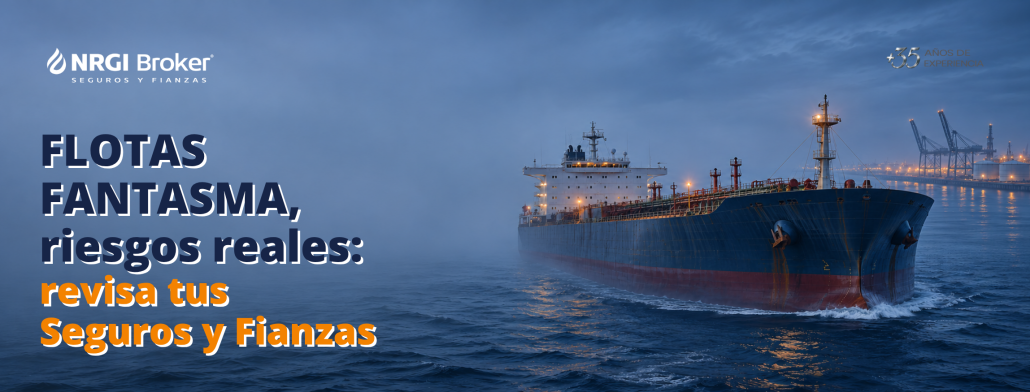
“SHADOW FLEETS”: The Phenomenon Threatening the Maritime and Insurance Sectors and Calling for Contractual Guarantees
By
Bárbara Pérez |Reinsurance Technical Manager | Specialist in Large Risks and Energy Law | NRGI Broker
Verónica Guerrero | Senior Surety Bonds and Guarantees Consultant | NRGI Broker
Fernanda Hernández | Digital Marketing ands Strategic Communication Specialist | NRGI Broker
November 9, 2026 | 8-minute read
For decades, globalization has interconnected trade, culture, and economies worldwide. Maritime and air transportation have been major drivers of this exchange, supported by international regulations that ensure fair and safe operations.
Within this framework, the International Maritime Organization (IMO) issues conventions governing lawful navigation in international waters, including:
- SOLAS: Safety of Life at Sea.
- MARPOL: Prevention of Pollution from Ships.
- STCW: Standards of Training, Certification and Watchkeeping for Seafarers.
The Technology Behind Safety: The AIS System
Chapter V (Regulation 19.2.1) of the SOLAS Convention requires vessels to have automatic means of determining and updating their position at all times.
Today, this translates into the Automatic Identification System (AIS). For the international insurance sector, keeping AIS active is an essential requirement before issuing any policy:
- In the event of a loss, it helps establish liability.
- It helps accurately determine the actual causes of the incident.
What Is the “Shadow Fleet” or “Ghost Fleet”?
Although switching off or manipulating AIS carries severe penalties and invalidates insurance coverage, some vessels intentionally disconnect this system to evade radar detection. Their objective? To transport goods originating from countries or entities sanctioned by bodies such as OFAC in the United States or included on United Kingdom sanctions lists, among others.
These vessels—often aging, poorly maintained, and registered in countries with lax regulations—are known as the “Shadow Fleet” or “Ghost Fleet”.
What Are the Main Risks?
- Lack of international certification: These vessels often lack inspections by classification societies belonging to IACS, significantly increasing the risk of collisions, contact damage, and fires.
- Lack of adequate coverage: Operating outside the legal framework, they lack robust Protection and Indemnity (P&I) insurance to cover the damage they may cause.
- Critical environmental risk: Unable to berth or anchor in regulated ports, they conduct offshore ship-to-ship transfers of hydrocarbons. An error during these unsupervised operations can trigger massive ecological disasters, with no clearly identifiable responsible party or financial guarantees to remedy the damage.
The Challenge for the Insurance Sector
The rapid growth of this phenomenon presents an unfortunate dilemma: when losses are caused by or linked to the shadow fleet, traditional insurers face significant difficulties pursuing subrogation and recovering costs. This ultimately affects hull, cargo, and environmental liability portfolios, impacting ports, terminals, and the entire global supply chain.
What is your view on this challenge? What additional measures should authorities and financial institutions take to mitigate the impact of the shadow fleet?
Ports and Terminals Facing Risks That Arrive from the Sea
The impact of shadow fleets can reach port operators even when their own activities are legitimate. A collision during berthing, a spill in an unloading area, or damage to facilities can interrupt operations and lead to claims. Exposure depends on each company’s involvement, its contracts, and its legal responsibilities.
For example, if a vessel damages a quay and puts it out of service, the operator may face repair costs and reduced revenue. Recovering those amounts from the responsible party can be difficult when ownership structures are opaque or insurance backing is uncertain. This scenario illustrates the importance of reviewing both prevention measures and the terminal’s financial protection.
Insurance to Review for Port Operations
The analysis should begin with the insured’s actual activities: facility management, loading and unloading, storage, handling hazardous substances, or providing port services. Solutions that may be considered include the following:
Ports and Terminals Insurance and Port Liability Insurance. Review the scope of coverage for damage to third parties arising from operations, including vessels, cargo, and property in care, custody, or control when expressly covered. A product’s name does not replace a review of its coverage.
Property Damage Insurance. Assess protection for declared quays, warehouses, facilities, and equipment against covered risks. Cranes and cargo-handling equipment may require specific coverage depending on their use and characteristics.
Environmental Liability Insurance. Review the scope of coverage for pollution, cleanup expenses, and insurable liabilities. Gradual pollution, the substances handled, and transfer operations require particular attention.
Business Interruption Insurance. This may cover financial losses resulting from an interruption when the policy’s triggering conditions are met, typically in connection with covered physical damage. Delays, precautionary closures, or sanctions are not automatically covered.
Cargo Insurance. Review which stages of transit, loading, unloading, and temporary storage are included. The operator’s liability coverage and the cargo insurance should be coordinated to identify gaps in protection.
Hull insurance protects interests related to the vessel, while P&I responds to certain liabilities of the shipowner or operator under its rules. Verifying the vessel’s insurance and reviewing the terminal’s policies are therefore complementary tasks: neither replaces the other. In all cases, limits, deductibles, exclusions, territorial scope, and sanctions clauses must be reviewed.
Surety Bonds Supporting Port and Terminal Commitments
Port activities also depend on the fulfillment of obligations under concessions, permits, construction contracts, supply agreements, and service contracts. Surety bonds can guarantee specific obligations to a beneficiary; their applicability depends on the governing instrument, the wording of the guarantee, and the surety company’s assessment.
Concession or Permit Bonds. Guarantee obligations established in the relevant concession title or authorization when this form of guarantee is accepted.
Bid Bonds. Support the maintenance of a bid and the obligations established in the tender documents when required.
Advance Payment Bonds. Guarantee the proper investment, use, application, and amortization of an advance payment made to a contractor or supplier, or, failing that, its full or partial repayment, in accordance with the contract and the surety bond.
Performance Bonds. Support the full or partial fulfillment of the obligations, terms, deadlines, conditions, and specifications agreed upon for expansion projects, maintenance, equipment supply, or port services.
Quality and Maintenance Bonds. Guarantee obligations relating to defects, failures, latent defects, or poor-quality materials or workmanship, in accordance with the terms established in the contract and the bond.
Environmental Compliance Bonds. Support compliance with obligations, mitigation measures, environmental conditions, remediation plans, or the closure and decommissioning of a project that may cause ecological impacts.
These bonds do not generally cover damage caused by a shadow fleet, nor do they replace liability or environmental insurance. Their purpose is to guarantee the obligation expressly bonded and established in the contract. If contractual amounts, deadlines, or scope change, the surety company must be notified so that the corresponding amendments can be made to avoid novation of the bond—that is, the extinguishment of the original bond.
Performance Bonds: Backing for Port Contracts
At ports and maritime terminals, performance bonds support the obligations of contractors, suppliers, and service providers in accordance with each contract. They may be required for quay expansion or rehabilitation works, equipment supply, and port facility maintenance services.
Their scope relates to the timing, manner of performance, and quality obligations expressly guaranteed. For example, under a crane maintenance contract, the bond may support completion of the agreed work within the specified deadlines, subject to the contract and the bond’s terms. In the event of a breach, the beneficiary may submit a claim, which the surety company will assess under the applicable terms.
Issuance involves reviewing the contract and its attachments, as well as the applicant’s technical, financial, and legal capacity. NRGI Broker provides support in arranging performance bonds suited to the sector and the type of contract.
Prevention and Document Review Before Each Operation
As part of preventive risk management, it is advisable to verify the vessel’s identity and IMO number, its owner and operator, the validity of its certificates, and the authenticity of its insurance backing. Route inconsistencies, frequent flag changes, periods of AIS disconnection, and cargo origin documentation warrant clarification and a coordinated assessment. An isolated indicator does not, by itself, establish that an operation is unlawful. [3, 4]
For the terminal, this review should be accompanied by contracts defining responsibilities, emergency response protocols, and up-to-date records of contractors’ insurance and surety bonds. Applying international sanctions requires an analysis of jurisdiction and the operation’s connections; not all foreign sanctions lists apply in the same way to a Mexican company.
Protection for Operations and Backing for Commitments
The shadow fleet phenomenon reinforces the need to assess how a maritime incident could affect a port’s or terminal’s facilities, cargo, and commitments. Insurance provides backing against covered risks, while surety bonds guarantee obligations arising from a concession title, authorization, or contract. Their coordination should reflect each company’s operations and contractual arrangements.
At NRGI Broker, we support companies in the Ports and Terminals sector in reviewing their insurance and surety bond needs. Contact our specialists to explore the solutions your operation requires.
Protect your port operations and back your commitments. Contact us on WhatsApp for guidance on insurance and performance bonds for your company.
Supporting References
- International Maritime Organization. (n.d.). AIS transponders. https://www.imo.org/es/ourwork/safety/pages/ais.aspx
- International Maritime Organization. (2015). Resolution A.1106(29). Revised guidelines for the onboard operational use of shipborne automatic identification systems (AIS). https://wwwcdn.imo.org/localresources/en/OurWork/Safety/Documents/AIS/Resolution%20A.1106%2829%29.pdf
- U.S. Department of the Treasury. (2023, October 12). Price Cap Coalition advisory for the maritime oil industry and related sectors. https://home.treasury.gov/news/press-releases/jy1797
- Office of Foreign Assets Control. (2025, April 16). Guidance for shipping and maritime stakeholders on detecting and mitigating Iranian oil sanctions evasion. https://ofac.treasury.gov/system/files/2025-04/Iran%20Shipping%20Advisory_4162025.pdf





Leave a Reply
Want to join the discussion?Feel free to contribute!