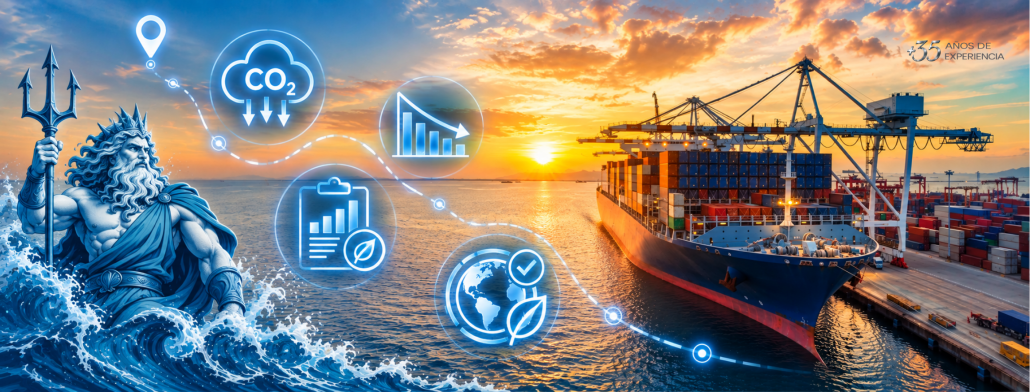
CURRENT TRENDS IN MARITIME INDUSTRY RISKS
By Barbara Perez
Technical Reinsurance Manager | Specialist in Large Risks and Energy Law | NRGI Broker
October 19, 2026 | 10-minute read
Climate change, emerging risks, and insurance sector initiatives impacting shipowners, ports, and terminals.
The Importance of Maritime Transport in Global Trade
Maritime transport is one of the pillars of international trade. According to the United Nations Conference on Trade and Development (UNCTAD), more than 80% of global trade volume is transported by sea.¹
This relevance is due to its capacity to move large volumes of cargo nationally and internationally, efficiently and at a relatively low cost, as well as to connect producers, markets, ports, and consumers within global supply chains.
In Mexico, maritime transport ranks second among the modes used for foreign trade. According to data from the Ministry of the Navy, in 2024, 38% of imports and 20% of exports were transported by sea.²
Maritime transport does not only comprise vessels, but also the range of activities carried out at ports and terminals, which in Mexico alone comprise 103 ports and 15 authorized terminals. These facilities carry out, among other operations, the reception, loading, unloading, and storage of goods; the loading, unloading, and transfer of fuels and hydrocarbons; as well as the reception and management of wastewater.
Likewise, ports and terminals may be involved in handling damaged vessels or vessels involved in casualties. Once their operational life has ended, vessels must be sent to specialized facilities, in accordance with the laws and regulations applicable to the matter.
A Sector Exposed to Global Risks
Maritime transport faces various risks inherent to its activity, including hydrometeorological, operational, and legal risks, among others. However, according to the 2025 Review of Maritime Transport published by UNCTAD,³ the industry currently faces new challenges arising from changes in trade and tariff policies; geopolitical tensions affecting strategic routes and passages, such as the Strait of Hormuz; the strengthening of international regulations aimed at decarbonization; the energy transition; and the effects of climate change on the oceans and coastal infrastructure.
In particular, geopolitical conflicts increase risk exposure for vessels, crews, cargo, and ports. These situations require navigation routes to be reconsidered and, depending on the route, may result in diversions that add between 10 and 14 days of travel.
This translates into greater fuel consumption, prolonged exposure to meteorological phenomena, and increases in operating and insurance costs.
Climate change, in turn, generates physical, operational, and economic effects throughout the maritime chain. The intensification of certain meteorological phenomena may increase the frequency and severity of casualties, affecting vessels, cargo, and port infrastructure, as well as disrupting connectivity and supply chains.
These impacts are compounded by longer transit times, increased exposure due to the accumulation of values at anchorages where vessels remain for extended periods before obtaining a berth, and vessels carrying less cargo due to reductions in the maximum permitted draft resulting from severe droughts occurring in 2026 due to the “El Niño” phenomenon affecting the operation of the Panama Canal.
A key issue is the development of international regulation aimed at ocean sustainability and the decarbonization of the maritime and port sector. In this context, the Paris Agreement⁴ aims to keep the increase in the global average temperature well below 2°C above pre-industrial levels and to pursue efforts to limit the temperature increase to 1.5°C.
To achieve this objective, the Parties must submit and periodically update their nationally determined contributions under a five-year review cycle that allows them to progressively increase their level of commitment. The Agreement also provides for financial support from developed countries to developing countries in order to contribute to reducing Greenhouse Gas (GHG) emissions, strengthen resilience, and improve their capacity to adapt to the adverse effects of climate change.
Decarbonization in the Maritime and Port Sector
The International Maritime Organization (IMO) leads international regulatory efforts to reduce GHG emissions from maritime transport. In 2018, it adopted an initial strategy in this area, which was reviewed and updated in 2023 with more ambitious targets and an orientation toward the progressive elimination of emissions from the sector.
The IMO’s 2023 Strategy maintains the objective of reducing the carbon intensity of international shipping by at least 40% by 2030, compared with 2008 levels. It also establishes indicative checkpoints to reduce total annual GHG emissions from ships by at least 20% by 2030 and by at least 70% by 2040, with the aim of reaching net-zero emissions by around 2050.⁵
Based on the premise that emissions must first be measured in order to assess and reduce them, the IMO adopted 2008 as its reference year. In its Fourth GHG Study, published in 2020, it estimated that, if no additional measures are implemented, emissions from international shipping could represent between 90% and 130% of the levels recorded in 2018 by 2050, depending on global economic and energy developments.
This projection shows that energy-saving technologies and reductions in vessel speed are sufficient on their own to achieve the established targets. The transition will also require the progressive incorporation of fuels and energy sources with low, zero, or near-zero GHG emissions.
In Mexico, since 2024 there has been a port decarbonization strategy issued by the Ministry of the Navy, which aims to “Achieve an appropriate balance between economic activity and environmental protection in national ports, promoting the use of clean fuels with low or zero carbon emissions, as well as the development of innovative infrastructure and technologies that contribute to more efficient logistics management that is less exposed to disruptions in port operations, with the resulting improvement in environmental conditions and the competitiveness of our ports, leading to better commercial conditions for our country” (General Coordination of Ports and Merchant Marine, Ministry of the Navy: 2024. Page 11).
Among its main lines of action are the preparation of port emissions inventories for the Administrations of the National Port System (ASIPONAS) and the Integral Port Administrations (APIS); process automation; the use of low-emission fuels; and the adoption of specialized systems to collect, record, and process the information necessary to measure and calculate GHG emissions.
Financing and Insurance in the Maritime Sector: The Poseidon Principles
One of the fundamental aspects of the Paris Agreement is financing intended to support developing countries in their efforts to reduce GHG emissions. This issue is particularly relevant in an industry such as the maritime sector, which requires significant investments that come primarily from credit institutions specializing in the maritime sector, since they cannot be financed entirely by shipowners, shipyards, and concessionaires.
With the aim of incorporating global environmental challenges into financial decisions, in June 2018, 45 financial executives specializing in the maritime sector met with some of the world’s leading shipowners and experts in the field to analyze how climate risk could be integrated into these decisions. As a result of this effort, the four Poseidon Principles were published in June 2019, with the objective of supporting the decarbonization of maritime transport.
The Poseidon Principles constitute a framework for assessing and disclosing the climate alignment of the ship finance portfolios of their 36 signatories, which represent three-quarters of global ship financing. Their four principles are as follows:
1.Assessment
Signatories annually measure the emissions intensity of their maritime transport portfolios and assess their alignment with climate decarbonization objectives.
2.Accountability
The information obtained is collected and recorded in accordance with IMO standards and other recognized standards regarding fuel consumption.
3.Enforcement
Signatories include a covenant clause in their new maritime transport business activities to collaborate with shipowners in collecting data and ensuring that this information is accurate and standardized.
4.Transparency
Signatories publicly acknowledge their participation in the Principles and publish the results of their climate alignment assessments.
Two other initiatives emerged from this initiative. The first is aimed at shipowners and charterers of vessels engaged in the transport of dry bulk cargo and tankers chartered on a time or voyage basis. In response to the need to transparently report emissions related to maritime transport, they launched the Sea Cargo Charter⁶ in October 2020. This Charter also provides technical guidance for aligning chartering activities with environmental responsibility and decarbonization.
Furthermore, recognizing the importance of the insurance sector in the maritime and port industry, in 2021 a group of maritime insurance institutions concerned about environmental responsibility saw an opportunity to participate directly in this issue and launched the Poseidon Principles for Marine Insurance (PPMI), with the aim of aligning their portfolios of hull and machinery insureds, initially, with the decarbonization objectives established by the IMO.
Institutions associated with this initiative include GARD, Navium Marine, and Swiss Re Corporate Solutions, among other signatories. It is also expected that more companies in the sector, including brokers and captive reinsurers, will join as affiliate members.
Recently, institutions that are signatories to the Poseidon Principles joined forces with the Poseidon Principles for Marine Insurance. In this way, participants from both sectors were integrated into a common platform to strengthen efforts to decarbonize maritime transport.
What Does It Mean for the Insurance Sector to Have an Initiative Supporting Decarbonization?
The year 2030 will be key to measuring progress in reducing GHG emissions globally. By then, attention will focus on reports from International Organizations and experts in the field, as well as on the results of the measures adopted by each country.
Decarbonization is no longer an exclusively reputational issue. The participation of the insurance sector in initiatives such as the Poseidon Principles indicates that measuring and reducing emissions could become increasingly important when purchasing marine insurance. In the short term, insurers could request information on emissions from fleets and port operations, as well as the measures adopted to reduce them, and consider these elements when determining coverage terms and premium costs.
It may be premature to speak of a radical replacement of fossil fuels in current fleets, as adapting their propulsion systems will require considerable investment. However, the construction of new vessels is likely already evaluating the use of natural gas, hydrogen, methanol, ammonia, or biofuels. Before adopting any of these options, it will be necessary to analyze the risks associated with their use, which represents a challenge for the insurance sector. This analysis will continue in future publications, where we will delve deeper into the topics transforming the maritime industry.
References
- UNCTAD (2025, April 23). Maritime transport: UNCTAD releases new statistics.
- General Coordination of Ports and Merchant Marine, Ministry of the Navy. Mexico Port Decarbonization Strategy (2024, June 28). Page 3.
- International Maritime Organization (IMO). Fourth IMO Greenhouse Gas Study 2020. 46 pages.
- United Nations. United Nations Framework Convention on Climate Change. Paris Agreement (2015, December 12). Art. 2. Page 2.
- International Maritime Organization (IMO). 2023 IMO Strategy on Reduction of GHG Emissions from Ships. Annex 15. Resolution MEPC 377 (2023, July 7). 17 pages.
- The Sea Cargo Charter Association. Sea Cargo Charter – Technical Guidance. Version 5.2. January 2026.

Leave a Reply
Want to join the discussion?Feel free to contribute!